
Hackney Wick and Fish Island are two halves of one small industrial district on either side of the canal, squeezed between the Olympic Park and the River Lea. Give them three or four hours: a free museum inside an old Olympic building, a mile of towpath, a cluster of brewery bars, and more painted walls than any other square kilometre in London.
The two names confuse people, so here is the simple version. Hackney Wick is north of the Hertford Union Canal, in the borough of Hackney. Fish Island is south of it, in Tower Hamlets, and it is not an island: it is a wedge of land between the canal and the Lee Navigation whose streets were named after freshwater fish, which is how you get Dace Road, Bream Street and Roach Road. You can walk across the whole of both in half an hour.
This is not a sightseeing district. There is one major free attraction, the rest is warehouses, workshops, bridges and water, and the pleasure of it is the walking. Our guide to Stratford and the Olympic Park covers the big venues on the other side of the water; this page is about the scruffier side, what is actually open, and how to time a visit so you are not standing in an empty industrial street on a Tuesday morning.
Getting your bearings
- Station
- Hackney Wick, on the Overground’s Mildmay line; step-free
- From Liverpool Street
- About 25 minutes, changing at Stratford
- The one paid-for nothing
- V&A East Storehouse, free, daily 10am to 6pm, and to 10pm on Thursday and Saturday
- Walk to the Storehouse
- About 8 minutes from the station
- Hackney Wick
- North of the Hertford Union Canal, borough of Hackney, postcode E9
- Fish Island
- South of it, borough of Tower Hamlets, postcode E3
- Best day
- Saturday or Sunday afternoon; several bars do not open at all early in the week
- Time needed
- Three to four hours, or a full day with the Olympic Park
Start at the Storehouse, because it anchors the visit
The single reason a visitor crosses London for this postcode is V&A East Storehouse, which sits inside Here East, the low building used as the press centre during the 2012 Games. Half a million objects sit on open racks, walkways run round three sides of a four-storey void, and none of it costs anything. It is eight minutes on foot from the station, and on Thursday and Saturday evenings it stays open to 10pm.
Our full guide to what to do at the Storehouse covers the free object-ordering service and the rule that catches people out, which is that no bag of any size may go past the entrance hall. Read it before you set off; the locker queue on a Saturday is not the place to discover the policy.
Put the Storehouse first and everything else in the area becomes an afternoon that costs whatever you choose to drink. Put it last and you risk arriving after the light has gone, with the canal bars full and your energy spent.
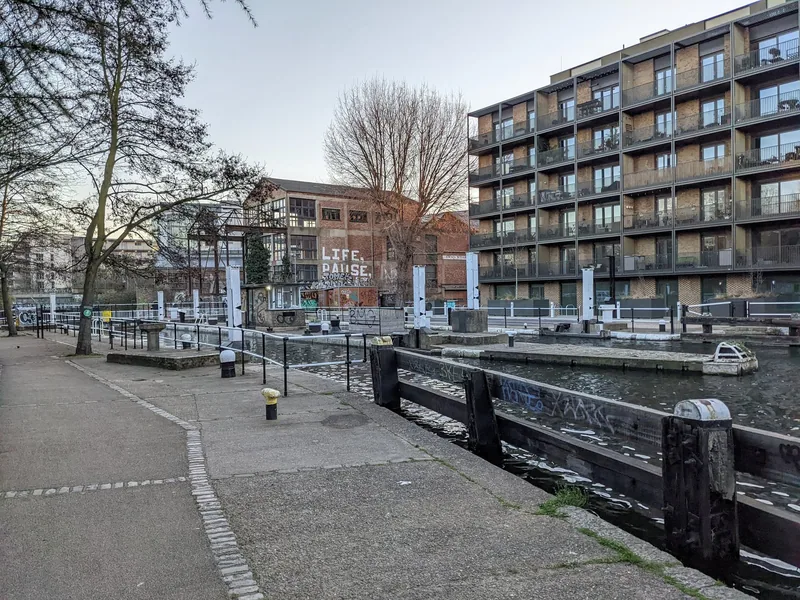
Photo: The wub · CC BY-SA 4.0 · Wikimedia Commons · resized
The brewery yards: where they are and what to expect
Queen's Yard, off White Post Lane, is the short dead-end street that holds most of the drinking. Three breweries operate within a few doors of each other there: CRATE, which brews and also runs a pizza kitchen with a large canal-side terrace, Howling Hops, whose bar pours straight from the fermenting tanks rather than from taps on a back wall, and Old Street Brewery, which moved its production east into the same yard.
A few things are worth knowing before you plan an evening around them. These are working breweries with bars attached, not pubs: opening days are shorter than a pub's, several do not open before the afternoon and some stay shut on the quieter weekdays, so check the day you are going. Food is usually a resident kitchen rather than a menu of the brewery's own, and the kitchens change. Prices sit at the normal London level for craft beer, which is to say more than a chain pub and less than a hotel bar.
Almost everything here takes cards and several places take nothing else, which is worth knowing if you were planning to pay in notes; our guide to how card payments work in Britain explains the limits and the one situation where a foreign card can still be surcharged. For the wider scene beyond this yard, our guide to brewery taprooms across London compares Bermondsey, Tottenham and the rest.
Queen's Yard is a building site as often as it is a beer garden. Hackney Wick is under long-term redevelopment, and individual venues here have closed, moved and reopened repeatedly over the past decade. Treat any list of bars, this one included, as a starting point rather than a timetable, and look up the specific place on the morning you go.
The smokehouse on Fish Island, and what PGI means
Cross the Hertford Union Canal into Fish Island and the best-known business on it is H. Forman & Son, a salmon smokehouse founded in 1905 and now sitting in a salmon-pink building facing the stadium across the water. It has a restaurant and a gallery alongside the smoking rooms.
The detail that makes it more than a curiosity is a legal one. "London Cure Smoked Salmon" is a registered protected geographical indication, first recognised in 2017 and carried onto the British register at the end of 2020, which means the name can only be used for salmon cured and smoked in a defined part of east London to a published specification. It is the same category of protection that covers Melton Mowbray pork pies. You can read the entry on the GOV.UK register of protected food names.
Book if you want to eat there, especially at weekends, and be aware that the area around it has no other concentration of restaurants. Our guide to oysters and seafood in London puts it alongside the older fish restaurants in the centre.
The claim about artists' studios, and what is actually true
You will read almost everywhere, including in our own commissioning notes for this page, that Hackney Wick has the densest concentration of artists' studios in Europe. We can find no authority behind it. The phrase traces back to press coverage in the mid-2000s, has been repeated ever since without a count attached, and no government body, arts council or borough publishes a figure that would let anyone test it.
What is true is more interesting and easier to check on the ground. Cheap warehouse space attracted studios here from the 1990s onwards; the Olympics and the redevelopment that followed pushed rents up sharply; and a large number of those studios have since been demolished, rebuilt or relocated. Plenty remain, in buildings you will walk past without noticing, and the newer blocks include purpose-built workspace. So: a lot of artists, genuinely, but not a record you can verify.
The practical consequence for a visitor is that you cannot simply turn up and see inside one. Studios are workplaces. The time to come is an open-studios weekend, which local groups run irregularly, usually in late spring or early summer; search for a current date rather than trusting a year-old listing.
The painted walls, and how to see them properly
What you can see any day is the street art, which covers shutters, bridge abutments, gable ends and the undersides of the canal bridges. It is not curated and it is not permanent. Pieces are painted over within weeks, which is the point, and the best of it is usually on the industrial streets between White Post Lane and the towpath rather than on the main road.
Walk it in daylight, look up, and look at the backs of buildings. No tour is necessary here, although if you want a guide to the history and the names, our page on street art tours explains how the Shoreditch tours work and which of them extend east.
Walking: the canals, the locks and The Line
The water is the reason to come on foot. The Hertford Union Canal, built in the 1830s and often called Duckett's Canal, runs west from Old Ford Locks to join the Regent's Canal at the corner of Victoria Park. Go that way and it is a quarter of an hour to Victoria Park, forty minutes to London Fields and Broadway Market. The rest of that route, all the way to Little Venice, is in our page on the Regent's Canal.
Turn the other way, onto the Lee Navigation, and you are in the Olympic Park within ten minutes. This is also the northern end of The Line, a free outdoor sculpture trail that runs from the Queen Elizabeth Olympic Park to The O2, following the waterways and the line of the Greenwich Meridian. Walking the whole thing is most of a day and involves crossing the Thames, either on the cable car or on the Jubilee line. The trail's own route map and artwork list is the place to plan it.
The towpaths are flat, hard-surfaced and shared with fast commuting cyclists. If you would rather ride than walk, our page on cycle hire and riding in London covers the docking stations around the park, and our page on London's long walking routes sets the Lea Valley beside the Thames Path.
Three bridges look like shortcuts and one of them is not. The canal here has several crossings within a few hundred metres, and the map on your phone will happily route you over a footbridge into a gated private yard. If you are heading for the Storehouse, follow the signed route from the station rather than the shortest blue line.
Getting here, and the hour everything changes
Hackney Wick station sits on the Overground’s Mildmay line, the orange one that runs from Stratford to Richmond. From Liverpool Street the usual route is a fast train to Stratford and one stop back west, about 25 minutes in total; from Highbury & Islington it is a single direct ride. The station is step-free. If the Overground's renamed lines are new to you, our explainer on the six Overground line names sorts out which colour goes where.
From Stratford you can also simply walk, about twenty minutes through the park, which is the pleasant option on a dry day and the reason many people arrive here as the second half of an Olympic Park visit. Our guide to the park and its venues today sets out that side.
| When | What it is like |
|---|---|
| Weekday morning | Quiet to the point of empty. The Storehouse is at its calmest; most bars are shut |
| Thursday evening | The Storehouse is open to 10pm and the yards are busy but not full. The best combination |
| Saturday afternoon | Peak. Queues at the Storehouse, every terrace taken, the towpath crowded |
| Stadium event day | Thousands of people walking through on their way to and from the London Stadium. Avoid, or plan around the kick-off |
| After dark, off the main streets | Unlit towpaths and empty industrial roads. Stick to White Post Lane and the station route |
That last row matters more here than in most of London, not because the area is dangerous but because it is genuinely deserted in places once the bars have closed. Our advice on getting home late in London applies, and the Overground finishes earlier than the Underground does.
Is it worth the journey?
Come if
- You want the Storehouse, which is unlike anything else in the city and free
- You enjoy walking beside water and looking at buildings that were not designed to be looked at
- You like breweries and want them within one short street of each other
- You are already spending a day at the Olympic Park and want a second half to it
Skip it if
- It is your first visit to London and you have three days or fewer
- You are travelling with small children: there is little for them beyond the park itself
- It is raining hard; almost all of the appeal is outdoors
- You are coming on a Monday or Tuesday, when much of it is closed
For a different kind of day on the water, with museums at the end of it, compare our verdict on Greenwich against Richmond. And if you want the same creative-warehouse character with more nightlife attached, our guide to where to go out in London covers the clubs further west in Hackney.
Frequently asked questions
What is the difference between Hackney Wick and Fish Island?
They are neighbours separated by the Hertford Union Canal. Hackney Wick lies north of it in the borough of Hackney, with the station, Queen's Yard and most of the bars. Fish Island lies south of it in Tower Hamlets, and is a quieter grid of streets named after freshwater fish. Walking between the two takes a few minutes.
How do I get to Hackney Wick from central London?
Take the Overground’s Mildmay line. From Liverpool Street, go to Stratford first and come one stop back west, about 25 minutes in total. From Highbury & Islington there is a direct train. The station is step-free, and from Stratford you can walk it in about twenty minutes through the Olympic Park.
Is there anything free to do in Hackney Wick?
Yes, and it is the main reason to come. V&A East Storehouse is free with no booking, open every day from 10am to 6pm, and to 10pm on Thursday and Saturday evenings. The canal towpaths, the street art and the northern end of The Line sculpture trail also cost nothing.
Does Hackney Wick really have the most artists' studios in Europe?
Nobody can show the evidence. The claim has been repeated in guidebooks and articles since the mid-2000s, but no arts body or council publishes a count that would confirm it. There are a lot of studios, many have been lost to redevelopment since 2012, and none of them are open to casual visitors except on open-studios weekends.
How long should I spend in Hackney Wick?
Three to four hours covers the Storehouse, a canal walk and a drink. Make it a full day only if you combine it with the Olympic Park, the V&A East Museum at Stratford or a long walk south along The Line.
Sources
- V&A - Visit V&A East Storehouse (checked September 2026)
- GOV.UK - Protected food and drink names: London Cure Smoked Salmon (checked September 2026)
- The Line - East London's public art trail (checked September 2026)
- Queen Elizabeth Olympic Park - Getting here (checked September 2026)
- Transport for London - London Overground (checked September 2026)