
Camley Street Natural Park is a two-acre nature reserve squeezed between the Regent's Canal and the railway lines into King's Cross, about ten minutes' walk from St Pancras International. It has a pond, a reedbed, woodland, a café and a visitor centre, and it opens every day: 10am to 5pm from April to September, 10am to 4pm from October to March.
It exists because local people fought for it. The site was a coal drop serving the railway, demolished in the 1960s, and nature moved back in on its own. When the land came up for development the London Wildlife Trust campaigned to turn it into a reserve instead, and it opened in 1985. Everything around it has since been rebuilt as offices, flats and shops, which makes the two acres look stranger every year.
Our pages on Victoria Park and Epping Forest cover the big open spaces of north and east London. This one is smaller than a football pitch, and the interest is in what has managed to live there rather than in the space itself.
Camley Street Natural Park: the essentials
- Address
- 12 Camley Street, London N1C 4PW
- Opening
- April to September, 10am to 5pm. October to March, 10am to 4pm. Open daily
- Entry
- The Trust publishes opening hours but no admission price. Expect to pay only for the café and for booked events
- Facilities
- Visitor centre, Kingfisher Café, toilets including an accessible one, baby-changing
- Dogs
- Assistance dogs only
- Parking
- None. Camley Street has double yellow lines on both sides; drop-offs by arrangement
- Designations
- Local Nature Reserve and a Site of Metropolitan Importance for Nature Conservation
- Nearest stations
- King's Cross St Pancras, about ten minutes on foot
What lives in two acres beside a railway
The reserve packs woodland, grassland, ponds, reedbed and marshy ground into a narrow strip, and the mix is what makes the species list longer than the size suggests. Kingfishers use the canal. Reed warbler, Cetti's warbler and reed bunting nest in the reeds. Green woodpeckers work the grass, sparrowhawks hunt over the site, and common pipistrelle bats come out at dusk.
On the water and at the edges: emperor dragonflies, common toads, yellow water-lily, yellow iris, teasel, musk mallow, oxeye daisy and dog-rose. In the wood: long-tailed tits, blackcaps, dunnocks and lesser stag beetles. None of that is rare in the English countryside. All of it is remarkable 300 metres from a mainline terminus.
Along the canal frontage the Trust has installed floating reedbeds. They give birds somewhere to nest, invertebrates somewhere to live and fish somewhere to spawn and shelter, and they also strip excess nutrients out of the water, which helps with canal pollution. They are worth looking at from the viewpoint at the southern end of the site.
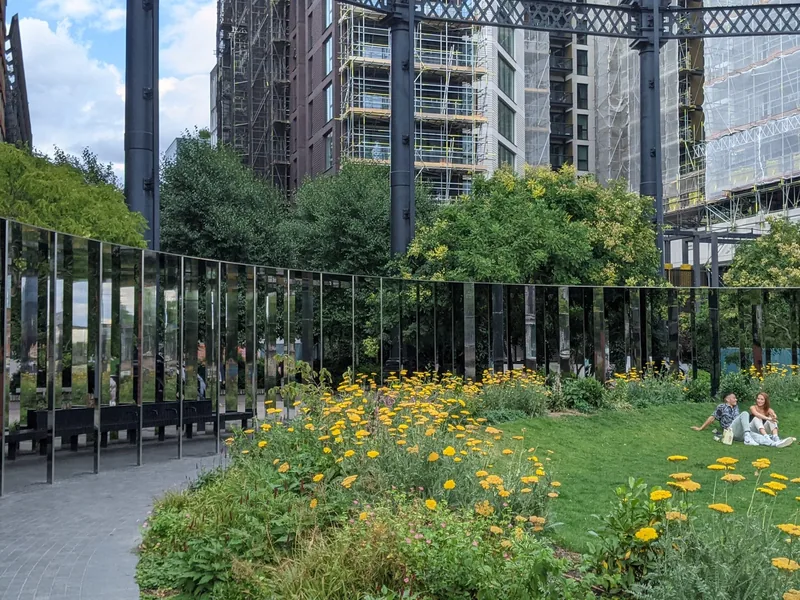
Photo: ClemRutter · CC BY-SA 4.0 · Wikimedia Commons · resized
Getting in, and getting around inside
The entrance is on Camley Street itself, between Granary Square and the gasholders. From King's Cross St Pancras, walk north through Granary Square and along the canal; from the Regent's Canal towpath, the reserve is on the west bank. It takes about ten minutes from either station concourse and there is no signage on the main road that you would notice at speed.
Inside, the ground around the visitor centre and the main path down to the pond-dipping platform have accessible surfaces. The rest of the footpaths are woodchip, which is passable but soft. At the southern end, steep steps with handrails climb to the canal viewpoint, and there is no step-free alternative to that particular spot. The visitor centre itself is fully accessible and has an accessible toilet.
Half an hour is enough, and that is the point. This is not a half-day out. Most people walk the paths, sit by the pond, have a coffee and leave inside an hour. Treat it as the green half-hour in a day at King's Cross rather than as a destination you cross London for, and it will not disappoint you.
The café, the centre and what is on
The Kingfisher Café in the visitor centre serves coffee, cake and light lunches. The centre is also used for school visits, family learning events and private hire, and the Trust runs free family events through the year alongside ticketed walks and talks. Numbers are limited on the guided events, so book rather than turning up.
Opening hours vary occasionally for events, and the Trust posts exceptions on the reserve's own page. That is worth a glance before a special trip, because an hour's difference matters when a site closes at four in winter.
What happened to the coal drops
Before 1985 this was railway land. Coal arrived by train from the north, was dropped into bunkers and then loaded onto canal barges for distribution across London. The buildings came down in the 1960s and the ground was left. Brambles, willows and birds did what they usually do with abandoned industrial land, and by the early 1980s there was enough growing here to be worth saving.
The same pattern explains most of the reserves in this article. London's best urban wildlife sites are almost all failed industry: reservoirs, filter beds, gravel pits, railway sidings and burial grounds that stopped being used for their original purpose long enough for something else to move in.
The surrounding regeneration is covered in our guide to King's Cross, which explains Coal Drops Yard, Granary Square and the fountains. If you are staying in the area, our page on hotels around King's Cross and Paddington has the practical side.
Where else nature has taken London back
| Site | What it was | Getting there |
|---|---|---|
| Woodberry Wetlands, N4 | Victorian reservoirs beside the New River, opened to the public in 2016 | Manor House, about two miles from Camley Street |
| Walthamstow Wetlands, N17 | Ten working reservoirs, now Europe's largest urban wetland nature reserve | Tottenham Hale or Blackhorse Road |
| WWT London Wetland Centre, SW13 | Four disused Barnes reservoirs, opened 2000. The only one here with an admission charge | Barnes station, or a bus from Hammersmith |
| Greenwich Peninsula Ecology Park, SE10 | Created freshwater marsh on reclaimed industrial land | North Greenwich |
| Gillespie Park, N5 | Former railway sidings beside the Arsenal stadium, now a local nature reserve | Arsenal or Finsbury Park |
| Sydenham Hill Wood, SE26 | Remnant of the Great North Wood, with a disused railway tunnel mouth | Sydenham Hill |
Of these, the WWT reserve in Barnes is the only one that charges and the only one that will fill a whole day. The rest are free and take an hour or two each. Woodberry Wetlands sits between Stoke Newington and Manor House; Walthamstow Wetlands is a short walk from Walthamstow and is worth pairing with the market there.
Check who owns the website before you follow a link about a London reserve. At least one domain that used to belong to a London wetland site has been taken over and now serves unrelated commercial content. Reach these places through the London Wildlife Trust, the relevant council or the water company that runs the reservoirs, rather than through whatever a search engine returns first.
The best months, and the worst
April to July is when the reserve does most of its work. The reedbed fills with singing warblers, the pond is loud with frogs and then dragonflies, and the meadow patches flower. Early morning, soon after the gates open at ten, gives you the birdsong before the café fills up.
Late summer is quieter and greener, and the interest shifts to insects. Autumn brings berries, fungi and the first migrants moving down the canal corridor. Winter strips the place back: bare willows, a grey pond and a four o'clock closing time, though it is also the season when you are most likely to have the paths to yourself and the easiest time of year to spot a kingfisher against bare branches.
Rain is the real limitation. There is shelter in the visitor centre and under the trees, but the paths turn soft and a wet hour here is not much of an hour. On a bad forecast, swap it for something indoors and come back another day; our list of wet-weather options has plenty within a mile.
Visiting with children
Pond dipping is the main event, and the platform at the end of the accessible path is built for it. The Trust runs family learning sessions through the year, many of them free, and school groups use the centre on weekdays in term time, which can make a weekday morning busier than you expect.
For under-fives the reserve is about the right size: enough to explore, small enough that nobody gets tired or lost. Older children will want more, and the city farms listed in our guide to London's city farms and playgrounds or the free galleries at the Wellcome Collection fifteen minutes south are the natural next stops. Our broader advice on London with children covers planning a day around several short stops rather than one long one.
A morning around King's Cross that includes it
A workable route: start at the British Library or the Wellcome Collection when they open, walk up to Granary Square, spend half an hour at Camley Street, then follow the towpath west. The Regent's Canal runs from here through Camden to Little Venice, and the stretch immediately west of Camley Street is one of the quieter parts of it.
That gives you a morning of green and water in Zone 1 with no admission fees, which puts it firmly on the list of things worth doing in London for nothing. For the enclosed gardens that work the same way in other parts of the centre, see our guide to London's walled and hidden gardens, and for a much larger and wilder version an hour further out, Crystal Palace Park and the woods around it.
Frequently asked questions
What are Camley Street Natural Park's opening hours?
It opens daily at 10am and closes at 5pm from April to September and at 4pm from October to March. The Trust publishes occasional changes for events on the reserve's own page, so check before a special trip, particularly in winter when the closing time is early.
How far is Camley Street Natural Park from King's Cross station?
About ten minutes on foot. Walk north from King's Cross St Pancras through Granary Square and along the canal; the entrance is on Camley Street. There is no visitor parking and Camley Street has double yellow lines on both sides, so arriving by car is not practical.
Can you take a dog to Camley Street Natural Park?
Only assistance dogs are allowed, because the reserve is small and the wildlife is easily disturbed. If you are walking a dog in the area, the towpath and the open space around Granary Square are the alternatives, and Regent's Park is about twenty minutes west.
Is Camley Street Natural Park accessible for wheelchair users?
Partly. The visitor centre is fully accessible with an accessible toilet, and the area around it plus the main path to the pond-dipping platform have firm surfaces. Other footpaths are woodchip, and the canal viewpoint at the southern end is reached by steep steps with handrails.
What wildlife can you see at Camley Street Natural Park?
Kingfishers on the canal, reed warbler, Cetti's warbler and reed bunting in the reedbed, green woodpeckers, sparrowhawks and long-tailed tits in the trees, common pipistrelle bats at dusk, and emperor dragonflies and common toads around the pond. Spring and early summer are the most productive months.
Sources
- London Wildlife Trust - Camley Street Natural Park (checked September 2026)
- London Wildlife Trust - Events at Camley Street Natural Park (checked September 2026)
- WWT London Wetland Centre - Plan your visit (checked September 2026)