
Choose Oxford for a first day trip from London. It is not the prettier city, and its punting is worse, but you can walk from the station to the first museum in under ten minutes and spend the whole day inside free buildings that open every day of the week. Cambridge is the better choice on a warm afternoon when you intend to get on the river, and it is faster to reach from King's Cross.
Both cities are about an hour from London and both are built around colleges that were never designed for visitors. Our full guides to a day in Oxford and a day in Cambridge cover the trains, the sights and a route through each one. This page only does one job: it compares them on the four things that actually decide which day you enjoy more, and it comes down on one side.
Oxford and Cambridge side by side
- Fastest train from London
- Oxford 52 minutes from Paddington; Cambridge 48 minutes from King's Cross
- Second option
- Oxford also from Marylebone, from 1 hour 12 minutes, with advance singles from £5.40; Cambridge also from Liverpool Street
- Station to the first thing worth seeing
- Oxford 5-10 minutes on foot; Cambridge about 20 minutes, or 1.1 miles
- Free museums open on a Monday
- Oxford: three. Cambridge: none of the two main ones
- Flagship paid visit
- Christ Church, Oxford, £20.95-£26.95 adult; King's College Chapel, Cambridge, £15.75-£18.00 adult
- Punting
- Cambridge, clearly
- Our verdict
- Oxford for a first visit; Cambridge in summer if you will punt
The first twenty minutes decide more than anything else
This is the comparison nobody makes, and it is the one that changes the shape of the day. Oxford's station sits on the western edge of the centre. The Ashmolean Museum says the walk from the station is five to ten minutes, and from Carfax Tower in the middle of town it is five. You step off the train and you are effectively there.
Cambridge's station is a long way out. The University's Museum of Zoology puts it at a 20-minute walk, or 1.1 miles, and the Fitzwilliam Museum gives the same figure. There are buses and taxis from the forecourt, and the U bus runs past the Fitzwilliam, but on a day trip that is forty minutes of walking or two bus fares each way, plus the decision-making that goes with them.
On a 9am-to-6pm day, that difference is most of an hour. It is also the difference between arriving in a city and arriving on a road. If you have children, or a limited appetite for walking, it matters more than any of the individual sights.
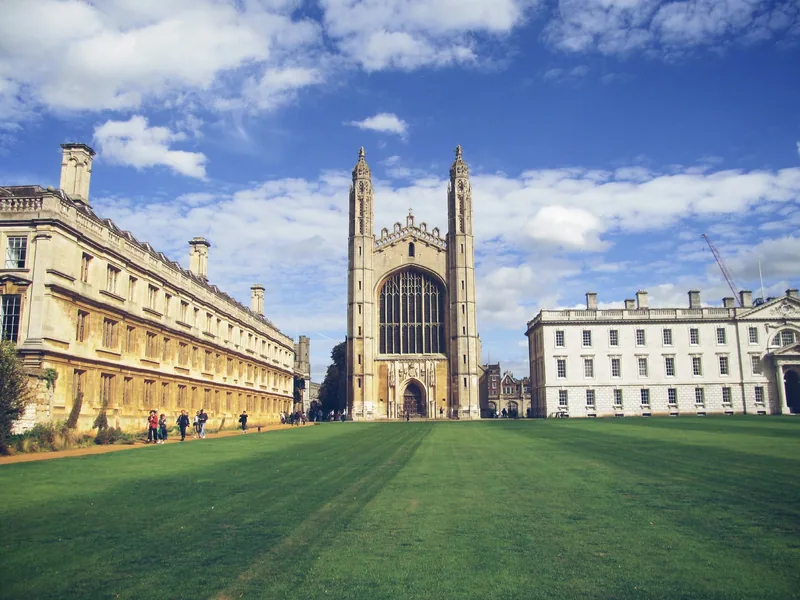
Photo: Margaret K. · CC BY-SA 4.0 · Wikimedia Commons · resized
What you can get into without paying, and on which days
Both cities have free university museums. The gap is in how many, and when they open.
| Free to enter | City | Opening (September 2026) |
|---|---|---|
| Ashmolean Museum | Oxford | 10am to 5pm, last entry 4.45pm |
| Museum of Natural History | Oxford | Daily 10am to 5pm, last admission 4.45pm |
| Pitt Rivers Museum (same building) | Oxford | Tuesday to Sunday 10am to 5pm; Mondays from noon |
| Weston Library (Bodleian) | Oxford | Mon-Fri 9am to 5pm, weekends 10am to 5pm; no ticket needed |
| Fitzwilliam Museum | Cambridge | Tuesday to Saturday 10am to 5pm, Sunday noon to 5pm; closed Mondays |
| Museum of Zoology | Cambridge | Tuesday to Saturday 10am to 4.30pm, Sunday noon to 4.30pm; closed Mondays |
Read the Monday column twice. In Cambridge, both of the free museums a visitor would actually choose are shut, and a Monday trip becomes an expensive walking day. In Oxford, everything is open, and the Pitt Rivers, which is the one most people remember afterwards, simply starts at noon instead of ten.
The Pitt Rivers deserves the extra sentence. It is a Victorian ethnographic collection arranged by type rather than by place, in wooden cases in a dim hall behind the dinosaurs, and it has never been modernised. Nothing in Cambridge is quite like it, and you walk into it through the Natural History Museum for nothing.
In Oxford, the free half of the day is strong enough to be the whole day. Ashmolean, Natural History, Pitt Rivers, the Weston Library's exhibition galleries and a walk across Christ Church Meadow together fill nine hours and cost nothing but lunch. In Cambridge the equivalent list is the Fitzwilliam, the Backs and a walk. That is the single clearest argument for Oxford.
Getting inside a college: two different problems
Visitors imagine wandering through quadrangles. In practice, both universities have made that difficult, in different ways.
In Oxford, the standard answer is Christ Church, which is a genuine visit: Tom Quad, the Great Hall, the cathedral and the gardens, with a multimedia guide that is compulsory and included. It is not cheap, and the Great Hall shuts over lunch for students to eat, which catches out a lot of people who came specifically for the room that inspired the Hogwarts hall. The prices and the exact closure times change with the term, and our Oxford page above carries both.
In Cambridge, the flagship college is largely off limits. Trinity keeps its courts closed to the public, and the only way inside is a porter-led tour at 10am or 2pm costing £10 a head, with under-12s free, and the Dining Hall currently excluded. Trinity's stretch of the Backs is open 9am to 5pm and the Wren Library is free for a couple of hours in the middle of the day during term. King's College Chapel, which is the building everyone comes for, charges £15.75 booked ahead on a weekday, rising to £18.00 for a standard weekend ticket.
So Oxford's paid option costs more but buys a full site; Cambridge's costs less but buys one chapel and, at Trinity, a guided walk past what you cannot otherwise enter. If your image of the day involves being inside old buildings, Oxford gives you more of it.
Check King's College Chapel's visiting calendar before you commit to Cambridge. It closes to sightseers for services and events, and its published closures for autumn 2026 include 1 to 4 October and every Sunday from 11 October to 29 November. The building is the reason many people pick Cambridge, and turning up to find it closed reduces the day to a walk.
The money, for a couple and for a family
The fare is the part you can control. Chiltern Railways sells advance singles from London Marylebone to Oxford from £5.40, so a couple who book ahead and travel off-peak can reach Oxford and back for around £21.60 between them, with children aged 5 to 15 at half the adult fare. Cambridge operators do not publish a comparable headline fare, so price your own date on the National Rail planner; the mechanics are in our guides to buying UK train tickets and the railcards a visitor can buy.
Where the two cities diverge is what happens after you arrive.
- Oxford, spending nothing: three free museums, a free library exhibition and Christ Church Meadow. Total cost of the day: the train and lunch.
- Cambridge, spending nothing: the Fitzwilliam, the Backs on foot and the outside of the colleges. Good, but thinner, and unavailable on a Monday.
- Cambridge, doing the famous things: King's College Chapel at £15.75 plus a Trinity tour at £10 comes to £51.50 for two adults before you have eaten or punted.
- Punting: add the largest single variable. There is no official price list and several operators compete along the river, so agree the length, the price and whether the boat is shared before you step in.
For the wider arithmetic of a cheap day out of the capital, including which destinations are covered by a London fare cap, see the cheapest day trips from London.
When Cambridge is the right answer
There are four situations where we would send you to Cambridge instead, and they are not small.
You are going to punt. The Backs, the stretch of river running behind King's, Clare, Trinity and St John's, is the best thing either city has to offer from water level, and Oxford has no equivalent. If the forecast is warm and still, and you intend to spend an hour on the river, go to Cambridge and plan the day around it.
You are staying in north or east London. King's Cross to Cambridge takes 48 minutes at its fastest and Liverpool Street is the alternative. If your hotel is near either, you save a cross-town journey at both ends; the terminal-by-terminal rundown shows which station serves what.
You want a smaller day. Cambridge's centre is more compact than Oxford's once you reach it, with less traffic, and the whole thing can be walked slowly. Oxford is a working city with buses down the middle of it.
You have already been to Oxford. Obvious, but worth saying. They are not interchangeable, and the second visit is more interesting than the first comparison suggests.
Weather, and the Sunday problem
Cambridge is an outdoor city for visitors: the river, the Backs, the college exteriors, the meadows. Oxford is an indoor one: museums, a library, a great hall, a cathedral. In November that is not a close contest, and it is the reason our advice tilts further towards Oxford between October and March. For the London equivalent of the same problem, our wet-weather guide to the capital does the same job.
Sundays are awkward in both. Christ Church opens to sightseers only in the afternoon on Sundays, and King's College Chapel closes to visitors on Sundays through much of the autumn. The free museums in both cities open later on Sundays too. If Sunday is your only free day, accept that you are having a shorter visit and build it around a single building plus a long walk.
Can you do both in one day? No
People ask, because a map makes it look plausible. It is not. There is no fast direct route between the two cities from London, you would spend most of the day on trains and buses, and you would arrive at each place with an hour to spare. A tour that promises both delivers a coach park and a photograph.
If you have two free days and want both, do them on separate days and accept the repetition; they are more different than a first visit suggests. If you have two free days and want variety instead, pair one of them with something unlike a university town: Blenheim Palace is close to Oxford, Stratford-upon-Avon is on the same Chiltern line, and St Albans is a short, cheap trip in the Cambridge direction. Our page on how many days London needs is the place to work out whether you have room for any of this.
Travelling with children changes the answer again, and not always towards the colleges; the day trips that work with children sets out which ones survive contact with a seven-year-old. The route options and journey times for the Oxford leg are compared in detail on our sister site's London to Oxford route guide.
Frequently asked questions
Is Oxford or Cambridge better for a day trip from London?
Oxford, for most first-time visitors. The station is much closer to the centre, there are three free museums rather than one, and they are open on Mondays when Cambridge's are shut. Choose Cambridge if you want to punt on the Backs, or if you are staying near King's Cross.
Which is closer to London, Oxford or Cambridge?
Cambridge is marginally quicker by train: the fastest King's Cross service takes 48 minutes, against 52 minutes from Paddington to Oxford. Oxford has a second route from Marylebone that is slower but often much cheaper, with advance singles starting at £5.40.
Can you visit Oxford and Cambridge on the same day?
Not sensibly. There is no quick direct link between them for a day tripper based in London, and you would spend most of the day travelling for about an hour in each city. Do them on separate days, or pick one and use the whole day properly.
Can you go inside the Cambridge colleges for free?
Rarely. Trinity keeps its courts closed and charges £10 for a porter-led tour, though its stretch of the Backs is open in the daytime and the Wren Library is free for a short window on weekdays in term. King's College Chapel charges from £15.75. Chapel services at King's are free and open to everyone.
Which city is better for families with young children?
Oxford, mainly because of the Museum of Natural History and the Pitt Rivers, which share a building, cost nothing and hold children's attention. Cambridge's strongest family option is punting, which works well from about age six on a calm day and badly in wind or rain.
Sources
- Ashmolean Museum - Plan your visit and directions (checked September 2026)
- Oxford University Museum of Natural History - Visit us (checked September 2026)
- Pitt Rivers Museum - Visit us (checked September 2026)
- Bodleian Libraries - Plan your visit (checked September 2026)
- Fitzwilliam Museum - Plan your visit (checked September 2026)
- University of Cambridge Museum of Zoology - Visit us (checked September 2026)
- Trinity College Cambridge - Visiting Trinity College (checked September 2026)
- Chiltern Railways - London to Oxford fares and journey times (checked September 2026)