
Blenheim Palace stands eight miles north-west of Oxford, at Woodstock, and is a long but straightforward day from London: about an hour on the train from Paddington, then a short bus or taxi. It is a UNESCO World Heritage Site, the only non-royal, non-episcopal house in England called a palace, and the house where Winston Churchill was born in 1874.
It is also enormous. The park covers 961 hectares, the house was built between 1705 and 1722, and nobody sees all of it in a day. Allow six hours on site if you want the state rooms, the Churchill exhibition and a serious walk in the park, and work backwards from there when choosing a train.
Our guides to Buckingham Palace, Hampton Court and Eltham Palace cover the great houses inside London. Blenheim is the one that needs a train ticket, and this page is mostly about whether the day works.
We could not verify Blenheim's current ticket prices. The palace's website blocked our research requests when we checked in September 2026, returning a browser challenge rather than a page. Everything below about prices, opening days and what is included is therefore described in general terms. Check blenheimpalace.com for the current figures before you book a train, and look in particular for whether your ticket converts into an annual pass, as estates of this kind often offer.
Blenheim Palace: the fixed facts
- Where
- Woodstock, Oxfordshire, about eight miles from Oxford
- Built
- 1705 to 1722, to designs by John Vanbrugh with Nicholas Hawksmoor
- Why it exists
- Given by the nation to John Churchill, 1st Duke of Marlborough, for his victory over French and Bavarian forces in 1704
- The park
- Landscaped by Lancelot "Capability" Brown from 1761, who created the two lakes
- World Heritage status
- Inscribed in 1987 under cultural criteria (ii) and (iv); the listed property covers 961 hectares
- Nearest station
- Long Hanborough, about an hour from Paddington, then roughly two miles
- Alternative
- Oxford, 49 to 55 minutes from Paddington, then a bus to Woodstock
- Time needed
- Six hours on site for house, exhibition and park
Getting there: two stations, neither of them at the gate
The direct option is Long Hanborough, on the Great Western line from Paddington towards Worcester. Trains take about an hour with no changes. A Super Off-Peak Return was £44.10 when we checked a weekday in October 2026, but Advance singles started at £12.00, which is the difference between an expensive day and a cheap one. The station is roughly two miles from the palace, so you need a taxi, a pre-booked car or a willingness to walk on country roads.
The more flexible option is Oxford. Great Western trains from Paddington take 49 to 55 minutes direct, with an Off-Peak Day Return at £37.70 and Advance fares from £18.00. Chiltern Railways runs from Marylebone in about an hour and twenty minutes, usually direct, with an Off-Peak Day Return at £43.70 for the Chiltern route or £37.70 on a route-any-permitted ticket, and Advance fares from £15.00. From Oxford city centre, buses run north to Woodstock, where the palace has a gate directly off the town square.
| Route from London | Time | Off-peak return | Cheapest Advance single found |
|---|---|---|---|
| Paddington to Oxford, direct | 49 to 55 minutes | £37.70 | £18.00 |
| Marylebone to Oxford, direct | About 1 hour 20 minutes | £43.70 by Chiltern, £37.70 any permitted route | £15.00 |
| Paddington to Long Hanborough, direct | About 1 hour | £44.10 Super Off-Peak | £12.00 |
Fares checked for a weekday in October 2026. Advance tickets are tied to a specific train and are not refundable, which our guide to buying British rail tickets explains, and a railcard takes a third off most off-peak fares if you qualify under the rules set out in our railcard page.
Both bus operators serving Woodstock refused our requests, so check the timetable yourself. Stagecoach and Oxford Bus Company both returned errors to our research connection in September 2026, and we are not prepared to publish a frequency we have not seen. Look up Oxford to Woodstock on the operator's site or on a journey planner the day before you travel, and note that Sunday services in rural Oxfordshire are thinner than weekday ones.
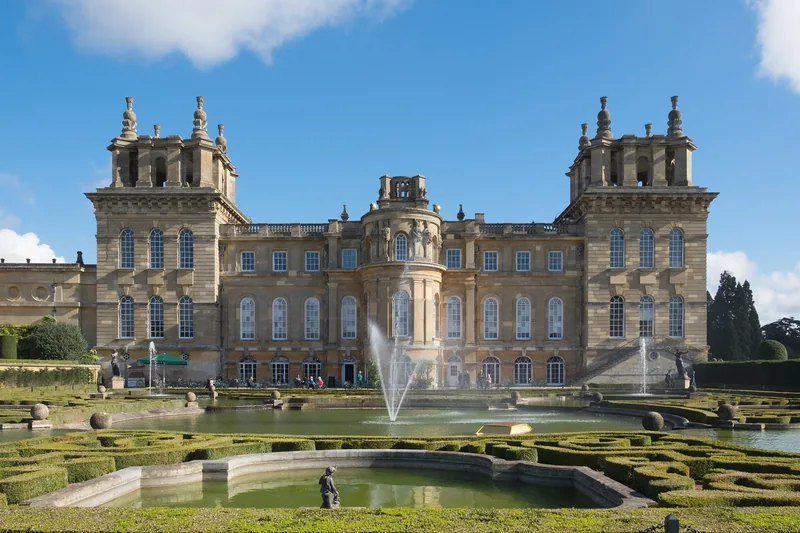
Photo: DeFacto · CC BY-SA 4.0 · Wikimedia Commons · resized
The Woodstock gate, and why it matters
Blenheim has an entrance directly off Woodstock town square, which means that if you arrive by bus you walk in through the Triumphal Arch and get the approach the architects intended: the park opens up, the lake appears below, and the house sits across the water. Arriving by car puts you in a car park and sends you round the side.
Woodstock itself is a small stone-built town with pubs, tearooms and the Oxfordshire Museum, and it is a sensible place to eat rather than queueing inside the estate. If the bus back to Oxford is infrequent, an hour in Woodstock is a better way to fill the gap than an hour at the exit.
What is actually inside
The state rooms run along the south front: a sequence of tapestried and painted spaces built to impress ambassadors rather than to be lived in, with Louis Laguerre's painted hall and the Duke of Marlborough's victories woven into Brussels hangings. This is architecture as propaganda, and reading it that way makes it far more interesting than treating it as a house.
The Churchill connection runs through the estate. Winston Churchill was born here in 1874, proposed to Clementine in the Temple of Diana beside the lake, and is buried at Bladon church a short walk outside the park wall. There is a permanent exhibition about him in the house. If you are following that thread across a London trip, the Churchill War Rooms in Whitehall are the other half of it.
Blenheim runs a changing programme of exhibitions, contemporary art installations and events, along with a formal Italian Garden, a Secret Garden, a rose garden, a walled garden, a maze and family attractions. Which of these are included in a given ticket varies, and some are seasonal. That is another reason to read the ticket page before you travel rather than after you arrive.
The park is the reason to come
Vanbrugh regulated the course of the little River Glyme and threw an enormous bridge across the valley. Capability Brown then dammed the river from 1761 to create the two lakes, drowning the lower part of the bridge in the process, and the result has been called a naturalistic Versailles. It is among the most influential landscapes in Europe and it is free of charge to look at if you are already inside the estate.
Walking routes of two to five miles circle the lakes and the Great Park. The Grand Cascade, the Column of Victory and the Temple of Diana are all reachable on foot, and the further you go from the house the fewer people you meet. If the weather is good, budget at least two hours for this and treat the house as the shorter half of the day.
Two things to know. The distances are real: from the Woodstock gate to the far end of the lake and back is a decent walk. And the ground is undulating and largely unsurfaced away from the main drives, so wear proper shoes rather than the ones you packed for the West End.
How Blenheim compares with the London palaces
Blenheim gives you
- A landscape park of a scale that does not exist in London
- Baroque state rooms rather than royal domestic interiors
- Room to walk for hours without a crowd
- A single coherent story: one battle, one family, one building
The London palaces give you
- No train fare and no bus connection to worry about
- Half a day rather than a whole one
- Royal collections and Tudor or Georgian interiors
- Somewhere to go on a wet afternoon at short notice
If you have three days in London and have not yet seen the Tower or Westminster Abbey, Blenheim is the wrong choice. If you have a week, or you have been before, it is one of the strongest single-site day trips in southern England. Kensington Palace is the London building that comes closest in period, and it takes ninety minutes rather than six hours.
Combining Blenheim with Oxford
Doing both in one day is possible and slightly unsatisfying. Oxford deserves at least four hours, Blenheim at least six, and the bus between them eats an hour in each direction. If you must, do Blenheim in the morning, take the bus back in the middle of the afternoon and give Oxford the evening, when the colleges are shut anyway and the pubs are the point.
The better plan is two separate days, and our Oxford day trip guide sets out what a full day there looks like. A route-by-route comparison of the ways to reach the city is also on our sister site's London to Oxford page. If you are heading that way anyway, the Cotswolds start a few miles beyond Woodstock, and the Blenheim gate is one of the natural entry points to them.
Other great houses within a day of London
Blenheim is the biggest, but it is not the only one. Highclere Castle opens for limited seasons and is best known from television. Warwick Castle is run as a commercial attraction with shows and events and suits families better than architecture enthusiasts. Sissinghurst is the garden equivalent, an hour east instead of an hour west, and RHS Wisley is the easiest of all of them to reach without a car.
Whichever you choose, the same three questions decide whether the day works: how long the journey really takes, what the last useful train back is, and whether the place is open on the day you want to go. The full list is on our days out from London page, and our guide to the London terminals explains which station each one leaves from.
Frequently asked questions
How do you get to Blenheim Palace from London by train?
Two ways. Paddington to Long Hanborough takes about an hour direct and leaves you roughly two miles from the palace, so you will need a taxi. Or take a train to Oxford, from Paddington in 49 to 55 minutes or from Marylebone in about an hour and twenty, then a bus north to Woodstock, where the palace has a gate on the town square.
How much does it cost to get to Blenheim Palace from London?
Off-peak returns to Oxford were £37.70 from Paddington and £43.70 by Chiltern from Marylebone in September 2026, with Advance singles from £15.00 to £18.00. Paddington to Long Hanborough was £44.10 Super Off-Peak with Advance singles from £12.00. Admission to the palace is extra and should be checked on its own website.
How long do you need at Blenheim Palace?
Six hours is realistic if you want the state rooms, the Churchill exhibition and a walk around the lakes. Four hours covers the house and the formal gardens without the wider park. Working backwards from the last sensible train home, that generally means leaving London before ten in the morning.
Was Winston Churchill born at Blenheim Palace?
Yes, in 1874. He was a grandson of the 7th Duke of Marlborough, and the palace holds a permanent exhibition about him. He proposed to Clementine Hozier in the Temple of Diana in the grounds, and he is buried at Bladon, a short distance outside the estate wall.
Is Blenheim Palace worth it compared with the palaces in London?
It depends on your time. For a first visit to Britain with three days in London, the Tower and Westminster Abbey come first. For a longer stay, Blenheim offers baroque state rooms and a Capability Brown park on a scale nothing in the capital can match, and the park alone justifies the journey in good weather.
Sources
- UNESCO World Heritage Centre - Blenheim Palace (checked September 2026)
- National Rail Enquiries - London Paddington to Oxford, times and fares (checked September 2026)
- National Rail Enquiries - London Marylebone to Oxford, times and fares (checked September 2026)
- National Rail Enquiries - London Paddington to Long Hanborough, times and fares (checked September 2026)