
London has more good bakeries than it had ten years ago, and some of them have queues. The short answer is that a queue is worth joining when the bakery makes one thing better than anyone else and sells out of it by mid-morning, and not worth joining for a croissant you can buy unqueued three streets away.
Britain does not have a strong bakery tradition of its own in the French or Scandinavian sense. What London has instead is a mix: French laminated pastry, Scandinavian cardamom and cinnamon buns, Jewish rye and babka, Portuguese custard tarts, Italian maritozzi and a home-grown enthusiasm for sourdough that began around 2005 and has not stopped.
That mix is why a bakery crawl here is more varied than in Paris or Copenhagen, and also why the quality is uneven. This page is about how to tell the difference, what things cost and when to turn up. If you are after a cup of coffee to go with it, our guide to finding a good coffee in London covers the roasters.
What a London pastry costs
- Plain croissant
- From about £2.90 (GAIL's own price list, September 2026)
- Pain au chocolat
- From about £3.30
- Almond croissant
- From about £4.20
- Cinnamon or cardamom bun
- About £4.00
- Filled or specialist pastry
- £4.40 and up; single-item bakeries often charge £5–£7
- Best time to arrive
- Opening, or within the first 90 minutes at weekends
- Worst time
- Saturday and Sunday 10:00–12:00 at any bakery with a social-media following
The five things London bakes that are worth a detour
Work out what you actually want before you pick a bakery. These are the items London does distinctively well, and each has a different set of specialists.
- The cruffin. Croissant dough baked in a muffin tin, then filled with cream or curd. It is a texture trick, crisp on the outside and soft inside, and it is best eaten within an hour of baking.
- The cardamom bun. Swedish in origin, twisted rather than rolled, heavily spiced and brushed with syrup. Sweeter and more aromatic than a cinnamon bun.
- The babka bun. A London invention: the chocolate-and-brioche loaf of Jewish bakeries turned into a single portion.
- The custard doughnut. Deep-fried, sugared and filled to order with vanilla custard. This is the one that most often sells out first.
- Sourdough bread. Not a pastry, but the reason many of these bakeries exist. Look for a dark, almost burnt crust and an open, irregular crumb.
Almost no bakery is good at all five. A place that lists thirty items and never sells out is a café that also bakes. A place that lists eight and posts "sold out" by noon is a bakery.
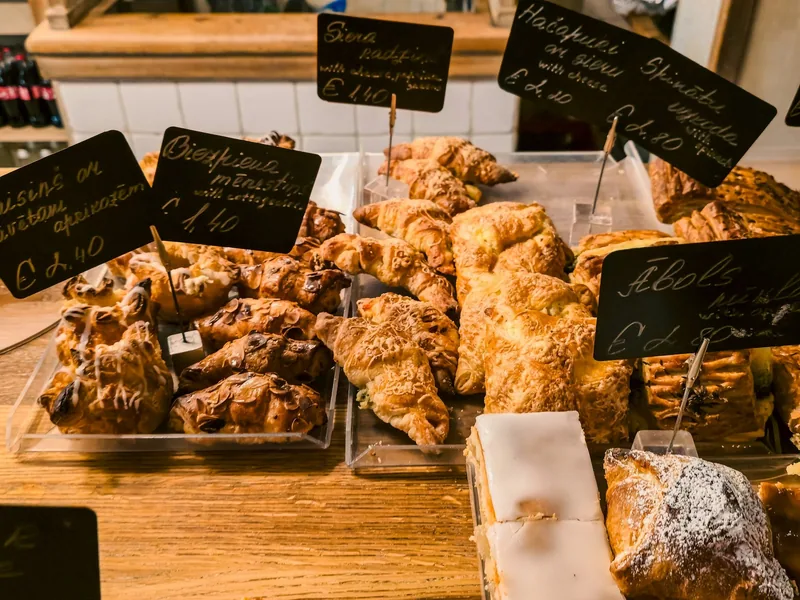
Reading the queue: when to arrive and what sells out first
Bakery queues in London are shorter and faster than they look. Most move at roughly one customer every 20 to 30 seconds once they reach the counter, and a line of thirty people is usually about fifteen minutes.
What is worth planning around is the stock, not the wait. Laminated pastries are baked in batches through the morning; filled doughnuts and anything with cream are usually made once. If a bakery has a signature item, it typically sells out between 11:00 and 13:00 at weekends, and later on weekdays.
Three practical rules. Arrive in the first hour of opening if you want a specific item. Go on a weekday if you can: the same bakery that has forty people outside at 11:00 on Sunday often has four at 09:00 on Tuesday. And check whether the bakery takes pre-orders for collection, because several of the busiest ones do, and it turns a 25-minute queue into a 30-second one.
The last hour of the day is where the bargains are. Many independent bakeries sell off the day's remaining bread and pastries cheaply in the final 30 to 60 minutes before closing, or list them through a surplus-food app. You will not get first choice, but you will pay a fraction of the morning price. Our guide to saving money in London has more of this kind of thing.
What "artisan" adds to the price, and whether it is worth it
GAIL's, a chain with branches across London, is a useful benchmark because it publishes its prices. On its own online shop in September 2026 a plain croissant is £2.90, a pain au chocolat £3.30, an almond croissant £4.20, a cinnamon bun £4.00 and a pistachio and chocolate croissant £4.40.
Small independents usually sit at or slightly above those prices, and single-item specialists charge more: £5 to £7 for one filled pastry is normal in central London. A supermarket croissant costs well under £1.
What the money buys, when it is well spent, is butter content, a long fermentation and baking that morning. What it sometimes buys is a queue and a photograph. The test is simple: eat it plain, without coffee, standing outside. A good croissant shatters and leaves flakes on your coat. If it bends, it was made yesterday or somewhere else.
Bakeries that belong to restaurants
Some of the most reliable baking in London happens at the back door of a restaurant. St John, the Smithfield restaurant that did more than anyone to revive British cooking, runs a bakery from Arch 72 Druid Street in Bermondsey and a shop at 180 Borough High Street, and its doughnuts and Eccles cakes turn up all over the city.
The Druid Street arch matters for another reason: it sits on the same run of railway arches as the brewery taprooms in our guide to craft beer and brewery taprooms, so a Saturday morning pastry and an afternoon beer are the same five-minute walk. The area around it is covered in our page on Borough and Bermondsey.
The pattern repeats elsewhere. Bakeries attached to a restaurant tend to bake smaller quantities, open shorter hours and close on the days the restaurant is shut, so check before travelling across town.
The Scandinavian strand: cinnamon, cardamom and where to find it
Swedish and Danish bakeries have done well in London, partly because a cardamom bun survives a morning on a counter better than a croissant does. Fabrique, a Swedish sourdough bakery, has London branches; Bageriet, a small Swedish bakery at 24 Rose Street in Covent Garden, sells buns, princess cake and semlor in season.
Rose Street is a good illustration of how hidden this kind of shop can be in central London: it is an alley barely two metres wide, a minute from the Piazza, and most people walking through Covent Garden never turn into it.
Scandinavian bakeries usually close earlier than French ones, and several take a summer holiday of two or three weeks in August. Check the website rather than assuming.
Where the bakeries cluster
You can walk between several good bakeries in these areas, which is more efficient than crossing London for one.
| Area | What it is good for | Getting there |
|---|---|---|
| London Fields and Broadway Market | Sourdough, viennoiserie, Saturday market stalls | London Fields (Weaver line), Bethnal Green |
| Columbia Road and Hackney Road | Sunday morning baking alongside the flower stalls | Hoxton (Windrush line), Bethnal Green |
| Islington and Newington Green | Small independents with short menus | Angel, Highbury & Islington |
| Bermondsey and Borough | Restaurant bakeries and market counters | London Bridge, Bermondsey |
| Marylebone and Fitzrovia | Chains and hotel bakeries, less queueing | Baker Street, Goodge Street |
On a Sunday the obvious combination is the Columbia Road flower market and the bakeries on the surrounding streets, both of which are finished by early afternoon. On a Saturday, Hackney and London Fields gives you the most bakeries per kilometre of anywhere in London. If you want everything in one building instead, the counters at Borough Market include several bakers.
Allergies, and what the label must tell you
Since 1 October 2021, UK law has required food that is packaged on the premises before it is ordered, which the Food Standards Agency calls prepacked for direct sale, to carry the name of the food and a full ingredients list with allergens emphasised in the list. The rule is often called Natasha's Law.
Pastries handed to you loose from a counter are not covered by that labelling rule, but the business must still be able to tell you the allergen information on request. In practice this means you should ask, and staff in a bakery are used to the question.
Wheat is unavoidable in most of what a bakery sells. Some bakeries do produce gluten-free lines, but very few can avoid cross-contamination in a room full of flour, and honest ones say so. Our guide to gluten-free eating in London covers the dedicated bakeries and what to ask.
Turning a bakery into a meal
A pastry and a coffee is not breakfast for most people, and it costs about the same as a bowl of porridge in a café. If you want a proper breakfast, see our guide to the full English; for eggs and a long sit-down later in the morning, brunch in London explains how that works here.
Bakeries do suit families. There is no booking, no minimum spend and no waiting for a table, and children can pick their own. Our guide to London with children has more low-effort options. At the other end, if you want the full pastry-and-cake ceremony sitting down, that is afternoon tea, which is a different institution altogether and needs booking.
Frequently asked questions
Which London bakery queue is actually worth it?
One where the bakery makes a small number of items, bakes them that morning and sells out. If the same item is available at four o'clock in the afternoon, there was no need to queue at nine. Queues of more than about forty people rarely repay the wait for a standard croissant.
How much does a croissant cost in London?
From about £2.90 for a plain croissant at GAIL's in September 2026, rising to £4.20 for an almond one and £4.40 for filled varieties. Small independents are broadly similar; single-item specialists charge £5 to £7. Prices change often, so check the bakery's own board.
What time do London bakeries open?
Most open between 07:00 and 08:00 on weekdays and an hour later at weekends, and many close by 16:00 or when they sell out. Bakeries attached to restaurants often keep shorter hours and close on the restaurant's rest days.
Can I pre-order pastries to avoid the queue?
Often, yes. Several of the busiest London bakeries take collection orders through their websites, usually with 24 hours' notice for bread and longer for cakes. It is the single most effective way to skip a weekend queue.
Do London bakeries label allergens?
Items packaged on the premises before you order them must carry a full ingredients list with allergens emphasised, under the rule that came into force on 1 October 2021. Loose items sold from a counter do not need a label, but staff must be able to give you the allergen information if you ask.
Sources
- GAIL's Bakery - pastry price list (checked September 2026)
- Food Standards Agency - allergen labelling for prepacked for direct sale food (checked September 2026)
- Food Standards Agency - PPDS allergen labelling changes for bakers (checked September 2026)
- St. JOHN - restaurants, bakery and shop locations (checked September 2026)
- Bageriet, Rose Street - Swedish bakery (checked September 2026)
- Fabrique Bakery - London locations (checked September 2026)