
The Princess Louise, at 208 High Holborn, two minutes' walk from Holborn station, is the best place in central London to stand inside a late-Victorian pub as it was meant to be used: a ring of small screened compartments round one bar, lined with some of the finest tiles and decorated glass in any London pub. The screens themselves are not Victorian. They were taken out in the twentieth century and put back by the owners in 2007, using a surviving door panel as the pattern.
That makes the pub two things at once. The walls, the glass, the ceiling, the columns and the bar fittings are genuinely of the 1870s to 1890s, and are listed at Grade II*. The partitions that divide the floor are a careful modern reconstruction of a plan that had vanished. Knowing which is which is the pleasure of a visit.
Our field guide to how to read a Victorian pub interior explains island bars, etched glass and why pubs were divided at all. This page is about this one building: how it was made, how it was unmade, what was put back, and how to see it at a quiet hour.
The Princess Louise at a glance
- Address
- 208 High Holborn, London WC1V 7BW, on the south side of the street
- Listing
- Grade II*, Historic England list entry 1378884, first listed 15 January 1973
- Hours
- 12:00 to 23:00 Monday to Saturday; 12:00 to 22:00 Sunday (CAMRA listing, read November 2026)
- Food
- Upstairs; lunch on weekdays and early evening Monday to Thursday, none at weekends (CAMRA listing, read November 2026)
- Owner
- Samuel Smith, the Yorkshire brewery, which sells only its own drinks
- Nearest station
- Holborn (Central and Piccadilly lines), about 100 metres east
Who Princess Louise was
The pub is named after Princess Louise, the fourth daughter of Queen Victoria, who lived from 1848 to 1939. She was a trained sculptor, which is not common knowledge: the marble statue of her mother in front of Kensington Palace is her work, and it is described on our page about Kensington Palace. Naming a new or rebuilt pub after a popular member of the royal family was an ordinary Victorian habit, and our page on why London pubs are called what they are explains the others.
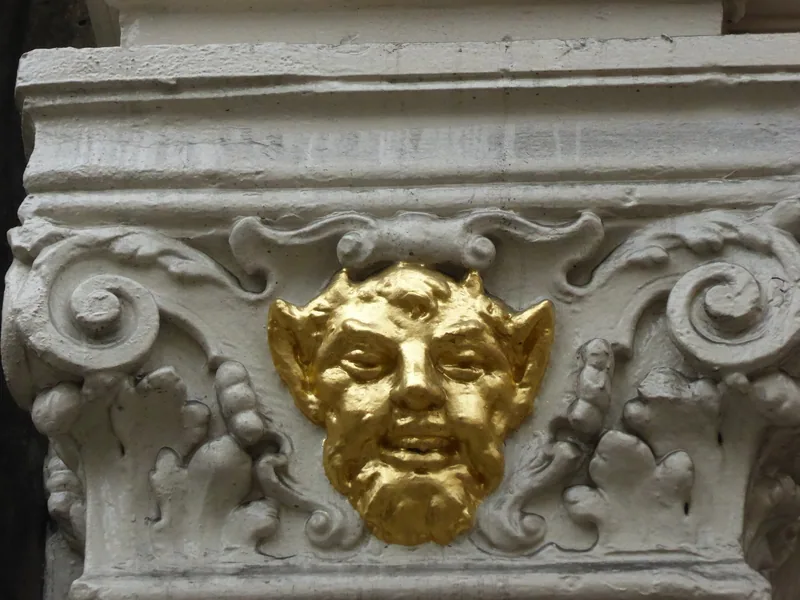
Photo: Ardfern · CC BY-SA 4.0 · Wikimedia Commons · resized
Built in stages, between 1872 and the late 1890s
The list entry calls the building mid-nineteenth century, with an interior of 1891. The account of the pub's history published by CAMRA's London Pubs Group fills in the stages. In 1872 the owners, W. and H. H. Whale, extended their pub at number 209 into number 208 next door, and the ornate iron columns and the swirling ceiling probably date from that work.
In the 1890s Henry Whale, the son, ordered the lavish upgrade you see on the walls. Around 1892 the glass was supplied by R. Morris and Son of Kennington, who signed it, and the tiles by W. B. Simpson and Sons of St Martin's Lane. A plan of 1897 by the architects Bird and Walters, of which a copy hangs on the stairs, shows small screened booths around a central serving counter. That plan is the document the twentieth-century restorers relied on.
What is original, and what came back in 2007
Sometime in the early or middle twentieth century the partitions were taken out. CAMRA's national pub guide says they had certainly gone by the late 1960s, leaving one open room around the bar, and the pub stayed that way for decades.
The present owners, Samuel Smith, reinstated them under the architect Michael Drain. The London Pubs Group dates the work to 2007; CAMRA's national pub guide dates the screen work to 2008, and the restoration won the best refurbishment class of that year's pub design awards. The work may well have run across both years. The new glass in the screens copies the one original door panel that survived, which you can find on the right-hand side as you face the bar.
| Feature | Date | Source of the date |
|---|---|---|
| Iron Corinthian columns and patterned ceiling | Probably 1872 | CAMRA London Pubs Group |
| Decorative glass by R. Morris and Son, polychrome tiles | Around 1891 to 1892 | List entry; CAMRA |
| Mahogany bar fittings by W. H. Lascelles and Co. | 1890s, described as original | List entry |
| Central serving counter with clock and dumb waiter | 1890s | CAMRA London Pubs Group |
| Basement gents with marble urinals | 1890s | List entry |
| Timber and etched-glass screens | 2007 to 2008, reconstructed | CAMRA |
| Mosaic floors in the side corridors | 2007 | CAMRA London Pubs Group |
The result, in CAMRA's description, is seven separate drinking areas: corridors down the left and right sides, two small snugs on each side, and small bars at the front, the rear left and the rear right, all opening onto one large U-shaped counter.
A slow walk round the ground floor
Go in by either of the two wide front doors, which flank a curved bay window. From outside, notice the shopfront of red granite columns with carved masks on their capitals, which the list entry records.
Then take the side corridors slowly. The walls are where the Victorian work is best preserved: a tiled dado, many of the tiles laid on the diagonal, and above it wide coloured tile panels alternating with gilded and etched mirrors. CAMRA rates the display among the finest anywhere. Look for the glass-maker's signature in the mirrors.
In the centre stands the serving counter. CAMRA describes it as a peninsula-style stillion, the trade word for the central structure that held the casks and bottles, with arches, shelves, a small dumb waiter for sending orders upstairs and a four-sided clock. Overhead, four iron columns with Corinthian capitals hold up the patterned ceiling, edged by a band of tiles decorated with urns and garlands. At the back on the left, and down the stairs, are stained-glass panels representing music, drama and painting.
Choose a compartment, not the corridor. The side corridors are passages for staff and customers moving between rooms, and they are where the best tiles are. Look at them on the way in, then sit in one of the snugs; it is the only way to understand how the screens divide the room, and you will not be standing in everyone's way.
The gents, and the stairs
The basement men's lavatory is listed in its own right as part of the building: the list entry calls it an interesting contemporary gents with marble urinals and tiled walls and fittings. CAMRA's London Pubs Group says the urinals are signed by their makers, J. Tylor and Sons of London and Sydney, and ranks them second in Britain only to those of the Philharmonic in Liverpool. Women visitors who want to see them should ask the staff at a quiet moment.
The staircase up to the first floor has an elaborate wrought-iron balustrade, and the first-floor bar has good fittings and an Art Nouveau dado, according to the list entry. This is also where food is served when the kitchen is open.
There is no step-free route to either floor or to the toilets, which are in the basement. If you use a wheelchair, the ground-floor compartments are where you can see the interior, and you should ask the staff about the door widths before you go.
Getting there, and the station's stairs
Come out of Holborn station onto High Holborn and walk west, towards St Giles and Centre Point; the pub is on the south side of the street, about two minutes away. Holborn station has no lifts, according to TfL's station data, so it is not step-free. If you need a step-free route, our guide to step-free transport in London sets out the options, and a bus along High Holborn stops close to the door.
Covent Garden is about ten minutes' walk south-west, and the British Museum about the same distance north. For the streets around the pub, see our guide to Holborn; for staying nearby, our page on hotels in Holborn covers the choice.
When the rooms are quietest
Holborn is an office district, and on weekdays the pub fills after work: from about 17:30 until 19:30 most compartments will be full and the corridors crowded. This is our observation, not a published figure.
The best time to see the interior is mid-afternoon on a weekday, roughly 14:30 to 16:30, after the lunchtime trade and before the offices empty, or a weekend afternoon.
Samuel Smith's pubs work differently
Samuel Smith is an independent brewery from Tadcaster in Yorkshire that sells its own beers, lagers, ciders, spirits and soft drinks in its pubs rather than other companies' brands. You will not find the familiar international brands on the taps, and CAMRA's guide notes that its beer is especially good value for London. Our page on what a pint costs in London gives the wider picture.
The brewery also runs its pubs with house rules of its own, posted inside. Read the notices by the bar. Ordinary bar manners still apply, and they are covered in our guide to pub etiquette.
Combining it with other interiors
The Princess Louise is the compartmented Victorian pub. Its opposite in mood is the Black Friar at Blackfriars, an Edwardian Arts and Crafts room full of bronze friars, twenty minutes away by Central line to St Paul's and a short walk. For a pub that is older than both, Ye Olde Cheshire Cheese on Fleet Street is about twenty minutes' walk east along High Holborn and down Fetter Lane. Our guide to London's historic pubs lists the rest.
Frequently asked questions
Are the screens in the Princess Louise original?
No. The original screens were stripped out in the first half or middle of the last century and had gone by the late 1960s. The present ones were made for the owners, Samuel Smith, in 2007 to 2008, following an 1897 plan, with glass copied from the one surviving original door panel. The tiles, mirrors, columns, ceiling and bar fittings are original.
Why is the Princess Louise a listed building?
Historic England listed it at Grade II* in 1973, giving the richness of its Victorian interior as the reason for the higher grade. The list entry singles out the polychrome tiles, the gold embossed glass by R. Morris and Son, the original mahogany bar fittings, the iron columns, the staircase and the basement gents.
Is the Princess Louise open on Sundays?
Yes. CAMRA's listing in November 2026 gave Sunday hours of 12:00 to 22:00, against 12:00 to 23:00 on other days. Food is not served at weekends according to the same listing, so eat elsewhere if you come on a Saturday or Sunday.
Which station is nearest to the Princess Louise?
Holborn, on the Central and Piccadilly lines, about two minutes' walk east of the pub along High Holborn. The station has no lifts and is not step-free. Chancery Lane on the Central line is about eight minutes' walk east.
Sources
- Historic England - Princess Louise Public House, 208 and 209 High Holborn, list entry 1378884, Grade II* (checked November 2026)
- CAMRA London Pubs Group - Princess Louise, 208 High Holborn (checked November 2026)
- CAMRA - Princess Louise, London: pub guide entry, opening and food times (checked November 2026)
- Transport for London - Holborn Underground Station (checked November 2026)