
Holborn is the working district between the West End and the City, where the English legal profession lives. Two of London's best free museums face each other across one square here, there is a Georgian arcade nobody photographs, and on a Sunday the streets are close to empty.
Most visitors pass through Holborn without noticing it. They change trains at the station, or walk from the British Museum towards Covent Garden and cross Kingsway on the way. That is a reasonable way to treat it, because Holborn has no single sight that anchors a day. What it has is a dense set of small ones within ten minutes of each other, and an atmosphere that is genuinely different from the tourist streets either side.
It is also the clearest case in central London of a neighbourhood built for weekdays. Come on a Tuesday lunchtime and it is crowded, cheerful and full of places to eat. Come on a Sunday afternoon and you will have Lincoln's Inn Fields to yourself, which is its own kind of pleasure.
Holborn in short
- Where
- Between Bloomsbury and the City; mostly the London Borough of Camden, with the Inns of Court on its southern edge
- Postcodes
- WC1V and WC2A, with EC1N at the Hatton Garden end
- Stations
- Holborn (Central, Piccadilly, Zone 1); Chancery Lane (Central); Farringdon and Russell Square nearby
- Step-free
- Holborn station is not step-free. Farringdon, ten minutes east, is
- To Oxford Circus
- Three minutes on the Central line
- Best for
- Two free museums, Georgian and Victorian architecture, weekday lunch
- Worst for
- Sunday, evening atmosphere, anything a child under ten would choose
What counts as Holborn
Holborn is a street, a former metropolitan borough and a loosely agreed district, and the three do not line up. The street runs east from the junction with Kingsway to Holborn Circus. The district is generally taken to mean everything between Bloomsbury in the north, Covent Garden in the west, the Thames in the south and the boundary of the City of London in the east.
Practically, if you are standing among barristers' chambers, red-brick Victorian offices and a lot of reference libraries, you are in Holborn. The name is pronounced with the first "l" swallowed, closer to "hoe-bun" than to how it is written, which is worth knowing before you ask for directions.
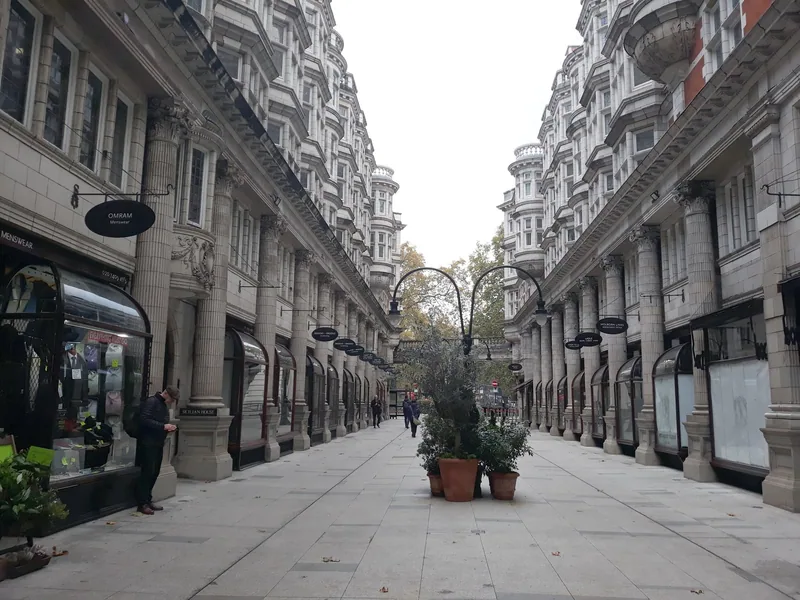
Photo: Simon Burchell · CC BY-SA 4.0 · Wikimedia Commons · resized
Two free museums facing each other
The reason to make a deliberate trip is Lincoln's Inn Fields, where two of London's strangest collections sit on opposite sides of the same square.
Sir John Soane's Museum is an architect's house left exactly as he arranged it in the 1830s, crammed with casts, fragments, paintings and an Egyptian sarcophagus in the basement. It is free, takes no advance bookings and has no timed slots, so you queue at the door if it is busy. It opens Wednesday to Sunday, 10:00 to 17:00, and is closed on Mondays and Tuesdays, though it does open on bank holidays. Numbers inside are limited, which is why the queue exists.
The Hunterian Museum, inside the Royal College of Surgeons at 38-43 Lincoln's Inn Fields, is free and open Tuesday to Saturday, 10:00 to 17:00, closed Sunday and Monday. Booking is recommended rather than required. There is a free curator's highlights tour every Wednesday at 14:15, with twelve places handed out at the reception desk on a first-come basis.
The two opening patterns overlap only on Wednesday, Thursday, Friday and Saturday. If you want both in one visit, those are your days, and Wednesday gets you the tour as well. Allow an hour and a half for the Soane and an hour for the Hunterian, plus the walk of about three minutes between them.
Wednesday to Saturday is the only window for both Lincoln's Inn Fields museums. The Soane closes Monday and Tuesday; the Hunterian closes Sunday and Monday. Neither charges anything, and together they are a serious half-day for nothing.
The Inns of Court, and where you may actually walk
Four Inns of Court govern entry to the English bar, and two of them, Lincoln's Inn and Gray's Inn, are in Holborn. They are private institutions rather than public sites, but their gardens, courtyards and passages are generally open to people on foot during office hours and closed at weekends. You walk in, you keep quiet, and nobody stops you.
Gray's Inn has a long strip of lawn and plane trees known as the Walks, usually open on weekday lunchtimes. Lincoln's Inn has a chapel, a Tudor gatehouse on Chancery Lane and a large hall, with the same weekday rhythm. Our guide to Temple Church and the Inns of Court covers the two southern Inns and the history of the whole system, so we do not repeat it here.
The public face of the profession is the Royal Courts of Justice on the Strand, where you can sit in on a civil hearing for nothing. Its Victorian Gothic front is the best free architectural spectacle in the area.
The small things nobody photographs
Sicilian Avenue, off Southampton Row, is a short pedestrian arcade with a colonnade at each end, laid out at the beginning of the twentieth century as a shopping street and now a run of cafes with tables outside. It is the most pleasant thirty seconds of walking in Holborn and almost nobody turns down it.
Staple Inn, on the south side of High Holborn near Chancery Lane station, presents a timber-framed frontage to the street with a quiet courtyard behind it. Holborn Bars, the enormous red terracotta pile a little further east, was built as an insurance company's headquarters and has a courtyard you can walk into.
Red Lion Square, a short walk north, is a small garden square with benches and a lunchtime population of office workers. And at Holborn Circus the district ends at Ely Place and St Etheldreda's Church, a private street with a medieval church on it, which is the single oddest thing within five minutes of here.
For indoor oddity, Novelty Automation on Princeton Street is a room of handmade satirical coin-operated machines, and it is the one place in Holborn a bored teenager will enjoy. The London Silver Vaults on Chancery Lane, a basement of underground strongrooms full of silver dealers, is free to walk into on weekdays and closed on Sundays.
Eating, and why the queues form at half past twelve
Holborn's food economy is built around about 90 minutes of weekday demand. From roughly 12:15 to 13:45 every sandwich counter, salad bar and soup shop between Kingsway and Chancery Lane has a queue out of the door, and by 15:00 several have shut for the day. Plan around that: eat at 12:00 or at 14:00 and you will walk straight in.
The market end of it is Leather Lane, a weekday street market with a long line of hot-food stalls, five minutes north-east towards Hatton Garden. It belongs to our guide to Leather Lane and shopping in Clerkenwell, which has the trading days and what to order.
The pubs are the other draw, and they are genuinely old ones rather than themed. Because the whole Fleet Street and Holborn run is covered in detail elsewhere, we send you to historic pubs in London for the individual houses and to pub walks and historic crawls for the route that links them. Note the same weekday pattern: several close early on Saturday and all day Sunday.
If you want something after the Soane, the gelaterias of Seven Dials are about ten minutes' walk west; see ice cream and gelato in London for which counters are worth the detour.
Holborn after dark
It empties. Offices close between 17:30 and 19:00, the pubs fill for two hours with people who work here, and by 21:00 the streets between Kingsway and Gray's Inn Road are quiet enough to hear your own footsteps. There are no clubs, no late restaurants to speak of, and very little reason to be out.
That is not a complaint. Walking through the Inns of Court area on a winter evening, with gas-style lamps and no traffic, is one of the more atmospheric free things to do in central London. It is simply not a night out, and if you want one you walk fifteen minutes west into Soho or ten minutes north into Bloomsbury.
Staying here
The idea that nobody stays in Holborn is out of date. High Holborn has a five-star hotel at number 252 and several chain hotels within a few minutes, and the district's weekday-only rhythm means room rates often drop at weekends, which is exactly when a visitor wants them.
The trade-off is real, though. You are ten minutes' walk from Covent Garden and twelve from the British Museum, on the Central and Piccadilly lines, and you will eat dinner somewhere else. Compare it with Bloomsbury, which has more hotels, more evening life and the same walk into the West End.
Getting in and out
Holborn station sits on the Central and Piccadilly lines in Zone 1, and it has no step-free route: there are escalators and stairs only, and it gets uncomfortably busy in the evening peak. Chancery Lane, on the Central line, is a quieter alternative for the eastern end of the district and is also not step-free.
The Central line reaches Oxford Circus in three minutes and Bank in about seven, so Holborn is genuinely central rather than merely near the centre. Walking is often quicker than it looks: the British Museum is twelve minutes, Covent Garden ten, the Southbank Centre twenty over Waterloo Bridge.
For a step-free journey, use Farringdon, about ten minutes' walk east, which has the Elizabeth line, Thameslink and three Underground lines and is step-free throughout.
What is changing nearby
The big development for anyone spending a day here is fifteen minutes east: the London Museum's new home in the Smithfield General Market buildings opens on 28 November 2026, with free galleries, and it will pull visitors through the streets between Holborn and Smithfield in a way nothing has for years. See Smithfield Market and the new London Museum for what is going in and what is being kept.
In the other direction, the concrete estates and arts buildings of the Barbican and Moorgate begin a twenty-minute walk away and are about to enter a long construction programme of their own. Holborn's own fabric is largely protected, and the visible change here is smaller: office refurbishment behind retained facades, and a slow reduction in through traffic.
Frequently asked questions
Is Holborn worth visiting?
Yes, for half a day on a Wednesday to Saturday, when both free museums on Lincoln's Inn Fields are open. It has no single major attraction, so treat it as a walk between small ones: the Soane, the Hunterian, the Inns of Court gardens, Sicilian Avenue and Ely Place, with lunch in the middle.
Which Tube station is best for Holborn?
Holborn itself, on the Central and Piccadilly lines, is in the middle of the district and three minutes from Oxford Circus. It has no step-free access, so wheelchair users and anyone with a pushchair should use Farringdon, ten minutes east, which is step-free and has the Elizabeth line.
Can you walk into the Inns of Court?
Generally yes, on foot, during weekday working hours. Lincoln's Inn and Gray's Inn are private institutions that keep their courtyards, passages and gardens open to quiet pedestrians on weekdays and shut at weekends. There is nothing to pay and no ticket, but they are places of work rather than attractions.
Are there hotels in Holborn?
Yes, including a five-star hotel on High Holborn and several chain hotels nearby, though far fewer than in Bloomsbury or Covent Garden. Because the area is dominated by offices, weekend rates can be better here than in the neighbourhoods either side.
What is there to do in Holborn on a Sunday?
Not much, and that is the honest answer. Sir John Soane's Museum opens on Sundays and the streets and squares are pleasantly empty, but the Hunterian, the Inns of Court, the Silver Vaults, Leather Lane market and most of the lunch trade are all closed. Save Holborn for a weekday.
Sources
- Hunterian Museum, Royal College of Surgeons of England - Visit (checked September 2026)
- Sir John Soane's Museum - Your visit (checked September 2026)
- Transport for London - Step-free access (checked September 2026)
- London Museum - Opening at West Smithfield, 28 November 2026 (checked September 2026)
- Food Standards Agency - Food hygiene ratings register (checked September 2026)