
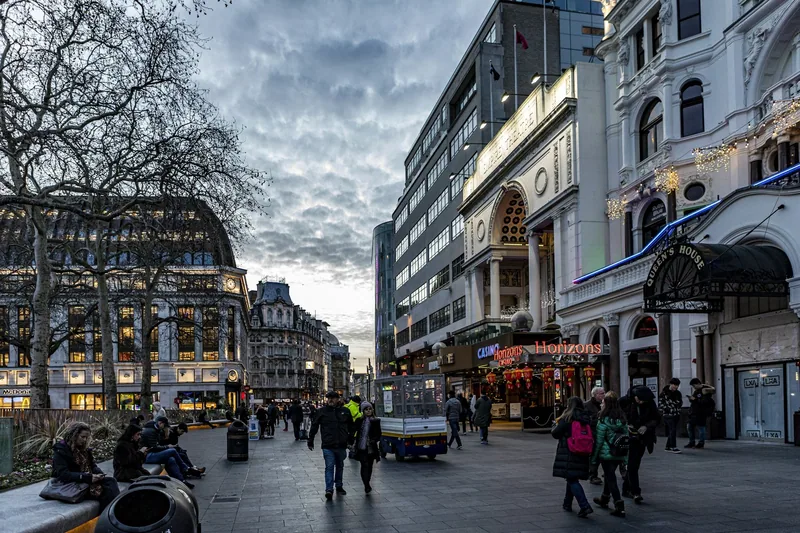
Leicester Square is a pedestrian square in the middle of the West End, surrounded by cinemas, and it is where London holds its film premieres. Theatreland is the name for the forty-odd commercial theatres in the streets around it. Both are worth an hour of your time; the restaurants directly on the square are the one thing to walk past.
The square itself is small, about 150 metres across, with a fenced garden in the middle and a paved perimeter. It was laid out in the 1670s, became a place of entertainment in the Victorian period, and has been the home of the British film industry's public face since the 1930s.
Almost everyone arrives here by accident, because four Tube stations funnel into it and because it sits between Soho to the north and Covent Garden to the east. Knowing what is actually worth stopping for saves a lot of standing about.
Leicester Square in brief
- Best for
- Cinemas, film premieres, the free statue trail, a base for theatre
- Nearest stations
- Leicester Square (Piccadilly, Northern), Piccadilly Circus, Charing Cross, Covent Garden
- Free to do
- Scenes in the Square statue trail and its audio tour; the gardens; watching a premiere from the barrier
- Ticket booth
- The Official London Theatre Ticket Booth, in the clock-topped building on the southern edge: Mon–Sat 10:30–18:00, Sun 11:00–16:00
- Cinema prices
- Prince Charles Cinema from £8 for a weekday matinee; £11.50–£14.50 evenings (2026 prices)
- Busiest
- Friday and Saturday evening, and any premiere night
- Time needed
- 30–45 minutes for the square; longer if you are seeing a film or a show
The garden, the statues and what is free
The central garden is open during the day and contains a marble fountain with a statue of Shakespeare, put up in 1874, and a statue of Charlie Chaplin as the Tramp. It is one of the few places in the immediate area where you can sit down without buying something.
Around the edges runs Scenes in the Square, a trail of bronze statues of film and television characters installed from 2020 onwards: Laurel and Hardy on a rooftop, Bugs Bunny in a flower bed, Gene Kelly on a lamppost from Singin' in the Rain, Mary Poppins mid-landing, Paddington and Mr Bean sharing a bench, Batman and Wonder Woman on the buildings, Harry Potter, the Iron Throne and, on the north terrace, Indiana Jones. Some are lit at night.
The trail is free, and so is the audio walking tour that goes with it, which is narrated by Alex Zane and available on the usual podcast platforms. It takes about half an hour and is the single best thing to do with children in this part of London without spending money. Our guide to free things to do in London has more in the same vein.
The cinemas: the biggest screen and the cheapest seat
Leicester Square has the highest concentration of cinemas in Britain, and two of them matter.
Odeon Luxe Leicester Square is the grand one, opened in 1937, with an art deco black granite frontage and a main auditorium of several hundred reclining seats equipped for Dolby Cinema. It is the venue for most European and world premieres held in London and for the annual Royal Film Performance. Tickets for an ordinary screening cost considerably more than at a suburban cinema, and the main screen is the reason to pay it; the three small screens are not.
The Prince Charles Cinema, at 7 Leicester Place just off the square, is the opposite and is beloved for it: a repertory cinema showing classics, 35mm and 70mm prints, sing-along screenings, all-night movie marathons and quizzes. Its 2026 prices are £11.50 or £14.50 for an evening, weekend or bank holiday matinee screening and £8 or £11 for a weekday matinee, with sing-alongs at £16 or £18.50 and double and triple features at £20 or £26. There is a 75p online booking fee per ticket.
The two prices are the non-member and member rates. Membership costs £15 a year for one discounted ticket per screening, or £20 for two; lifetime memberships are £60 and £100 and include two complimentary tickets. Members get £8 weekday matinees, at least £2.50 off other tickets, 15 per cent off the bar, priority booking and regular £1 screenings. If you are in London for a week and plan two visits, the annual membership pays for itself.
A weekday matinee at the Prince Charles costs less than a pint in the same street. £8 for a member and £11 otherwise buys a 35mm print of a film you have probably only seen on a laptop, in a proper cinema, in the middle of the West End. On a wet afternoon it is the best value in Leicester Square by a wide margin.
Film premieres: how to watch one for nothing
Premieres happen on the square several times a month, most often on a Wednesday or Thursday evening. The east side and part of the central garden are fenced off during the day, a red or coloured carpet is laid, and barriers go up for the public.
Watching from behind the barrier is free and needs no ticket. What it needs is patience: fans arrive from mid-morning for the best positions, and the cast usually appears between about 17:00 and 19:00. If you simply want to see what one looks like, turn up around 16:00, stand at the back and expect a large screen showing the arrivals.
Two practical points. The square becomes very congested on premiere nights and the pedestrian routes through it are closed, so allow extra time if you have a theatre ticket. And nobody publishes a comprehensive public calendar of premieres in advance; the fencing going up in the morning is usually the first sign. The BFI London Film Festival in October puts several galas here in a single fortnight.
The ticket booth, and the ones that are not it
What matters here is telling the real booth from the imitations. The genuine one, operated by the Society of London Theatre and formerly called TKTS, is a single low structure with a clock on top, standing on its own in the middle of the square's southern edge. Nothing else on the square is it.
Several shops on the surrounding streets use similar wording and similar lettering, sell the same shows at full price or more, and add a booking fee on top. They are not breaking any law; they are simply not the discount booth. How the discounts work, and the other ways into a cheap seat, are covered in our guide to cheap theatre tickets.
Why the restaurants on the square are worth walking past
The square is ringed by large restaurants and bars with photographs on the menus, staff outside inviting you in, and prices well above what the same food costs a street away. They exist because several million people a year pass through and very few of them come back.
Three specific things to watch for. Menus displayed outside that do not show the price of drinks. A service charge already added to the bill, which is legal but should be shown on the menu. And "special offer" boards that apply only to a limited part of the menu.
The alternative is a two-minute walk. Chinatown begins immediately north of the square through the Wardour Street gate and has better food at lower prices. St Martin's Court, the alley between Charing Cross Road and St Martin's Lane, has long-established restaurants used by theatre audiences. Soho's restaurants start one street north. For after the show, see our guide to late-night food in London.
Leicester Square is a pickpocket's favourite because everyone here is distracted. People stop suddenly to photograph statues, look up at cinema frontages and check their phones in dense crowds. Keep your phone in a pocket you can feel, carry bags in front of you, and be particularly careful at the station entrances and on premiere nights. Our guides to how pickpockets work and common tourist scams cover the specifics.
Theatreland: what is within five minutes
Theatreland is not a formal district but a cluster. From the square you can reach, on foot in under ten minutes, the theatres of Shaftesbury Avenue to the north-west, St Martin's Lane and Charing Cross Road to the east, the Strand to the south-east and the Haymarket to the south-west.
Almost all of them are Victorian or Edwardian, which has consequences: narrow seats, steep upper circles, small bars, short intervals and queues for the toilets. Many have limited step-free access. Our guide to West End theatre covers seating, booking and access properly.
Curtain times are typically 19:30 on weekday evenings, with matinees on two afternoons a week, usually Wednesday or Thursday and Saturday. Shows finish between 22:00 and 22:45, which is why every restaurant within five minutes is full at 22:30 and empty at 23:15.
Shops, chains and the things aimed at children
The corners of the square hold several large branded stores selling sweets, toys and film merchandise over multiple floors. They are loud, busy and expensive, and children will want to go in. If that is on the agenda, go in the morning before the queues build.
For better toy shopping, the traditional options are a few minutes away on Regent Street and in Covent Garden; see our guide to Hamleys and London's toy shops. For everything else, the shops immediately around Leicester Square are chains you will recognise.
Getting there, and where to go next
Leicester Square station sits on the Piccadilly and Northern lines and has exits on all four corners of the crossroads; it is famously only about 260 metres from Covent Garden station, which is one of the shortest journeys on the network and is faster to walk. Piccadilly Circus and Charing Cross are each about five minutes away on foot.
The square is a good starting point for a walk. West along Coventry Street brings you to Piccadilly Circus in four minutes. South down Charing Cross Road or Irving Street brings you to Trafalgar Square and the National Gallery in five. North through the gate is Chinatown, and beyond it Soho.
Late at night, the square is one of the busiest places in London and is well lit and heavily policed, but it is also where the crowds and the queues are. If you want a calmer route to a station after a show, walk east to Covent Garden or south to Charing Cross rather than through the middle. Our guide to London in the school holidays covers the weeks when the square is busiest of all.
Frequently asked questions
Is Leicester Square worth visiting?
For 30 to 45 minutes, yes: the free statue trail, the garden, the cinema frontages and the ticket booth are all here, and four Tube lines meet underneath. It is not a destination for a whole afternoon, and the food on the square is the weakest part of it.
How can I watch a film premiere in Leicester Square?
Stand behind the public barriers, which costs nothing and needs no ticket. Premieres are usually on weekday evenings, with the cast arriving between about 17:00 and 19:00; dedicated fans queue from mid-morning. There is no published public calendar, so the fencing going up in the morning is often the first indication.
How much are cinema tickets at the Prince Charles Cinema?
In 2026, £11.50 for members and £14.50 for non-members for evening, weekend and bank holiday matinee screenings, and £8 or £11 for a weekday matinee, plus a 75p online booking fee. Sing-along screenings are £16 or £18.50 and double features £20 or £26. Annual membership costs £15.
Where should I eat near Leicester Square?
Not on the square itself, where prices are high and quality inconsistent. Chinatown starts immediately to the north, St Martin's Court to the east has established theatre restaurants, and Soho's restaurants are one street away. All are within a five-minute walk.
Is Leicester Square safe at night?
It is busy, well lit and patrolled, and violent crime is not the usual risk. Theft is: pickpockets work the crowds around the statues, the station entrances and premiere barriers. Keep phones and bags secure, and be alert when you stop to take a photograph.
Sources
- Discover Leicester Square - Scenes in the Square trail and audio tour (checked September 2026)
- The Prince Charles Cinema - 2026 ticket prices and booking fee (checked September 2026)
- The Prince Charles Cinema - membership options (checked September 2026)
- Society of London Theatre - The Official London Theatre Ticket Booth (checked September 2026)
- ODEON Luxe Leicester Square (checked September 2026)
- Transport for London - line status and stations (checked September 2026)