
Wapping and Rotherhithe face each other across a bend in the Thames east of Tower Bridge. Both were docks; both are now mostly flats inside the old warehouses; and both have a handful of riverside pubs that are among the oldest in London. Between them runs the Thames Tunnel of 1843, the first tunnel ever driven under a navigable river, which now carries Overground trains.
Almost no visitors come here, which is the appeal. You can walk a kilometre of Wapping High Street on a Sunday morning and pass a dozen people. There are no ticket queues, no coach parties, and the only paid attraction on either bank is a small museum in a brick shaft.
Plan it as a half-day walk with lunch in a pub, ideally crossing the river once by boat or by train. It fits neatly between Whitechapel to the north and Canary Wharf to the east.
Wapping and Rotherhithe at a glance
- Best for
- Riverside pubs, dock history, empty Thames Path, Brunel's tunnel
- Stations
- Wapping and Rotherhithe on the Windrush line; Canada Water for the Jubilee line
- Brunel Museum
- Rotherhithe, SE16 4LF; open Friday to Monday 10:30-15:30
- Brunel Museum price
- Adult £10, concession £7, SE16 and SE8 residents £2.50 (September 2026)
- Crossing by boat
- Uber Boat RB4 ferry, Rotherhithe to Canary Wharf, £4.10 single
- Walking distance
- About 3 km along either bank, flat throughout
- Time needed
- Half a day
Getting there, and the tunnel you travel through
Wapping and Rotherhithe are one stop apart on the Windrush line of the London Overground, and the train between them runs through the Thames Tunnel itself. That is the shortest way to understand why this area matters: the tunnel below your feet was begun in 1825 by Marc Brunel, finished in 1843, and is the oldest part of the underground railway network anywhere.
Neither station is step-free, and both are small, deep and plain. Canada Water, a few minutes' walk from Rotherhithe, is step-free and connects to the Jubilee line, which reaches Waterloo in about 10 minutes and Canary Wharf in three. Our page on the Overground and DLR explains how the Windrush line fits with the rest of the network.
The other way to arrive is on the water. Uber Boat by Thames Clippers runs the RB4 cross-river ferry between Rotherhithe and Canary Wharf seven days a week, a single crossing that costs £4.10 with contactless or Oyster and has no child or Travelcard discount. River Bus fares do not count towards the daily cap. Our guide to the river bus has the full fare table.
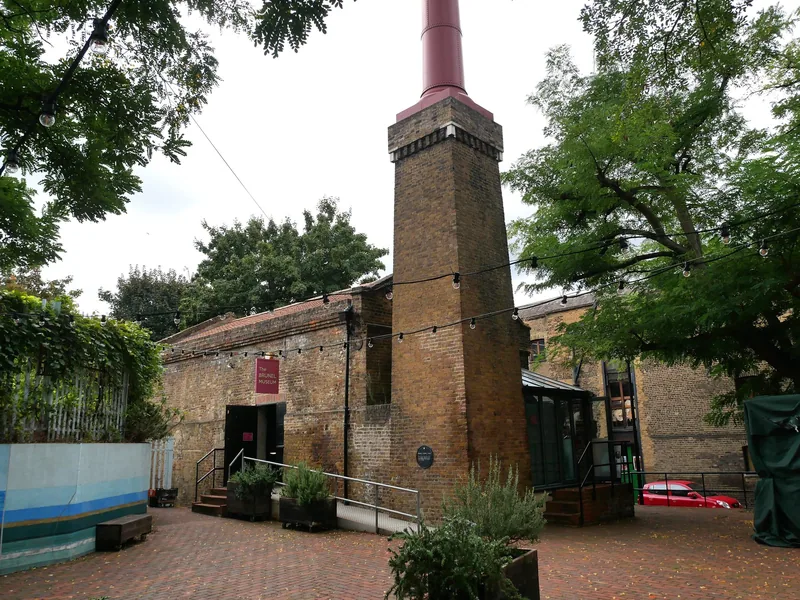
Photo: Doyle of London · CC BY-SA 4.0 · Wikimedia Commons · resized
Wapping High Street and what the warehouses were
Wapping High Street is not a high street in any usual sense. There are no shops along most of it. What there is instead is a narrow road running between six- and seven-storey brick warehouses, many with their iron loading doors and overhead cranes still in place, converted into flats from the 1980s onwards. Old wharf names are painted or carved above the entrances: Oliver's Wharf, Gun Wharves, New Crane Wharf, Metropolitan Wharf.
Between the buildings, narrow passages called stairs still lead down to the foreshore. Wapping Old Stairs and Wapping New Stairs are both signed, and at low tide you can stand on the gravel where lighters were loaded. Going down is legal; going onto the foreshore to search for objects is not, without a permit, and our guide to mudlarking on the Thames explains the licensing rules and the tide risk.
Tobacco Dock, north of the High Street, is a converted 1811 warehouse now used for events, with two replica sailing ships moored in the dry dock outside. Wapping Hydraulic Power Station, the last of its kind in London, closed in 1977 and is not open to the public.
Execution Dock and the pubs
The riverside pubs are the reason most people who come here at all come here. Three stand out.
- The Prospect of Whitby, on Wapping Wall, claims a licence going back to 1520 and describes itself as the oldest riverside pub in London. It has a flagstone floor, a pewter-topped bar and a terrace over the water. A replica noose hangs from a beam on the river side.
- Wapping Old Stairs are the gap in the river wall where the Thames still reaches the street, with a narrow pub beside them whose back terrace hangs over the foreshore.
- The Captain Kidd, in a converted warehouse on Wapping High Street, has the best beer garden of the three and the least history.
All three trade on Execution Dock, where the Admiralty hanged pirates, smugglers and mutineers between the 15th century and 1830. Condemned men were hanged at the low-water mark and left until three tides had washed over them. Captain Kidd was executed here in 1701. The exact site is not certain, and at least two pubs claim to stand next to it, so treat the gallows outside the Prospect of Whitby as a memorial rather than a marker.
Our round-up of historic pubs in London covers these alongside the older City taverns, and explains which claims about "the oldest pub" hold up.
Check the tide before you go down any river stairs. The Thames here is tidal and rises fast, and several sets of stairs have no handrail and are slippery with algae. Look at the day's tide times before you plan a foreshore walk, and never let children go down alone.
Rotherhithe: the Brunel Museum and the tunnel shaft
Cross to the south bank and the mood changes. Rotherhithe village is a small cluster of 18th-century buildings around a church, surrounded by 1980s housing on the filled-in docks.
The Brunel Museum occupies the engine house beside the original tunnel shaft. It is small, and the ticket is really for the shaft: a brick cylinder 15 metres across, sunk into the ground in 1825, from which the tunnel was driven horizontally. After the tunnel opened it was fitted out as an underground concert hall and fairground; you can now go down into it on a staircase and stand in the space.
Adult entry is £10, concessions for students, over-65s and disabled visitors are £7, and residents of the SE16 and SE8 postcodes pay £2.50 (September 2026). It opens Friday to Monday from 10:30 to 15:30, which catches people out, so check the museum's visiting page before travelling. There is a garden on top of the shaft with a view over the river.
The Mayflower, St Mary's and Surrey Docks
The Mayflower, on Rotherhithe Street, is a wooden-jettied pub with a deck over the water, named for the ship that carried the Pilgrims to America in 1620. The ship was moored at Rotherhithe before that voyage and returned here afterwards; the pub stands close to the spot, though the present building is later.
Across the lane, St Mary's Church was rebuilt in 1715, and its communion table is said to be made from timbers of the Mayflower after it was broken up. Christopher Jones, the ship's master, is buried in the churchyard, and a modern statue of him stands outside. The churchyard is small, quiet and free.
East along the river, Surrey Docks Farm is a working city farm with cattle, goats, pigs, bees and a blacksmith, free to enter, with a café and a riverside terrace. Our list of city farms and playgrounds in London puts it alongside the others. Further on are Greenland Dock, the largest surviving dock basin in the Surrey system, and Stave Hill Ecological Park, a small artificial hill with a view over the whole peninsula.
Walking the Thames Path here
This is one of the emptiest stretches of central London riverside, and the path is nearly continuous on both banks.
| Route | Distance | What you see |
|---|---|---|
| Tower Bridge to Wapping | 1.5 km, 20 minutes | St Katharine Docks marina, the warehouse frontage |
| Wapping to Limehouse | 1.5 km, 20 minutes | Shadwell Basin, Wapping Wall, the old hydraulic station |
| Rotherhithe to Greenwich | 4 km, about an hour | Surrey Docks Farm, Greenland Dock, the Deptford waterfront |
| Rotherhithe to Tower Bridge (south bank) | 2.5 km, 35 minutes | Shad Thames, Bermondsey wharves, the Design Museum's old home |
The path is diverted inland in several places where a building blocks the frontage, and the diversions are signposted but easy to miss. Our guide to walking in London covers the Thames Path as a whole. West of here the route runs into Southwark and Bankside; east it reaches Greenwich, where the foot tunnel takes you back under the river.
This is a cheap day out by London standards. Both banks are free to walk, the churchyard and the farm cost nothing, and the only tickets involved are £10 for the Brunel shaft and £4.10 for the ferry. Two adults can do the whole thing, lunch aside, for under £30. Our page on London on a budget has more days like it.
What is nearby
Tower Bridge is 20 minutes' walk west of Wapping, and St Katharine Docks, the marina just beyond it, is a pleasant and free place to look at boats. Eastwards, London Museum Docklands at West India Quay is free, occupies a Georgian sugar warehouse and tells the story of the port, including London's role in the slave trade. It is the single best indoor stop if the weather turns.
Rooms are scarce in both areas and most of the accommodation is short-let flats in converted warehouses; our page on apartments and short lets in London explains the 90-night rule and what to check before booking.
Frequently asked questions
Can you walk through the Thames Tunnel?
No. The 1843 tunnel carries Overground trains on the Windrush line, and the only way through it is on a train between Wapping and Rotherhithe. The Brunel Museum gives access to the original entrance shaft beside it, which you can walk down into.
How much does the Brunel Museum cost?
Adult entry is £10, concessions for students, over-65s and disabled visitors are £7, and people living in the SE16 and SE8 postcodes pay £2.50, as of September 2026. It opens Friday to Monday from 10:30 to 15:30 only.
Where exactly was Execution Dock?
The precise site is not established. Records place it on the Wapping foreshore near Wapping New Stairs, and more than one pub claims to stand beside it. The replica gallows at the Prospect of Whitby is a memorial rather than an accurate marker.
How do I cross between Wapping and Rotherhithe?
By train, one stop on the Windrush line through the Thames Tunnel. There is no pedestrian crossing between the two banks here. The RB4 river ferry links Rotherhithe with Canary Wharf instead, for £4.10 a single with contactless or Oyster.
Is there anything here for children?
Surrey Docks Farm in Rotherhithe is free and has cattle, goats, pigs and a blacksmith. The Brunel shaft interests older children, and there are playgrounds in Southwark Park. Otherwise this is an adult walk, with a lot of river and not much to do.
Sources
- The Brunel Museum - Visiting, opening days and prices (checked September 2026)
- Uber Boat by Thames Clippers - Cross river fares (checked September 2026)
- Transport for London - London Overground and the Windrush line (checked September 2026)
- Port of London Authority - Thames foreshore permits and safety (checked September 2026)
- Surrey Docks Farm - Visitor information (checked September 2026)