
The UK uses its own three-pin plug, defined in the British Standard BS 1363 and sold on travel adaptors as "Type G", and the mains supply is 230 volts at 50 Hz. Most visitors only need a simple plug adaptor, because phone and laptop chargers work on any voltage. A converter is only needed for single-voltage appliances, such as some hair dryers from North America.
British sockets look different from almost everywhere else. The plug has three thick rectangular pins, and it will not fit a European, American or Australian socket, nor they a British one. That is why a UK adaptor belongs near the top of your packing list.
The good news is that sorting this out is simple once you know what to check. This guide explains the British plug, how to tell whether your devices will work, which travellers need more than an adaptor, and how to avoid the cheap adaptors that UK safety officials have found to be dangerous.
UK electricity for travellers
- Plug and socket
- BS 1363: three rectangular pins, fused plug rated 13 amps; commonly labelled "Type G"
- Voltage
- 230 V (permitted range +10% / -6%)
- Frequency
- 50 Hz
- Adaptors for foreign plugs
- Covered by UK plug safety regulations
- Bathrooms
- Usually no ordinary sockets; often a two-pin shaver socket
- Power cut helpline
- 105, free, anywhere in the UK
How the British plug works
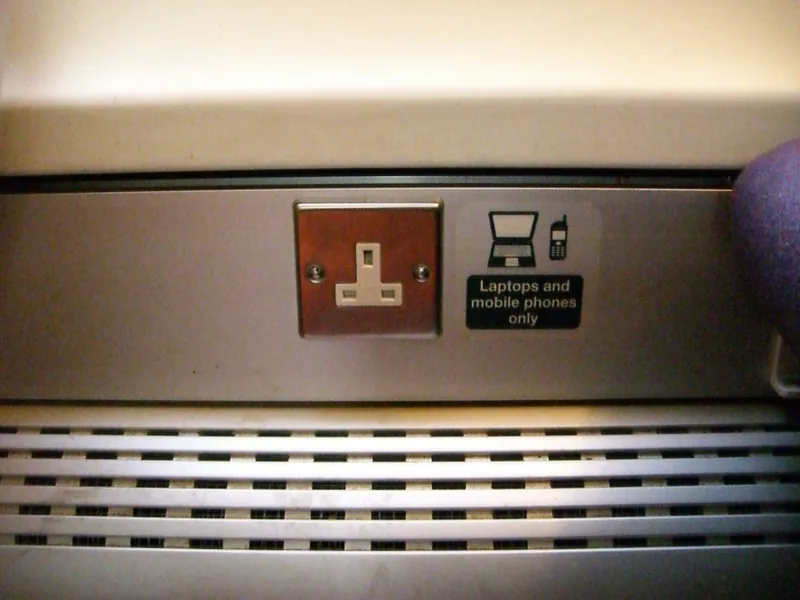
The UK plug is set out in law. The Plugs and Sockets etc. (Safety) Regulations 1994 refer to the BS 1363 standard: a 13 amp fused plug with three rectangular pins. The top pin is the earth, and the two lower pins carry the current. Many visitors notice how large and solid it is compared with the plugs at home.
Two features set it apart. First, every plug contains its own fuse, a small cartridge that breaks the circuit if too much current flows, which protects the flex of the appliance. Second, British sockets have shutters over the holes, which open only when a plug with a proper earth pin is pushed in. That makes the sockets safer for small children, but it also means a badly made adaptor may not go in properly.
Most British sockets also have their own on/off switch. If you plug in your charger and nothing happens, check that the switch next to the socket is turned on. It sounds obvious, but it catches out many visitors.
Adaptor, converter or both?
These two words are often mixed up, and the difference matters.
- A plug adaptor only changes the shape. It lets your foreign plug fit a British socket, but the electricity coming out is still 230 volts.
- A voltage converter (or transformer) changes the voltage, for example from 230 V down to 110-120 V, so a single-voltage appliance from North America can run safely.
Whether you need a converter depends entirely on the appliance, not on the country you come from. Look at the label or the small print on the charger or power brick. If it says something like "INPUT: 100-240V ~ 50/60Hz", it works anywhere in the world and needs only an adaptor. If it shows a single voltage such as "120V 60Hz", plugging it into a British socket through an adaptor alone can destroy it, or worse.
Read the small print on every charger before you pack. The input range printed on the plug or power brick tells you everything. Check each device once at home, and put anything that shows only 110 V or 120 V to one side: it either stays at home or travels with a converter.
Which of your devices will work
Almost all modern electronics are built for worldwide use, but heating appliances are often not. This table gives the usual pattern; your own device's label always has the final word.
| Device | Usually dual-voltage? | What you normally need |
|---|---|---|
| Phone and tablet chargers | Yes | Plug adaptor only |
| Laptop power supplies | Yes | Plug adaptor only |
| Camera battery chargers, e-readers, headphones | Yes | Plug adaptor only |
| Electric toothbrushes and shavers | Sometimes | Check the label; some work from a shaver socket |
| Hair dryers, straighteners, curling tongs | Often not, if bought in North America | A dual-voltage model, or buy or borrow one in London |
| Travel kettles, irons, heated rollers | Often not | Leave at home if single-voltage |
| CPAP machines and other medical devices | Varies | Check with the manufacturer before travel |
If you travel with medical equipment, charging a power wheelchair or mobility scooter, or other essential devices, check the power supply well before your trip. Our guide to accessible London has more practical advice for disabled travellers.
Visitors from the USA, Canada and Japan
North America runs on about 120 volts and Japan on 100 volts, so visitors from these countries need to take the most care. Your phone, tablet and laptop will almost certainly be fine with an adaptor. Your hair dryer or straightener may not be.
For high-power heating appliances, a small travel converter is often not enough, because a hair dryer draws a lot of power. In practice, the simplest choices are to pack a dual-voltage travel hair dryer, to use the one your hotel provides (many hotels have one in the room; ask when you book), or to buy an inexpensive one in London. A UK-bought appliance will come with a British plug and work without any adaptor.
North American plugs also often have two flat pins without an earth. They fit most travel adaptors, but a poorly made adaptor may hold them loosely. Check that the plug sits firmly, and do not use one that wobbles or gets warm.
Visitors from Europe, Australia and elsewhere
If you come from mainland Europe, your supply at home is also 230 volts. You need a plug adaptor for your devices, but not a converter.
Visitors from Australia and New Zealand use a similar voltage too, so an adaptor is all that is needed. Visitors from other regions should check the voltage printed on each device in the same way.
If you are combining London with a trip to the continent, for example a day in Paris by Eurostar, remember that you will need a different adaptor there. A good universal travel adaptor, bought from a reputable seller, covers both.
Choosing an adaptor that is actually safe
The UK's Office for Product Safety and Standards (OPSS) publishes reports on dangerous products stopped at the border or removed from sale, and travel adaptors appear regularly. The problems it describes are worth knowing about:
- In January 2026, OPSS reported a US-to-UK travel adaptor sold online whose UK plug did not meet the dimensions required by BS 1363. OPSS said a non-conforming fuse could lead to the plug overheating or exploding, and classed it as a risk of fire.
- In 2022, it reported an unbranded "Type G" travel adaptor marked 13A/250V that had no fuse at all, which OPSS described as a serious risk of electric shock.
A fuse rating printed on the plastic is not a fuse. The adaptor in the 2022 safety report was embossed with "13A / 250V" but had no fuse inside. Buy adaptors from established shops or brands rather than the cheapest online listing, and stop using any adaptor that is loose in the socket, crackles or feels hot.
In London itself, adaptors are easy to find in electrical shops, chemists, some supermarkets and large department stores; our guide to London's department stores lists the biggest. Airport shops also sell them, although often at higher prices, so if you forget yours, you can wait until you are in town. Our Heathrow arrivals guide covers the first hour after landing.
A few habits reduce the risk further. Do not plug one adaptor into another. Do not hang a heavy laptop brick from an adaptor where it pulls the plug half out of the socket. And unplug chargers you are not using, especially overnight in a hostel or a rented flat.
Hair dryers, shavers and British bathrooms
Visitors are often surprised to find no normal socket in a British bathroom. British wiring rules keep ordinary sockets well away from baths and showers for safety, so you will usually find only a shaver socket, often built into a light above the mirror.
A shaver socket takes a two-pin plug and supplies only a small amount of power. It is meant for electric shavers and some electric toothbrushes. Never use it for a hair dryer or straightener: they will not work, and forcing them in is dangerous. Many hotels fix a hair dryer to the wall in the bathroom or leave one in a drawer in the bedroom.
If you are staying in self-catering accommodation, check what the kitchen and bathroom provide before you pack appliances. Our guide to apartments and short lets in London covers what to ask.
How many sockets to plan for
Older hotel rooms in London can have surprisingly few sockets, and they are not always next to the bed. Families travelling with several phones, tablets and cameras will run out quickly.
One adaptor and a multi-port USB charger cover a whole family. Instead of packing four adaptors, take one good adaptor and a charger with several USB ports that accepts 100-240 V. It charges everyone's phone from one socket, and there is less to leave behind when you check out.
Many newer hotels have USB ports built into sockets or bedside lamps, but you cannot count on them. In hostel dormitories, sockets near the beds are shared and often in demand, so a short extension lead with a UK plug, bought in London, can be useful. Our guides to budget hotels and hostels in London help you choose a place to stay.
Travelling with young children? The shutters in British sockets are a helpful safety feature, but keep adaptors and chargers out of reach anyway. Our guide to London with kids has more practical tips for families.
Keeping your phone charged while you explore
A long day of maps, photos and ticket apps can drain a phone by mid-afternoon. That matters in London, because many visitors also use their phone to pay for the Tube and buses. A power bank in your day bag solves most of the problem. Check airline rules on carrying power banks in hand luggage before you fly.
For more on staying connected, including roaming, eSIMs and signal on the Underground, see our guide to mobile phones and SIM cards in the UK. When you write your packing list, our page on London's weather and what to pack covers clothes and rain gear, and our advice for first-time visitors covers the rest of the preparation.
Power cuts and electrical problems
If the power goes off in a hotel, tell reception. If you are in a rented flat, check the fuse box (also called the consumer unit) for a switch that has tripped, and if the whole street is dark, call 105, the free national power cut number. For any electrical fire, leave the building and call 999.
Our page on emergency numbers and what to do lists the other numbers worth saving before you travel.
Frequently asked questions
What plug adaptor do I need for London?
You need an adaptor for the British three-pin plug, the BS 1363 type usually sold as "Type G". It has three rectangular pins and a built-in fuse. The same plug is used across England, Scotland, Wales and Northern Ireland, so one adaptor covers the whole of the UK.
Do I need a voltage converter in the UK?
Only for appliances that work on a single, lower voltage. The UK supply is 230 volts at 50 Hz. Chargers marked "100-240V" need only a plug adaptor. Single-voltage 110-120 V appliances, such as some American hair dryers, need a converter or should be left at home.
Can I use my American hair dryer in London?
Only if it is dual-voltage and you switch it to the right setting. A standard 120-volt hair dryer can be damaged by the UK's 230-volt supply, and a hair dryer draws too much power for most small converters. Many hotels provide one, or you can buy one cheaply in London.
Are there USB sockets in London hotels?
Many newer hotels have USB ports by the bed, but older rooms may not, and the number of normal sockets can be small. Pack a charger with several USB ports that accepts 100-240 V, plus one good UK adaptor, and you can charge several devices at once.
Can I plug my shaver into the bathroom socket?
Usually, yes. British bathrooms rarely have ordinary sockets, but many have a two-pin shaver socket, often in a light fitting above the mirror. It is only for low-power devices such as shavers and some toothbrushes. Never plug a hair dryer or straightener into it.
Sources
- legislation.gov.uk - Electricity Safety, Quality and Continuity Regulations 2002, regulation 27 (checked September 2026)
- legislation.gov.uk - Plugs and Sockets etc. (Safety) Regulations 1994, regulation 3 (checked September 2026)
- Office for Product Safety and Standards - Product Safety Report: US/UK Travel Adaptor (2601-0166) (checked September 2026)
- Office for Product Safety and Standards - Product Safety Report: Unbranded Type G Travel Adaptor 13A/250V (2204-0047) (checked September 2026)
- GOV.UK - Call charges and phone numbers (checked September 2026)