
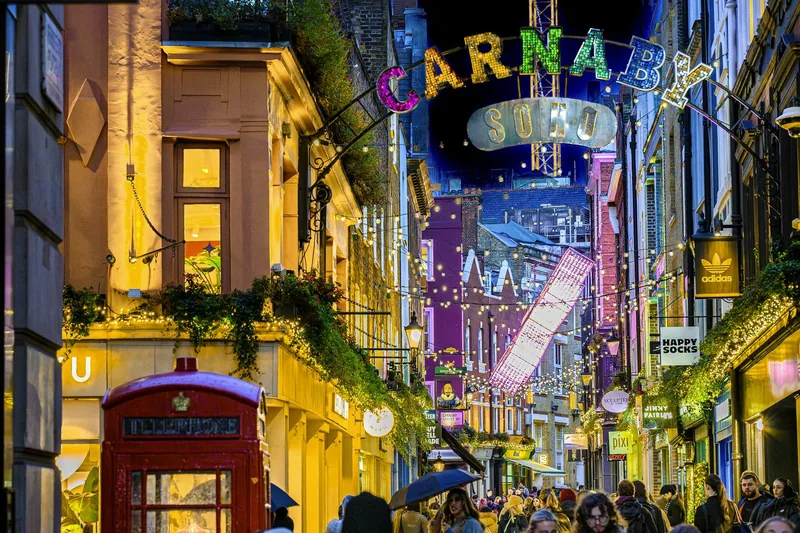
Carnaby Street itself is a short pedestrian run of brand shops under a permanent arch. The reason to come is what surrounds it: a grid of traffic-free lanes between Regent Street and Berwick Street where the rents are lower, the shops are smaller and the food is better. Walk the arch, then turn off it.
Our guide to Soho as a neighbourhood covers the history, the nightlife and the eating. This page is about buying things: which street has what, where the independents are, what has replaced the record shops, and how the area works at different times of day.
The geography is simple once you see it. Carnaby Street runs north to south, parallel to and one block east of Regent Street. Crossing it are Foubert's Place, Ganton Street, Beak Street and Broadwick Street. Behind those sit Newburgh Street, Kingly Street, Marshall Street and, further east, Berwick Street. All of it is walkable in twenty minutes and almost none of it has traffic.
Carnaby and Soho shopping: orientation
- Nearest station
- Oxford Circus, two minutes to the top of Carnaby Street
- Also useful
- Piccadilly Circus and Tottenham Court Road, both under ten minutes
- Typical hours
- Around 10:00-20:00 Monday to Saturday; six hours only on Sunday for larger shops
- Pedestrianised
- Carnaby Street and most of the lanes around it
- Best for
- Streetwear, sneakers, independent labels, beauty, records, delis
- Christmas lights
- Switch-on Wednesday 4 November 2026
The arch, and why the street is not what it was
The sign across the top of Carnaby Street is the photograph everyone takes, and it is worth knowing that the street's reputation and the street's current contents are two different things. In the 1960s this was where a handful of small tailors and boutiques sold clothes to people who could not afford Savile Row, and the name travelled round the world. Today the street is owned and managed as a single estate, and the shops on it are mostly established brands with flagship stores.
That is not a complaint. The estate has kept the whole grid pedestrian, which in the middle of the West End is worth a great deal, and it has pushed the more interesting tenants into the side lanes rather than out of the area altogether. But if you arrive expecting a street of one-off boutiques, you will be disappointed by Carnaby Street and pleased by everything within fifty metres of it.
Street by street: where to turn off
| Street | What it is for |
|---|---|
| Carnaby Street | Flagship fashion, beauty, sportswear, sunglasses; the arch and the seasonal decorations |
| Newburgh Street | The prettiest lane, with small independent shops and cafés; the one to walk slowly |
| Foubert's Place | Jewellery, accessories, sneakers and teenage labels |
| Broadwick Street | Streetwear and premium menswear, plus the site of the Broad Street cholera pump |
| Beak Street | Fashion and fragrance among some of the best restaurants in Soho |
| Kingly Street | Eating and drinking rather than shopping, and the entrance to Kingly Court |
| Berwick Street | Records, fabric, the street market, and the last of old Soho retail |
| Marshall Street | Quiet, residential, with the 1930s public baths at the end |
If you have half an hour, the useful loop is: enter Carnaby Street from Great Marlborough Street at the top, walk down to Broadwick Street, turn left, come back up Newburgh Street, and finish in Kingly Court for a coffee. That covers the good parts and skips the repetition.
Kingly Court is the escape hatch when the street is full. The courtyard off Kingly Street holds three floors of restaurants around an open middle, with seating on every level. It is the nearest thing in this part of Soho to somewhere you can sit down without paying West End prices for the privilege, and it is under cover on the upper walkways.
Berwick Street: what has survived
Berwick Street is the eastern edge of this shopping district and the part that has changed least. It still has a street market on weekdays, a couple of record shops and, unexpectedly, some of the best fabric shops in central London, left over from the days when Soho supplied the tailoring trade. If you sew, or you are looking for cloth that is not sold by the metre in a department store, this is the street.
The record shops are covered properly in our guide to digging for vinyl in London, which also explains which shops will ship a heavy box of records home for you.
The food shops worth going out of your way for
Soho's grocers are older than its fashion shops and considerably more useful for presents.
- Algerian Coffee Stores, 52 Old Compton Street. A narrow coffee and tea shop that opened in 1887 and still trades on its original site, selling beans by weight, loose tea, chocolate and coffee-making equipment. Beans in a paper bag are light, cheap and the most genuinely Soho thing you can take home.
- Lina Stores, Brewer Street. The original Italian deli behind a small chain of restaurants: fresh pasta, cured meat, cheese, oil and tinned goods. The deli counter is a separate shop from the restaurants.
- Chinatown's supermarkets, two minutes south, for tea, dried goods and kitchen equipment. See our guide to Chinatown in London.
Coffee is a shopping category in Soho in its own right, and several of the roasters here sell beans as well as cups; our page on where to find good coffee in London covers the roasters, and Italian food in London explains what to do with the pasta once you have bought it.
Prices, and where Soho is and is not good value
Nothing in this area is cheap, and the flagship stores on Carnaby Street charge the same as their branches everywhere else. Where Soho does offer something you cannot get elsewhere is in the narrow specialist shops: one label, one product type, staff who know it. Sneakers, fragrance, denim, fabric, records, coffee. If you want a bargain rather than a specialism, our guide to outlet shopping near London is the honest answer, and vintage and second-hand shopping covers the cheaper way to buy clothes in London.
Sunday is short. Larger shops can trade for only six continuous hours between 10:00 and 18:00, so many open at noon. Smaller independent shops are not covered by that limit and often open earlier, which makes Sunday morning the one time the lanes are genuinely quiet.
When to come
Weekday mornings are calm. From about 17:30 the area fills with people leaving work, and from Thursday to Saturday evening it is a drinking district rather than a shopping one, with crowds spilling out of the pubs onto the pedestrian streets. That is pleasant if you want the atmosphere and unpleasant if you want to try on shoes.
November and December are the big set piece. The Christmas decorations over Carnaby Street change theme every year and are usually the most ambitious in London, and the switch-on is on Wednesday 4 November 2026. Our guide to Christmas shopping in London has the wider calendar, and London after dark covers what the area turns into in the evening.
Liberty is three minutes away and costs nothing to look at. The mock-Tudor building on Great Marlborough Street sits at the top of Carnaby Street, and its staircases and atriums are one of the best free interiors in the West End. Our page on visiting Liberty explains what to look for in the woodwork.
What is next door
This district is small, and its value is partly that it touches so many others. North is Oxford Street and the chain stores. West is Regent Street and the flagships. South is Piccadilly. East, past Berwick Street, is the rest of Soho and then Leicester Square and the theatres, with our West End theatre guide for what is on. Ten minutes further east again is Covent Garden, which is the natural second half of a shopping day.
For books, Charing Cross Road is a short walk and still the bookshop street; see our guide to London's best bookshops.
Frequently asked questions
Is Carnaby Street worth visiting?
Yes, but for the area rather than the street. Carnaby Street itself is a short pedestrian parade of brand flagships. The smaller lanes around it, especially Newburgh Street, Foubert's Place and Kingly Court, hold the independent shops and the better food, and all of it is traffic-free.
Is Carnaby Street still the 1960s fashion street?
No. The boutiques that made its name in the 1960s have gone, and the street is now managed as a single estate let mainly to established brands. What survives from that era is the pedestrian layout and the concentration of small fashion shops in the surrounding lanes.
What time do the shops in Carnaby and Soho open on Sunday?
Larger shops can trade for only six continuous hours between 10:00 and 18:00, so many open at noon. Independent shops are not subject to that limit and often open earlier. Sunday morning is the quietest time to walk the area, before the shops on Carnaby Street open their doors.
Where is the best shopping in Soho?
Newburgh Street and Foubert's Place for independent fashion and accessories, Broadwick Street and Beak Street for streetwear and menswear, Berwick Street for records and fabric, and Old Compton Street and Brewer Street for food shops worth taking home from.
Which Tube station is best for Carnaby Street?
Oxford Circus, on the Central, Victoria and Bakerloo lines, comes out two minutes from the top of the street. Piccadilly Circus is about the same distance from the bottom end, and Tottenham Court Road on the Elizabeth line is a useful alternative if Oxford Circus is closed for crowding.
Sources
- Carnaby - Streets, brand directory, Kingly Court and events calendar (checked September 2026)
- Algerian Coffee Stores, 52 Old Compton Street (checked September 2026)
- Lina Stores - Brewer Street deli, Soho (checked September 2026)
- legislation.gov.uk - Sunday Trading Act 1994, Schedule 1 (checked September 2026)
- The Crown Estate - Regent Street and the surrounding side streets (checked September 2026)