
Fortnum & Mason is a grocer's shop that has been on the same stretch of Piccadilly since 1707. The ground-floor tea counter and the food hall below it are the reason to go, they cost nothing to walk around, and the tins of tea and biscuits are the most portable thing a visitor can take home from London.
Our guide to London's department stores explains where Fortnum's sits among the others. This page is about the shop itself: which floor has what, how the tea counter works, what a hamper really costs you in weight and money, and whether the tea room upstairs earns its price.
The building is at 181 Piccadilly, on the north side, between Piccadilly Circus and Green Park and opposite the Royal Academy. The pale green paint is the shop's own colour, called eau de nil, and it runs through everything from the shopfront to the packaging.
Fortnum & Mason Piccadilly at a glance
- Address
- 181 Piccadilly, St James's, London W1A 1ER (use W1J 9LE for satnav)
- Nearest stations
- Green Park and Piccadilly Circus, both about four minutes' walk
- Hours
- 10:00-20:00 Monday to Saturday; 12:00-18:00 Sunday, browsing from 11:30 (September 2026)
- Founded
- 1707, by William Fortnum and Hugh Mason
- Entry
- Free; no dress code
- Second entrance
- Jermyn Street, at the back, for the restaurant 45 Jermyn St.
A footman, a landlord and a pile of candle ends
The shop's own account of its origin is that William Fortnum was a footman in Queen Anne's household and was allowed to keep the palace's part-used candles as a perk. He sold them, and with his landlord Hugh Mason turned the sideline into a grocery business in 1707. It has been on Piccadilly ever since, which makes it one of the oldest shops in London still trading in more or less its original line of goods.
Two things built the modern reputation. One is tea: a blend was made for King Edward VII in 1902, and the tea counter has been the heart of the ground floor ever since. The other is the hamper, the wicker basket of food and drink that the company has been packing and sending for three centuries, to grouse moors, cricket grounds and, famously, expeditions.
The clock above the main doors is the shop's landmark. The two figures on it represent Mr Fortnum and Mr Mason, and they come out on the hour. It is worth timing a visit to catch it, although it is a modern addition rather than a Georgian one, and it takes less than a minute.
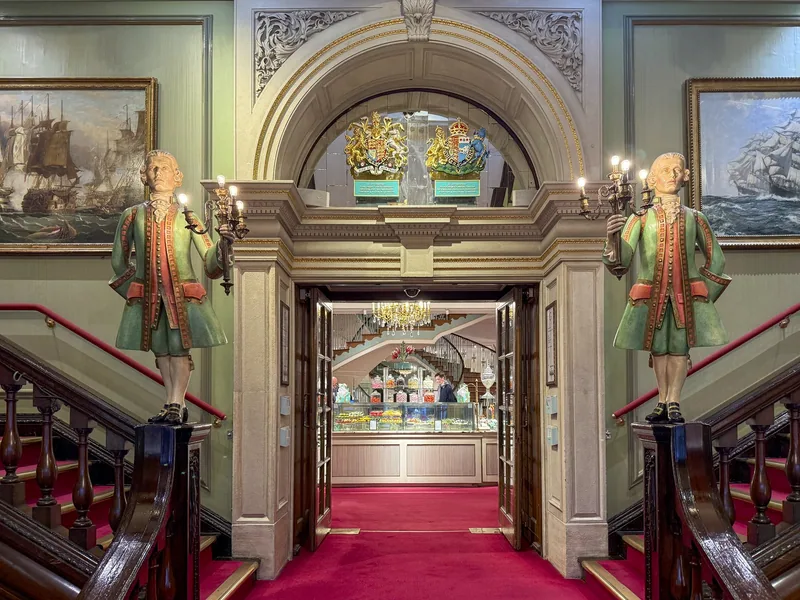
Photo: Hayden Soloviev · CC BY 4.0 · Wikimedia Commons · resized
Floor by floor, so you do not wander
The building is tall and narrow and the layout is not obvious from the door. This is what is where:
| Floor | What is there |
|---|---|
| Lower ground | Food hall, cheese counter, butchery, bakery, wine and spirits, coffee bar, the Wine Bar |
| Ground | The tea counter and bespoke blending service; biscuits, preserves, confectionery, hampers |
| First | The Parlour, for ice cream, cakes and light meals |
| Second | Personal shopping, fragrance consultation, the beauty room |
| Third | Gift wrapping service and the 3'6 Bar |
| Fourth | The Diamond Jubilee Tea Salon, the Drawing Room and the Tasting Room |
Most visitors need only two of those: the ground floor for gifts and the lower ground for food. The staircase is the point of the building, so use it rather than the lift at least once.
How the tea counter works
The tea counter on the ground floor sells loose-leaf tea by weight as well as the tins and caddies. If you are buying for yourself rather than as a present, loose tea in a paper bag is far cheaper and lighter than the same tea in a decorated tin, and you can decant it at home.
There is also a bespoke blending service, where staff work out a blend to suit the water and the milk you use at home. It takes time and costs more than a tin off the shelf, so treat it as an appointment rather than something to squeeze in between two other stops.
If you are new to English tea, ask for the difference between a breakfast blend, an afternoon blend and a single-estate tea before you buy. The staff will explain it without pressure, and the answer changes what you should take home.
The cheapest good present in the building is a small tin. A 25g or 125g tin of tea, a box of biscuits or a jar of preserve carries the packaging and the name at a fraction of the price of a hamper, weighs almost nothing and survives a suitcase. Buy several small ones rather than one large thing.
Hampers: the honest arithmetic
Hampers are what the shop is famous for, and they are the purchase visitors most often regret. The basket itself is heavy, it is an awkward shape, and airline hand luggage rules will not accommodate it. A hamper containing wine or spirits cannot go in the cabin at all.
Three sensible approaches:
- Have it delivered. If the hamper is a present for someone in Britain, the shop will send it. This is what hampers are designed for.
- Buy the contents, not the basket. Choose the tea, the biscuits and the preserves separately and pack them flat in checked luggage. You get the same goods without the wicker.
- Buy a small one if you want the basket itself, and accept that it goes in the hold.
Before you buy food to take abroad, check what your own country allows in. Britain's rules on bringing food the other way are set out in our guide to UK customs allowances, and many countries apply similar restrictions to meat, dairy and honey arriving from Britain. Tea, biscuits, sweets and sealed preserves travel almost everywhere without trouble.
Is afternoon tea upstairs worth it?
The Diamond Jubilee Tea Salon on the fourth floor is one of the best-known places in London to take afternoon tea, and it is priced accordingly. It is also one of the calmest, because it is four floors above the street and you have to have booked.
Our view: it is worth it if afternoon tea is the thing you came to London to do, and you want the version with a pianist, a tea sommelier and endless refills of whatever leaf you choose. It is not worth it if you simply want cake and a pot of tea in a nice room, because the Parlour on the first floor does that for a great deal less, and the ground-floor concession stands cost less again.
Practical points. Book well ahead, especially for weekends and December. Service in the Tea Salon runs from late morning into the early evening, and the other rooms keep shorter hours: 45 Jermyn St. serves in the afternoon, the Parlour from mid-morning, the Wine Bar and the 3'6 Bar from lunchtime. Prices change, so check the current menu on the shop's restaurant pages before you commit. Our guide to afternoon tea in London compares the main options and explains how far ahead each needs booking.
Two free things most visitors walk straight past. The window displays on Piccadilly change with the season and are among the best in London, and the lower-ground food hall has counters for cheese, bread and charcuterie where you can look without buying. Both take five minutes and cost nothing.
What to buy and what to skip
Worth it: tea, both loose and in tins; the biscuit range; preserves, marmalade and honey; chocolates; the mustards and condiments; a single good gift tin for someone at home.
Think twice: the full hampers, for the reasons above; the fresh food from the butchery and the cheese counter, unless you are eating it in London that day; wine and spirits, which are heavy, liable to customs limits and rarely cheaper here than elsewhere.
Skip: the general homeware and the branded accessories, which are pleasant and expensive and no more British than the equivalent in any other good shop. For a wider comparison, see our shortlist of souvenirs worth buying in London and our page on traditional British food, which explains what the preserves and the condiments are actually for.
Prices include 20% VAT and visitors cannot reclaim it when they leave Great Britain. The only exception is goods the shop ships directly to an address outside the UK; our page on tax-free shopping rules for visitors explains what remains of the old scheme.
When to go, and what to combine it with
Weekday mornings are quietest. Saturday afternoons and the whole of December are busiest, and the Christmas displays draw crowds that queue on the pavement. Sunday trading rules compress the day to six hours, with browsing from 11:30 and tills from noon; the same applies on the holidays covered in our guide to what closes on public holidays.
Fortnum's sits in the middle of the most walkable shopping district in London. Behind it is Jermyn Street, the traditional street for men's shirts and shoes, covered in our guide to Savile Row and Jermyn Street. West and north are the jewellers and arcades in our page on Bond Street and Mayfair. A few minutes east is Piccadilly Circus, and the whole area is set out in our guide to Mayfair and St James's.
For somewhere to sit down afterwards without paying for it, Green Park and St James's Park are both a short walk. There is a second Fortnum's in the Royal Exchange in the City of London, which is smaller, quieter and open on weekdays. And if you want the other historic West End shop with a building worth seeing, our page on Liberty covers it.
Frequently asked questions
Is Fortnum & Mason expensive?
The food hall and the restaurants are, but the entry-level gifts are not. A small tin of tea, a box of biscuits or a jar of preserves costs a few pounds and carries the same packaging as the expensive items. Walking around the shop and looking at the windows costs nothing at all.
What is the best thing to buy at Fortnum & Mason?
Tea, in a tin if it is a present and loose in a bag if it is for you. After that, biscuits and preserves. All three are light, sealed, allowed into most countries and unmistakably from the shop. Hampers are the classic purchase but are heavy and awkward to fly home with.
Do you need to book afternoon tea at Fortnum & Mason?
Yes, for the Diamond Jubilee Tea Salon on the fourth floor, and as far ahead as you can for weekends and December. The Parlour on the first floor and the ground-floor counters are easier to get into and cost considerably less for cake and a pot of tea.
What time does Fortnum & Mason open?
The Piccadilly shop opens 10:00 to 20:00 from Monday to Saturday, and 12:00 to 18:00 on Sunday, with browsing allowed from 11:30. The restaurants inside keep their own hours, which are shorter. Check the shop's website before a Sunday or bank holiday visit.
Which Tube station is nearest to Fortnum & Mason?
Green Park, on the Jubilee, Piccadilly and Victoria lines, is about four minutes away, and Piccadilly Circus is a similar distance in the other direction. Both involve stairs; Green Park has step-free access to the street and is the better choice with luggage or a pushchair.
Sources
- Fortnum & Mason - Piccadilly store: address, hours and floor guide (checked September 2026)
- Fortnum & Mason - Our history (checked September 2026)
- Fortnum & Mason - Restaurants and bars (checked September 2026)
- legislation.gov.uk - Sunday Trading Act 1994, Schedule 1 (checked September 2026)
- GOV.UK - Tax-free shopping (checked September 2026)
- GOV.UK - Bringing goods into the UK for personal use (checked September 2026)