
Thameslink is a main line that runs straight through the middle of London in a tunnel, north to south, with five central stations: St Pancras International, Farringdon, City Thameslink, Blackfriars and London Bridge. Off peak there are about 14 southbound trains an hour through that core, roughly one every four minutes, and every one of those five stations is step-free from the street to the platform. Most visitors never use it, which is a mistake if you are crossing London with a suitcase.
It is not the Underground and it is not the Elizabeth line. It is a National Rail service, run by a train company, on which your contactless card or Oyster works exactly as it does on the Tube for journeys inside London. It reaches Gatwick and Luton airports without a change, and it is the only railway that puts Brighton and Cambridge on the same through train. The Underground network, the fares and the map are covered in our guide to the Tube.
Thameslink at a glance
- The central core
- St Pancras International, Farringdon, City Thameslink, Blackfriars, London Bridge
- Step-free
- All five core stations, street to platform
- Frequency through the core
- About 14 southbound trains an hour off peak, more at the peak
- North of London
- St Albans, Luton Airport Parkway, Bedford, Cambridge, Peterborough
- South of London
- Gatwick Airport, Brighton, Sutton, Sevenoaks, Rainham
- Overnight
- Trains run through the small hours to Luton and Gatwick
- Gatwick fare from central London
- £19.20 peak, £10.70 off peak with contactless or Oyster, inside the daily cap
- Luton Airport Parkway from St Pancras
- £16.60 peak, £12.30 off peak, contactless only - Oyster is not valid
- Luton DART shuttle
- £4.90 extra, or included if you buy a ticket to "Luton Airport"
- Tube map
- Shown as a pink and white line with a Thameslink symbol, not as a Tube line
Where the line goes, and why it is drawn as one line
North of St Pancras, Thameslink trains run out through West Hampstead and Mill Hill to St Albans, Luton, Bedford, and on some services all the way to Cambridge and Peterborough. South of London Bridge they fan out to Gatwick Airport and Brighton, to Sutton and Wimbledon on a loop through south London, and east to Sevenoaks and Rainham in Kent.
The clever part is the middle. Between St Pancras and Blackfriars the line dives into a tunnel under Farringdon and the City, which means a single train can start at Bedford and finish at Brighton. For a visitor the consequence is simple: there is one railway in London that crosses the centre instead of stopping at the edge of it, and it is this one. Every other main line terminates in a ring around the middle, as our guide to London's railway terminals explains.
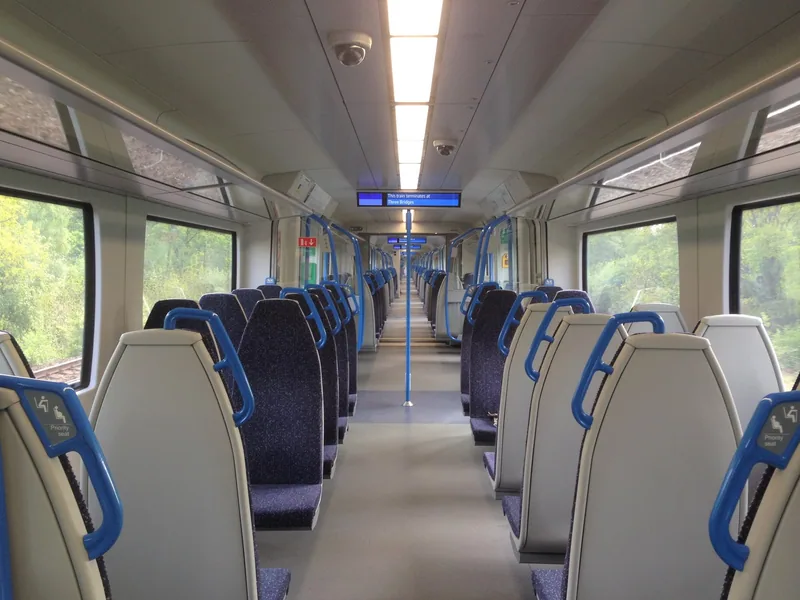
Photo: RM · CC BY-SA 4.0 · Wikimedia Commons · resized
The five central stations, and which one you want
| Station | Where the platforms are | What it is good for |
|---|---|---|
| St Pancras International | Platforms A and B, below the main concourse, through their own barriers | Eurostar, King's Cross, the northern main lines |
| Farringdon | Shared with the Elizabeth line and the Circle, Metropolitan and Hammersmith & City | The best interchange on the line: Elizabeth line to Heathrow or Canary Wharf |
| City Thameslink | Below Ludgate Hill, with entrances at either end | St Paul's Cathedral, Fleet Street, the Old Bailey |
| Blackfriars | On the bridge itself, across the Thames | Tate Modern and the Millennium Bridge, and the view |
| London Bridge | Through platforms above the main concourse | Borough Market, the Shard, the Jubilee and Northern lines |
Farringdon is the one to remember. It is the only station in London where Thameslink meets the Elizabeth line, so a train from Gatwick or Luton can put you on a train to Heathrow, Canary Wharf or Bond Street with one change and no stairs. Blackfriars is the one to look up from: the platforms run the width of the river, with glass sides, and there are entrances on both banks.
St Pancras has two completely separate sets of Thameslink platforms and neither is upstairs. Platforms A and B are on the lower concourse, reached through their own ticket barriers from the shop-lined Arcade, not from the main train deck where the Eurostar and East Midlands platforms are. Our King's Cross and St Pancras station guide has the layout.
How often it runs, measured rather than promised
We counted the southbound departures from St Pancras towards Blackfriars on TfL's journey planner across a full weekday late-morning hour: fourteen of them, at 11:05, 11:08, 11:13, 11:20, 11:23, 11:25, 11:28, 11:35, 11:40, 11:43, 11:50, 11:53, 11:55 and 11:58. That is a train roughly every four minutes off peak, better than the Circle line and about the same as the District.
The peak is denser still, and the line also runs through the night to both airports, roughly hourly in the small hours, which is covered in our guide to late-night airport transport.
The catch is that the trains are not interchangeable. Fourteen trains an hour through the core go to a dozen different places, so the destination on the front matters more here than on any Tube line. Standing on a Blackfriars platform, a southbound train might be going to Sevenoaks, Sutton, Gatwick or Brighton.
When Thameslink beats the Underground
Three situations, and they come up more often than you would think.
- Crossing the middle with luggage. St Pancras to London Bridge is one train, no change, step-free at both ends. The Tube alternative is the Northern line with escalators and a change. If you have a case, there is no contest.
- Anything involving St Paul's or Fleet Street. City Thameslink comes out under Ludgate Hill, about three minutes from the west front of St Paul's Cathedral, and it is one of the least crowded stations in the City.
- Getting to Farringdon from the south. From London Bridge or Blackfriars, Thameslink reaches Farringdon in a few minutes without touching a Tube line, and Farringdon puts you in Clerkenwell and next to the Elizabeth line.
The Tube wins where Thameslink does not go, which is most of the West End. There is no Thameslink station between St Pancras and Blackfriars except Farringdon and City Thameslink, so Oxford Street, Soho and Westminster all need something else.
Fares, caps and the Oyster trap
Inside London, Thameslink is priced like the Tube. Touch in and out with a contactless card or an Oyster card, pay the same zonal fare, and the journey counts towards your daily and weekly caps in the ordinary way; our page on how the contactless caps work sets out the mechanics.
Two places where it is different, and both catch people:
- Gatwick. Pay as you go works to and from the airport. It costs £19.20 at peak times and £10.70 off peak from Victoria, London Bridge or St Pancras, and it is inside the daily cap, unlike the Gatwick Express. It is not valid south of Gatwick, so Brighton needs a proper ticket. Our comparison is in Gatwick Express, Thameslink or Southern?
- Luton. Contactless works to Luton Airport Parkway at £16.60 peak and £12.30 off peak. Oyster does not work at all. And Luton Airport Parkway is not the airport: the DART shuttle to the terminal costs £4.90 on top, or nothing if you buy a rail ticket to "Luton Airport" rather than to "Luton Airport Parkway". Our page on getting to and from Luton does the arithmetic.
Beyond the pay-as-you-go area in either direction, Bedford, St Albans, Cambridge and Peterborough need a National Rail ticket, and buying it in advance is much cheaper than at the machine; our guide to buying UK train tickets explains Advance and Off-Peak fares.
The trains, and what to expect on board
Thameslink uses long walk-through electric trains with air conditioning, wide double doors and space to stand with a case, which is why they work better than a Tube train for an airport run. They are twelve carriages on the busy routes and eight on the quieter ones, and the platform indicator tells you which, so if you want a seat, walk towards the end of the platform the short trains do not reach.
Because it is a main-line railway rather than a metro, the seats face each other in bays as well as lengthways, and there is more room for bags. There is no first class on most services, and no catering; take your coffee with you.
Blackfriars is the only station in the world built across a river, and the platforms are free to stand on with any valid ticket. Come up from a Thameslink train and walk the length of the platform for an uninterrupted view downstream to St Paul's and upstream to the Houses of Parliament. It costs nothing extra and takes four minutes.
Step-free travel, which is the line's real advantage
All five central stations are step-free from the street to the platform: St Pancras and London Bridge are both rated Category A by Network Rail, and TfL's station data records lifts covering the platforms at Farringdon, City Thameslink and Blackfriars. That makes Thameslink the easiest way to cross central London with a wheelchair, a pushchair or heavy bags, and it is markedly better than the Northern line on the same axis.
North of the centre the picture is patchier: West Hampstead Thameslink is step-free, and Kentish Town is not. Staff assistance on National Rail can be booked up to two hours ahead or requested on the day, and our guide to step-free and accessible transport in London explains how.
Frequently asked questions
Is Thameslink part of the Underground?
No. It is a National Rail service run by a train company, shown on the Tube map as a separate line with its own symbol. Contactless and Oyster work on it inside London at the same fares as the Tube, and the journeys count towards the same daily and weekly caps.
Which stations does Thameslink stop at in central London?
Five: St Pancras International, Farringdon, City Thameslink, Blackfriars and London Bridge. All five are step-free from street to platform. Farringdon is the interchange with the Elizabeth line and City Thameslink is the closest station to St Paul's Cathedral.
Does Oyster work on Thameslink to Luton Airport?
No. Contactless cards and phones are valid to Luton Airport Parkway at £16.60 peak and £12.30 off peak, but Oyster is not accepted on that route at all. The DART shuttle from the station to the terminal is a separate £4.90, or it is included if your rail ticket is to "Luton Airport" rather than "Luton Airport Parkway".
How often do Thameslink trains run through central London?
About 14 southbound trains an hour off peak, which we counted from TfL's journey planner across a full weekday late-morning hour, so roughly one every four minutes. There are more at the peak and roughly hourly trains through the small hours to Gatwick and Luton.
Is Thameslink cheaper than the Gatwick Express?
Much cheaper off peak. Thameslink and Southern charge £10.70 off peak and £19.20 at peak times with contactless or Oyster, and those fares count towards the daily cap. The Gatwick Express costs £24.00 at any hour and is excluded from caps and Travelcards, for a journey about ten minutes quicker.
Sources
- National Rail - London Blackfriars station information (checked September 2026)
- Network Rail - St Pancras International, Thameslink platforms and step-free category (checked September 2026)
- Transport for London - Tube and rail fares, including National Rail services in London (checked September 2026)
- London Luton Airport - the Luton DART and rail tickets (checked September 2026)
- Transport for London - Stations, lifts and step-free data (checked September 2026)
- Transport for London - Journey Planner, used to count core-section departures (checked September 2026)