
Two of Britain's best-known indoor sporting events happen in the same north London building three weeks apart. The World Darts Championship fills Alexandra Palace from 11 December 2026 to 3 January 2027, and the Masters, snooker's invitation tournament for the world's top 16 players, follows from 10 to 17 January 2027. They could hardly be less alike: one is a loud fancy-dress party, the other is watched in near silence.
The darts has also changed how it sells tickets. For the 2026/27 championship, for the first time, seats were allocated by ballot rather than sold first come, first served, and that ballot closed in September 2026. If you are reading this hoping to buy for that edition, the honest answer is that your route now is the official resale platform, not the box office.
Below: how each event works, what a session actually involves, what the atmosphere is like from inside, and how to get back into central London from a hill in Haringey at midnight.
The winter season at Alexandra Palace
- World Darts Championship
- 11 December 2026 to 3 January 2027, the Great Hall, doors from 19:00. A record 180,000 tickets
- The Masters snooker
- 10 to 17 January 2027, the West Hall, doors from 11:30. Around 2,000 spectators
- Darts tickets
- Allocated by ballot for the first time in 2026/27. Official resale via See Tickets Fan-to-Fan
- Snooker age rule
- All ages welcome; under-16s must be with an adult aged over 21
- Nearest stations
- Alexandra Palace rail, Zone 3, from Moorgate and King's Cross; Wood Green (Piccadilly line)
- Payment
- Alexandra Palace is cashless throughout
Why both events are here
Alexandra Palace is a Victorian exhibition building on a hill in north London, run by a charity, with a park around it and one of the best free views of the city from its terrace. Inside are two big halls. The Great Hall is the concert-sized room; the West Hall is smaller.
The darts has been played here since 2008 and has outgrown its old room: for 2026/27 the championship moves into the Great Hall for the first time, which is how the organisers reached a record 180,000 tickets across the tournament. The Masters has been at the palace since 2012 and stays in the West Hall, where about 2,000 people watch a single table.
Our guide to London's big arenas covers the building's role as a music venue, and our round-up of free viewpoints in London explains why the walk up is worth it even without a ticket.
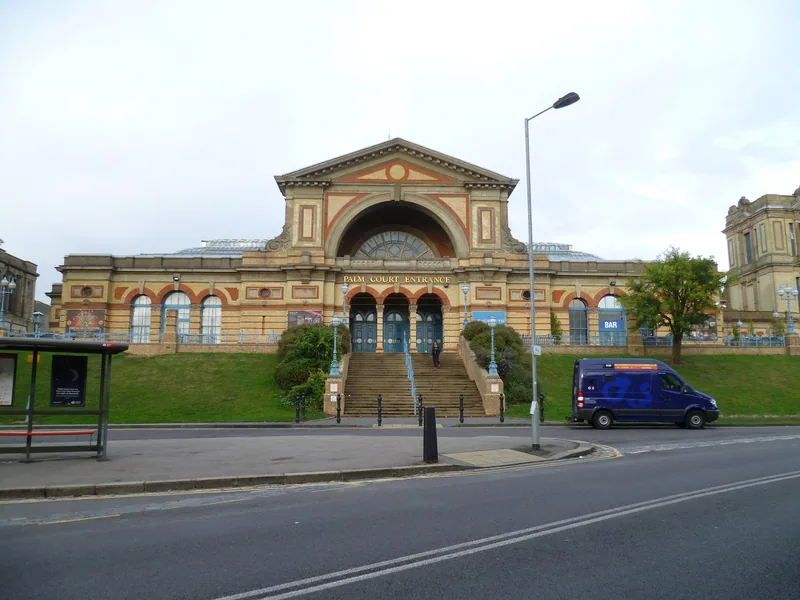
Photo: Philafrenzy · CC BY-SA 4.0 · Wikimedia Commons · resized
How the darts ballot works
This is the change that catches people out. Tickets for the 2026/27 World Darts Championship were allocated by ballot rather than sold on a first-come basis, and the rules were published in full.
- Applicants could apply for up to two sessions, with a maximum of six tickets per session.
- You could rank your preferred sessions, or choose "Any Session" if you were happy to take an alternative.
- There was no advantage in applying early: every valid application in the window had an equal chance, and selection was random once the ballot closed.
- Card details were taken at application. Successful applicants were charged automatically; unsuccessful ones were not.
- Applications could not be edited or cancelled once submitted.
- Accessible tickets were included in the ballot, with one complimentary carer ticket available and supporting documentation requested during the application.
- Successful and unsuccessful applicants were contacted in the week beginning Monday 21 September 2026.
Any tickets later resold must be listed through the official See Tickets Fan-to-Fan platform. That is the one route to a ticket now, and it is also the only safe one: a sold-out event with a fancy-dress crowd in a dark car park is an obvious setting for fraud, as our guide to scams aimed at visitors describes.
Watch the resale platform in the last fortnight, not in November. Returns on a ballot event appear when people's plans collapse, which is mostly in the ten days before the session. Set an alert if the platform offers one, and be ready to buy immediately; single tickets appear far more often than pairs.
What a darts session is actually like
A session is a block of matches, not the whole day. Evening sessions at the championship open their doors at 19:00 and run for roughly three to four hours, with several matches played one after another on a single stage. During the Christmas period there are often afternoon and evening sessions on the same day, sold separately.
The room is set out like a cabaret: long tables, everyone facing the stage, a bar, and a walk-on entrance for each player with music and lights. The crowd sings, chants at the players' entrance music, and goes completely quiet only when a player is throwing for a big finish. Large numbers of people come in costume, often in coordinated groups.
If you are bringing children or you do not drink, be realistic about what you are buying. This is a very loud, very beery night out; the television coverage does not exaggerate it. Fancy dress rules vary by event, and the venue asks you to check the individual event page, so do that before planning anything elaborate.
Prices vary by session, with the final and the last weekend the most expensive. Everything inside is card only, as our guide to paying for things in London explains, and for the bar itself our notes on British bar and pub etiquette are worth reading.
The Masters: the quiet one, and the easier ticket
The Masters is snooker's invitation tournament, first staged in 1975 and one of the three events that make up the sport's Triple Crown alongside the World Championship at the Crucible in Sheffield and the UK Championship. Only the world's top 16 ranked players are invited, so every match is between elite players from the first round onwards.
It runs from 10 to 17 January 2027 in the West Hall, with doors from 11:30. The room holds around 2,000 people and everybody is close to the single table. The atmosphere is the opposite of the darts: silence during a shot, applause for a good one, and an audible gasp for a missed ball.
All ages are welcome and under-16s must be accompanied by an adult aged over 21. The event is televised by BBC Sport, Eurosport, TNT and international broadcasters, which means the timings of individual matches move to suit the schedule. If you have a ticket for a specific session, you know the session, not which players you will see.
The Masters is the better bet for a visitor who wants to see world-class sport. It is easier to get a ticket than the darts, the hall is small enough that every seat is a good seat, and January is a quiet, cheap week in London. Our month guide to January in London covers what else is on at the same time.
Getting to Alexandra Palace
The palace has its own railway station, at the Wood Green entrance to the park, in Zone 3. Great Northern runs trains there directly from Moorgate, calling at Highbury and Islington, and there is also a service to and from King's Cross. This is the fastest route from the City and from the Islington side of town.
The nearest Underground station is Wood Green, on the Piccadilly line, about 20 minutes from Piccadilly Circus. The W3 bus runs from Finsbury Park and Tottenham to the palace itself, which saves you the climb. A day of travel to Zone 3 and back from the centre is capped at £10.50 with contactless or Oyster (2026); our guide to travel zones and caps explains how that works.
The walk from either station is uphill through the park, and in December it is dark, often wet and genuinely steep in places. Wear shoes you can climb in, and use the bus if anyone in your group would struggle.
Driving is possible: the palace has several car parks with a charging system, the first 30 minutes are free and Blue Badge holders park free in the East Court car park. But event nights change the arrangements and the local streets are residential, so check before you set off.
Getting home after a late session
An evening darts session that starts at 19:00 can finish close to 23:00, and several thousand people leave at once down a dark hill. The Great Northern service and the Piccadilly line both run late enough on most nights, but you need to check your specific date and your onward connection rather than the first leg alone.
Two practical notes. The Piccadilly line runs through Friday and Saturday nights as part of the Night Tube, which removes the pressure on those evenings: our guide to weekend night services lists them. On every other night, and especially over the Christmas and New Year period when services are reduced, have a night bus route in mind before you go in; our guide to night buses explains how the N-prefixed routes work.
Staying in north London removes the problem entirely, and our guide to staying in Camden and north London covers the area. Highgate and Crouch End, on the other side of the park, are the nicest places nearby for a meal beforehand.
Christmas and New Year timings
The darts is deliberately scheduled across the holiday, which is both its charm and a planning problem. There is a break around Christmas Day, and the tournament resumes for the closing rounds between Boxing Day and 3 January, with the final in the first days of the new year.
Public transport over that period is heavily reduced, and on 25 and 26 December much of it does not run at all. Our guides to the Christmas season and to December in London cover what runs and what does not, and if your session falls near 31 December, read our guide to the fireworks on the river before assuming you can cross the centre easily.
Other darts and snooker in London
Outside these two tournaments, professional darts visits London arenas on tour nights during the spring, and one-off snooker and darts exhibitions appear at various venues. None of these is on a fixed annual calendar you can plan a trip around; they are announced a few months ahead.
At an amateur level, both games are pub sports, and many London pubs still have a dartboard and league nights. If you simply want to throw darts rather than watch them, that costs nothing beyond a drink, and several bar chains now run scored, electronic versions aimed at groups.
Bags, cash and other practicalities
Alexandra Palace asks visitors to travel without bags where possible and sets limits by event, so check the page for your specific session; for live music in the Great Hall the limit is a single small bag no larger than 30 cm by 20 cm by 10 cm, and anything bigger goes to the bag drop. A cloakroom usually operates for events inside the venue, subject to space, so arrive early if you want to use it.
The venue is cashless: cards and mobile payments only, at the bars, food stalls and box office. For events in the Great Hall it typically opens a festival village of bars and street food outside the hall, which is a better option than queueing inside. Toilets and baby-changing facilities are available, and staff will direct you.
Frequently asked questions
When is the World Darts Championship at Alexandra Palace?
The 2026/27 championship runs from 11 December 2026 to 3 January 2027, in the Great Hall for the first time, with doors opening at 19:00 for evening sessions. A record 180,000 tickets were made available across the tournament.
How do I get tickets for the darts now that the ballot has closed?
Through the official See Tickets Fan-to-Fan resale platform, which is where ticket holders must list any tickets they resell. Returns tend to appear in the last fortnight before a session rather than months ahead, and single tickets come up far more often than pairs.
When is the Masters snooker and is it easier to get into?
The Masters runs from 10 to 17 January 2027 in the West Hall at Alexandra Palace, with doors from 11:30. It is generally easier to get a ticket than the darts, and the hall holds only around 2,000 people, so every seat is close to the table.
Can I take children to the darts?
Age rules are set per event, so check the specific listing. Be aware that an evening darts session is extremely loud, heavily focused on drinking and goes on for three to four hours. The Masters snooker is the calmer option: all ages are welcome, with under-16s accompanied by an adult over 21.
How do I get from central London to Alexandra Palace?
Great Northern trains run direct to Alexandra Palace station from Moorgate, via Highbury and Islington, and from King's Cross; the station is in Zone 3. The Piccadilly line reaches Wood Green in about 20 minutes from Piccadilly Circus, and the W3 bus runs up to the palace from Finsbury Park and Tottenham.
Sources
- Alexandra Palace - Paddy Power World Darts Championship 2026/2027 and ballot rules (checked September 2026)
- Alexandra Palace - Johnstone's Paint Masters Snooker 2027 (checked September 2026)
- Alexandra Palace - Getting here and parking (checked September 2026)
- Alexandra Palace - FAQs (bags, cloakroom, cashless, car parks) (checked September 2026)
- Transport for London - Daily and weekly fare caps (checked September 2026)