
Twickenham, in south-west London, is England's national rugby stadium and one of the largest in the world, with roughly 82,000 seats. It is now formally called Allianz Stadium, although almost nobody in Britain says that. England play there in the Six Nations each February and March and in the autumn international window in November, and those matches sell out months in advance.
This page covers the two things visitors most need: how the fixture calendar works, so you know whether there is a match during your trip, and what your realistic options are when the stadium is officially sold out. It also covers the part people underestimate, which is the journey: Twickenham is a 23-minute train ride from Waterloo and then a 17-minute walk, shared with 80,000 other people.
Twickenham in brief
- Official name
- Allianz Stadium, Twickenham. Capacity around 82,000
- Nearest station
- Twickenham, Zone 5, South Western Railway from London Waterloo
- Journey time
- About 22 to 23 minutes from Waterloo, direct, plus about a 17-minute walk
- Daily travel cap
- £15.30 for Zones 1 to 5 with contactless or Oyster (2026)
- Main England seasons
- Six Nations, February and March; autumn internationals, November
- 2027 Six Nations at Twickenham
- England v France, Sunday 14 February; England v Italy, Saturday 20 February; England v Scotland, Saturday 13 March
The rugby calendar, and when a match is actually on
England's home fixtures fall into two blocks. The Six Nations, against Ireland, Scotland, Wales, France and Italy, runs across February and March, and England play two or three of their five matches at home. The autumn window in November brings visiting teams from the southern hemisphere and Japan.
For the 2027 Six Nations, the official fixture list gives England three home dates at Twickenham: France on Sunday 14 February with a 16:10 kick-off, Italy on Saturday 20 February at 17:40, and Scotland on Saturday 13 March at 17:40. England's two away matches that season are in Dublin on Friday 5 February and in Cardiff on Saturday 6 March.
Outside those blocks, the stadium hosts club finals, women's internationals and occasional concerts, and those are far easier to get into. If your trip does not coincide with an England match, a club final is a much better use of a Saturday than staring at a sold-out page.
A Sunday kick-off changes your whole evening. The 2027 France match starts at 16:10 on a Sunday, which means the crowd leaves in the dark at around 18:15 and Sunday evening train frequencies are lower than on a Saturday. If you are travelling on from London that night, build in an extra hour.
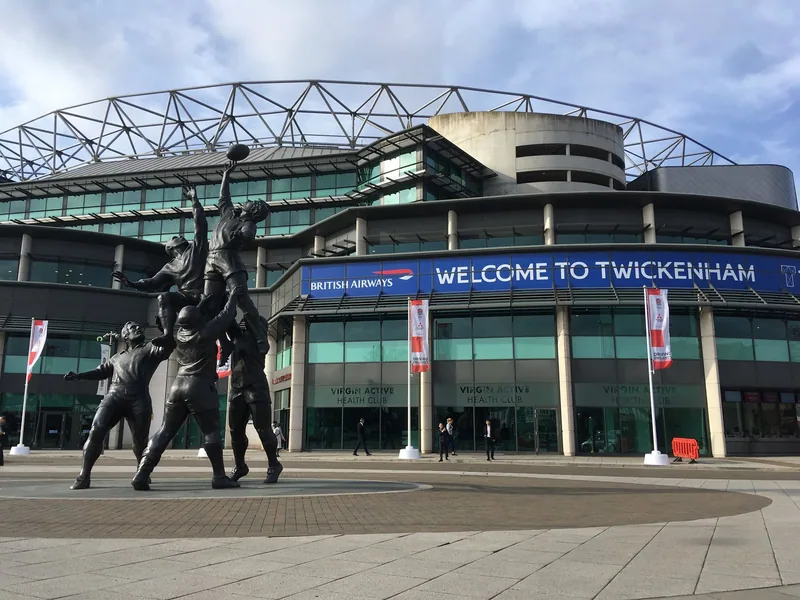
Photo: Christophe95 · CC BY-SA 4.0 · Wikimedia Commons · resized
How tickets are actually distributed
England internationals are not sold like concert tickets. The large majority go to rugby clubs, which receive allocations and distribute them to their own members, and to debenture holders, hospitality packages and travel operators. What reaches the general public is a small remainder, usually through a registration or ballot process run by the governing body.
That structure explains something visitors find baffling: a match can be "sold out" the day general sale opens, while the stands are visibly full of people wearing club ties. It is not a scam. It is how the sport funds its grassroots.
The practical consequence is that you should register an account with the official ticketing operation as early as you can, and watch for the public windows rather than waiting for a general on-sale. Because the exact mechanism changes from season to season, check the current rules on England Rugby and on the stadium's own site rather than relying on any guide, including this one.
Getting in when the match is sold out
There are four legitimate routes, in rough order of how likely they are to work.
- Official resale. Most major stadiums now run an authorised exchange where ticket holders who cannot attend list their seats at face value. Tickets bought this way are reissued properly and will scan at the gate. This is the only resale route worth trusting.
- Hospitality. Expensive, but genuinely available when ordinary seats are not. You are buying a package with food and a seat, typically several times the face value. Book only through the stadium's own hospitality arm or a named official partner.
- Official travel and tour operators. Some overseas supporters' tours hold allocations. This works if you are planning months ahead as part of a longer trip.
- A different match. Women's internationals, club matches and finals at the same stadium give you the same building, the same walk and a fraction of the price.
Street sellers outside Twickenham station are the fastest way to lose £200. Tickets for England internationals are personalised and can be cancelled if resold unofficially, so a ticket bought from a stranger may be void even if it is real. Our guide to scams aimed at visitors explains the usual approaches, which on match day include people selling outside the station and at the end of Whitton Road.
Getting there: the train, the walk and the crowd
Twickenham station is in Zone 5 and is served by South Western Railway from London Waterloo. The direct journey takes about 22 to 23 minutes, and contactless and Oyster work, with a Zones 1 to 5 daily cap of £15.30 (2026). Our guide to London's travel zones explains the cap, and our guide to the main railway terminals covers Waterloo itself.
From the station to the stadium is about a 17-minute walk up Whitton Road. On match day it is a single slow-moving river of people, and it takes considerably longer than the map suggests. Trains from Waterloo are packed for two hours before kick-off and the platforms at Twickenham are controlled by staff afterwards.
Three ways to make it easier. Travel early and spend the spare hour in Twickenham or Richmond rather than in the queue. Consider the neighbouring stations, since Richmond and Whitton are both within reach and far less congested after the final whistle. And if you are travelling as a group with a fixed onward train, do not plan to catch anything from Waterloo within 90 minutes of full time.
Driving is a poor idea. Residential streets around the ground operate match-day parking restrictions, and the local roads seize up. If you are arriving from outside London, our guide to buying UK train tickets covers advance fares into Waterloo.
What match day is actually like
Twickenham has a particular atmosphere that surprises people who expect football. The crowd is overwhelmingly good-natured, opposing supporters sit together without segregation, and there is no fencing between home and away fans. Beer is drunk in large quantities before and during the match, and the noise is loudest for the anthems and for a penalty kick, when the whole stadium goes silent and then roars.
The pre-match ritual matters as much as the game. The car parks around the ground fill with supporters who have brought tables, food and drink, and the pubs of Twickenham and Richmond are full from late morning. If you have never been, arriving three hours early is not wasted time; it is the event. Our guide to how a British pub works is worth reading first, and the rules on drinking in public explain what you can and cannot do on the street and on public transport.
Inside, expect airport-style bag searches, a bag size limit, and a cashless stadium. Check the current bag policy on the stadium's own site before you travel, since it changes between seasons.
Making a day of it in south-west London
One of Twickenham's advantages over the big east London venues is where it is. Richmond is one stop away and has riverside pubs, a good high street and the entrance to Richmond Park, where wild deer roam. Hampton Court Palace is further along the same railway line.
If there is no match on, the stadium runs tours and has a rugby museum, which our guide to London's stadium tours sets it beside the football equivalents. It is also the finishing stretch of an afternoon that can start on the river: the annual Boat Race passes through the same corner of London.
Rugby elsewhere in London
Twickenham is not the only rugby in the capital. Several professional clubs play in and around London through the winter, in far smaller grounds where you can usually walk up on the day and pay at the gate or buy online that morning. Tickets cost a fraction of an international, you are close to the pitch, and the atmosphere is friendly.
For a visitor who wants to see live rugby without the international circus, a club match is by far the easier answer. Check the club's own website for fixtures and prices, as kick-off times move for television.
If rugby is not available during your trip, London's other spectator sports are: our guides to Premier League football, cricket at Lord's and The Oval and NFL games in London cover the seasons and how tickets work in each.
Weather, timing and what to wear
February and March in London are cold and often wet, with average daytime highs around 9 to 12°C, and a late-afternoon kick-off means the temperature falls during the match. The stands are largely covered but the wind is not stopped by a roof.
Dress as you would for standing outside for four hours: layers, a waterproof, and shoes you can walk 17 minutes in each way. There is no dress code, and a replica shirt over a coat is the local uniform. Our month guides to February and March in London cover what else is happening and what the weather usually does.
Frequently asked questions
When do England play at Twickenham?
In the Six Nations across February and March, and in the autumn international window in November. For the 2027 Six Nations, England's home matches at Twickenham are against France on Sunday 14 February, Italy on Saturday 20 February and Scotland on Saturday 13 March.
How do I get tickets for a sold-out England match?
Use the official resale exchange, where ticket holders list seats at face value and tickets are properly reissued. Hospitality packages and official travel operators are the other legitimate routes. Do not buy from street sellers: international tickets are personalised and can be cancelled if resold unofficially.
How do I get to Twickenham stadium from central London?
Take a South Western Railway train from London Waterloo to Twickenham, about 22 to 23 minutes direct, then walk roughly 17 minutes to the ground. Twickenham is in Zone 5, so contactless and Oyster work and a day of travel caps at £15.30 for Zones 1 to 5.
Is Twickenham the same as Allianz Stadium?
Yes. The stadium took the name Allianz Stadium under a sponsorship deal, but the place is Twickenham and almost everyone still calls it that, including station signs and match-day announcements. You will see both names used on tickets and official pages.
Can I see rugby in London without going to an international?
Yes. Several professional clubs play in and around London through the winter at much smaller grounds, where tickets are inexpensive and usually available close to the date. Women's internationals and club finals are also staged at Twickenham itself and are far easier to get into.
Sources
- Six Nations Rugby - Guinness Men's Six Nations 2027 fixtures (checked September 2026)
- Transport for London - Journey Planner, Waterloo to Twickenham (sample journey, Tuesday 22 September 2026) (checked September 2026)
- Transport for London - Twickenham station, fare zone (checked September 2026)
- Transport for London - Daily and weekly fare caps (checked September 2026)
- Met Office - Long-term averages, Heathrow station 1991-2020 (checked September 2026)