
The Royal Opera House on Bow Street is the home of The Royal Opera and The Royal Ballet, and it is far cheaper to visit than most people assume: tickets for main-stage productions start at £9 (September 2026), and anyone aged 16 to 25 can buy £30 seats through a free scheme. The catch is that the cheapest seats are high up, some of them see only part of the stage, and the old day-seat queue no longer exists.
The company that performs here is now called Royal Ballet and Opera, and its website is rbo.org.uk. The building keeps its old name, so you will see both used. The season runs from September to July, with more than 500 performances a year across the Main Stage, the smaller Linbury Theatre, the Clore Studio and the Paul Hamlyn Hall.
Our guide to the city's main music venues places the opera house in context; this page is about getting into it. Below: what the ticket tiers really mean, how restricted view works, what happens if a show is sold out, and what the building offers on a day when you are not seeing a performance at all. If ballet and opera are not your thing, our guide to concert halls and church recitals covers the rest.
Royal Opera House in brief
- Address
- Bow Street, London WC2E 9DD
- Nearest station
- Covent Garden. Step-free: Leicester Square, Holborn or Tottenham Court Road
- Building open
- Daily from 12 noon; closes after the evening show, or 11pm Monday to Saturday and 9pm Sunday
- Cheapest main-stage seat
- From £9 (September 2026); The Nutcracker 2026/27 ran £10 to £238
- Age limit
- Children aged five and over only, each with their own ticket
- Payment
- Cashless throughout. Tickets are digital only
What the cheap seats actually get you
Prices for a single production can run from single figures to well over £200. The lowest prices sit at the top of the house, in the Amphitheatre and the Balcony, and the highest are in the Stalls and the Grand Tier. A seat at £9 or £10 is a long way from the stage, and you will want the opera glasses sold in the shop or a pair of your own.
What you do not lose is the sound. The auditorium is steep rather than wide, so the top level is nearer the stage than the equivalent seat in most West End theatres, and orchestral detail carries well. For a first opera, the money is often better spent on a cheap seat plus a programme than on a mid-price seat alone.
Prices also move. Royal Ballet and Opera adjusts them by performance according to demand, so the same seat can cost more for a popular Saturday than for a Tuesday in January. The house says increases are capped and incremental, and that the lowest-priced tickets and the tickets reserved for its Access and Young schemes are not subject to those rises. In practice that means booking early helps for a famous title, and midweek is nearly always cheaper.
Restricted view: what you can and cannot see
A restricted-view seat is one where part of the stage is blocked, usually by the curve of the horseshoe, a pillar or the overhang of the tier above. The house labels these seats when you book and publishes seat maps with restricted-view information, so nothing about it should be a surprise at the door.
The practical effect varies. From a side seat in the Stalls Circle you may lose a corner of the stage but sit very close to the singers. From the front rows of the Amphitheatre the view is wide but the very top of the set can be cut off, which matters more in a ballet with flying scenery than in a concert-style opera. If you are buying a restricted seat for a ballet, read the note on the seat carefully: dancers use the whole floor, and losing the downstage corner costs you more than it does in an opera.
Use "Help me find a seat" rather than the seat map. The booking system's seat-finder shows the best available seats in a price band, including the ones reserved for discount schemes, which are scattered around the auditorium rather than grouped in one block. Picking seats manually on the map often hides them.
Under 26? The single best deal in London opera
Young RBO is free to join. Create an account, add your date of birth, and if you are 16 to 25 you are enrolled automatically. It gives you £30 tickets for most main-stage productions, priority booking a day before general sale, free access to the company's streaming service, 10% off in the shop and 20% off selected tours.
Two limits matter. Young RBO tickets are for Monday to Thursday performances only, with exclusions, and you may book one guest ticket per performance but the guest must also be 16 to 25. Bring photo identification on the night; you can be asked to prove your age.
Twice a season the scheme takes over the whole auditorium for a Young RBO Night, with tickets from £1 to £30, discounts in the bars and pre-show tours. In the 2026/27 season those nights are the ballet Manon on 25 November 2026 and the opera Aida on 1 June 2027.
Two students can see a main-stage ballet for £60. A Young RBO member and a friend of the same age pay £30 each on a Monday to Thursday performance, which is less than many West End musicals charge for the back of the upper circle. Our round-up of discounted theatre seats covers the equivalent tricks in the commercial theatres.
Sold out? There are no day seats any more
This is the point where older guidebooks will send you wrong. The house used to hold back an allocation to sell in person from 10am on the day, and later replaced that with a weekly online release. Neither exists now. There is no queue outside the stage door and no rush ticket.
What happens instead is simple. When a performance shows as sold out, returned tickets go back on sale online the moment they are released, and most returns are processed more than 24 hours before the performance. There is no waiting list. The house specifically advises against turning up at the theatre on the day hoping for a seat.
So the method is to check the website often in the last fortnight, especially in the evenings after the previous day's performance, and to be ready to book immediately. Members and Patrons get priority booking before general sale, which is why the best dates for a headline production can look gone before they have ever been publicly available.
Cinema relays, streaming and the free screenings that stopped
Several productions each season are broadcast live to cinemas in the UK and around the world, and the company runs a paid streaming service with over 100 recorded productions. If you cannot get a seat for a specific title, a cinema relay is usually the nearest substitute, and the camera work gives you faces you would never see from the Amphitheatre.
Be careful with older advice about free outdoor screenings. The big-screen relays into public squares, including Trafalgar Square, ran under a sponsorship that ended, and the page listing them on the company's own website still shows the 2019 programme. Treat any promise of a free live relay as out of date until you see it on the current what's-on listings.
What it costs a family, and what the rules are
Children aged five and over are welcome at performances. Each child needs their own ticket and must sit beside an accompanying adult; under-fives are not admitted to the theatres at all, and that includes babies in arms. The Nutcracker, the classic family title, ran from 3 December 2026 to 13 January 2027 with prices from £10 to £238, a running time of about two hours 20 minutes including one 30-minute interval, and a warning for flashing lights and dry ice.
For younger children there are Family Sundays, aimed at ages three to ten, with two identical sessions of about two and a half hours (10:00 to 12:30 and 13:30 to 16:00) of workshops, short performances and craft. Tickets are released on general booking day and go quickly. Our guide to London with children has more on planning a day around one fixed booking.
Practical rules that catch people out
- Tickets are digital only. A link is emailed two days before, and each ticket has its own QR code, so you can forward one to a friend. Bring a charged phone.
- The auditorium opens 30 minutes before curtain up. If you arrive late you may have to wait in the foyer until a suitable break, which in some operas is up to 90 minutes away.
- Large bags are not allowed in the theatres or on tours. The cloakroom is free for ticket holders, and opens two hours before evening performances and 90 minutes before matinees. Pushchairs, e-scooters and e-unicycles cannot be stored at all.
- Every bag is searched at the door, and the house asks visitors to allow extra time, so do not arrive at 19:28 for a 19:30 curtain.
- No cash. Bars, shop and box office all take cards only.
- Only bottled water and ice creams may be taken into the auditorium, and glass bottles and open cups are not allowed anywhere inside the theatres.
There is no dress code, whatever you have read
The house states plainly that there is no formal dress code and asks only that you are fully clothed, with feet and torso covered, and that clothing carries nothing offensive. Some people in the Stalls do dress up, particularly on first nights, and nobody will look twice at a jacket. Equally, nobody will look twice at jeans in the Amphitheatre.
Opera is sung in whatever language it was written in, and English surtitles appear on a screen above the stage in both auditoriums, so you can follow the words without knowing Italian or German.
Visiting without a ticket: tours, lunchtime recitals and the roof
The building is open to the public daily from 12 noon, and you do not need a performance ticket to go in. Guided tours last 60 to 75 minutes and meet on the ground floor in front of the cloakroom; they cover backstage areas, and because this is a working theatre the route changes from day to day. Tour ticket holders get 10% off in the shop and café on the day, and an emailed discount on a streaming subscription afterwards. Under-fives may not join a tour at all, and anyone aged 14 or below needs an adult with them.
Recitals at Lunch are the cheapest way to hear the house musicians: Monday concerts at 1pm in the historic Crush Room, lasting 45 to 50 minutes, at £16 (September 2026). The autumn 2026 series ran from 21 September to 21 December.
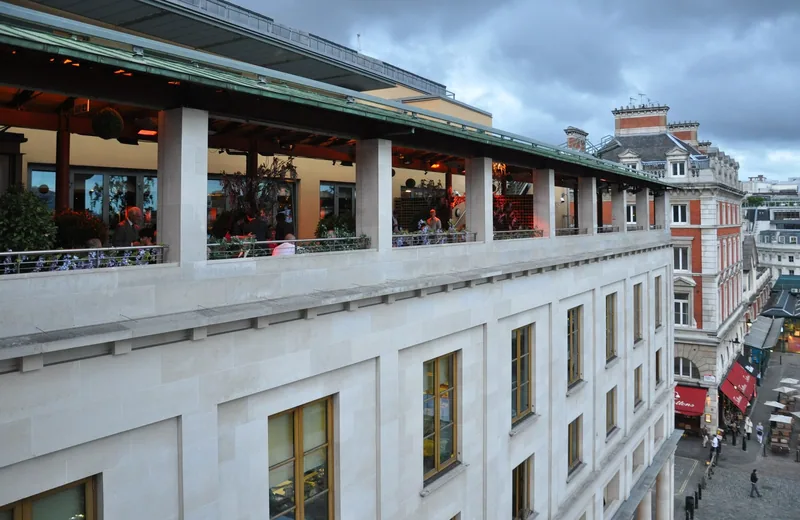
On the fifth floor, the Cicoria restaurant and its rooftop bar look out over the Covent Garden Piazza and are open to anyone, with no theatre ticket needed and walk-ins welcome. The view is one of the best in this part of town for nothing, and it makes a sensible stop while walking around Covent Garden or between the shops around the Piazza and Seven Dials.
Getting there, and getting home afterwards
Covent Garden station is the closest but it is small, has no escalators to the surface and is frequently exit-only after shows finish. Leicester Square is a five-minute walk and much easier; Holborn and Tottenham Court Road are also close and have step-free access. Bus stops at Aldwych, Drury Lane and Leicester Square Station serve the theatre, and there is no parking on site.
Evening performances of full-length operas can finish close to 22:30, which is fine for the last Tube on most lines, but check your route: see our guide to first and last trains, and at weekends several central lines keep running all night, as our guide to weekend night services explains. If you want to eat afterwards, the streets between here and Theatreland are full of options, and our guide to eating late in London lists kitchens still serving after 23:00.
Staying nearby saves the journey altogether. Our guide to beds in Soho and Covent Garden explains what the area costs and how loud it is at night. And for the other end of the price scale, our guide to live music that costs nothing includes recitals a few minutes' walk away.
Frequently asked questions
How much are the cheapest Royal Opera House tickets?
Main-stage productions start from £9 (September 2026), and The Nutcracker for the 2026/27 season ranged from £10 to £238. The cheapest seats are in the Amphitheatre and Balcony at the top of the auditorium. Prices vary by performance according to demand, so check the official website for your date.
Can I still queue for day seats at the Royal Opera House?
No. The day-seat queue and the later weekly rush release have both ended. Returned tickets go back on sale online as soon as they are released, and the house says most returns appear more than 24 hours before the performance. There is no waiting list and it advises against turning up on the day.
Is there a dress code at the Royal Opera House?
There is no formal dress code. The house asks only that you are fully clothed with feet and torso covered and that your clothing shows nothing offensive. Some people dress up for first nights and for seats in the Stalls, but ordinary clothes are entirely normal, especially upstairs.
Can children go to the Royal Opera House?
Children aged five and over can attend performances. Each child needs their own ticket and must sit next to an accompanying adult. Under-fives are not admitted to the theatres, including babies, but they are welcome at Family Sundays, which are designed for ages three to ten.
What does a restricted view seat mean here?
It means part of the stage is hidden, usually by the curve of the auditorium, a pillar or the tier above. The seats are labelled when you book, and the website publishes seat maps showing what is affected. Restricted seats matter more for ballet, where dancers use the whole stage floor, than for opera.
Sources
- Royal Ballet and Opera - Visitor information (checked September 2026)
- Royal Ballet and Opera - Your first visit to the ballet or opera (checked September 2026)
- Royal Ballet and Opera - Young RBO (checked September 2026)
- Royal Ballet and Opera - Help Centre (tickets, dress code, sold-out performances) (checked September 2026)
- Royal Ballet and Opera - The Nutcracker 2026/27 (checked September 2026)
- Royal Ballet and Opera - Recitals at Lunch (checked September 2026)
- Royal Ballet and Opera - Tours (checked September 2026)
- Royal Ballet and Opera - Family Sundays (checked September 2026)