
You can hear live music in London every day of the year without buying a ticket: licensed musicians on Underground platforms, public pianos in the railway stations, lunchtime recitals in City churches, choral services in the cathedrals, free pub gigs in back rooms, and whole festivals in the street. Not all of it is good, but a surprising amount of it is played by professionals.
This page is about music that genuinely costs nothing, or costs whatever you decide to put in a hat. Our guide to ticketed venues across the city covers the paid side, and the classical and jazz sections below link on to fuller guides where the subject deserves it.
Two honest warnings before the list. Free music moves. A weekly pub session depends on one landlord and one bandleader, and a station piano can be removed for building works, so check on the week rather than trusting any published list, including this one. And "free" often means a collection plate, a tip jar or a contactless tip point. If you enjoyed it, pay something.
Free music, by time of day
- Morning
- Station pianos; buskers at the busier Tube interchanges
- Lunchtime, weekdays
- City church recitals, roughly 13:00 to 14:00; conservatoire concerts
- Late afternoon
- Choral evensong at the cathedrals and big parish churches
- Evening
- Pub back rooms, open-mic nights, free album launches in small venues
- Summer weekends
- Park bandstands, street festivals, carnival sound systems
- Usual cost
- Nothing, or a few pounds in a collection
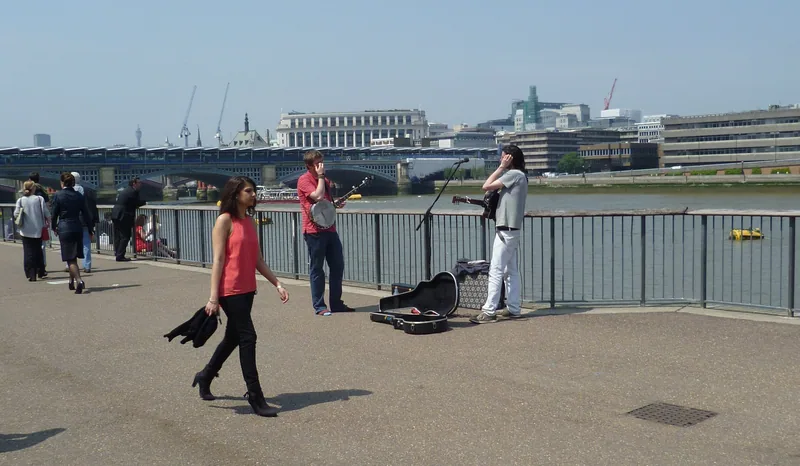
Buskers on the Underground are licensed, and they are good
The London Underground Busking Scheme is not a free-for-all. Performers audition in front of a panel of music industry judges, and those who pass are licensed to play on marked pitches inside stations. Transport for London says passengers hear more than 100,000 hours of live music a year this way, in front of a daily audience of around 3.5 million people.
The branded pitch is how you tell the difference. If a musician is standing on one of the official spots, they have been auditioned and licensed; anyone playing elsewhere in the station has not. TfL runs the scheme with Busk in London, the street performance programme sponsored by the Mayor, and expects to hold its next round of auditions in late 2026.
Tipping has largely gone contactless: many buskers now have a card reader propped in the instrument case, which solves the problem that nobody carries coins any more. The best pitches, in terms of sound and of performers, are the large interchange halls where a single musician can fill the space without competing with train noise. Our guide to using the Underground explains the layout of the bigger stations.
Station pianos: anyone can sit down and play
Several London railway stations keep public pianos that any passer-by may play. The best known are at St Pancras International, where the instruments have become a small institution and have been used for impromptu performances by well-known musicians passing through the station.
What you actually get depends entirely on who walks up. On a good morning it is a conservatoire student killing an hour before a train; on a bad one it is a child hammering the same four notes. Either way it is free, it is indoors, and St Pancras is worth seeing anyway, as our guide to King's Cross and St Pancras explains.
If you want to play yourself, the etiquette is simple: wait for the person before you to finish, keep it to a few minutes if others are waiting, and do not move the piano or lean anything on it.
The weekday lunchtime recital circuit
Between about 13:00 and 14:00 on weekdays, churches in the City, and some in the West End, put on recitals lasting 45 minutes to an hour. Entry is generally free with a retiring collection, and the performers are often young professionals. St Bride's on Fleet Street runs its own lunchtime series; St Mary-le-Bow on Cheapside has a regular Wednesday recital at 13:05, alongside its other sung services.
The conservatoires add to this. The Royal College of Music programmes lunchtime concerts both in its own halls and in West End churches, including St James's Piccadilly and St Pancras Church, and prices many events on a pay-what-you-can basis between £2 and £15 with a free option. Booking is online and capped at ten tickets per transaction.
Our guide to classical music in London goes into the halls, the seating and the booking mechanics in detail. For a visitor with a free hour in the middle of a sightseeing day, the church circuit is the single best value in the city.
A lunchtime recital fits into a museum day without costing an hour. Most City church recitals start at about 13:00 and are over by 14:00, which is roughly how long a queue for a paid attraction takes. Two people can sit down, hear a professional pianist and put £10 in the collection between them.
Choral services: free, and among the best singing in Britain
Sung evensong takes place in the late afternoon at the cathedrals and at several parish churches, and no ticket is needed. St Paul's Cathedral states that all of its regular services are free of charge, although some special services and concerts there are ticketed, so check its calendar for the date you want.
You are attending worship rather than a concert. Arrive a few minutes before the start, sit where you are directed, stay to the end, and do not applaud. Choirs also take holidays, so in some weeks a visiting choir sings, or the service is said rather than sung. The cathedral's own service schedule tells you which.
Pub gigs and back rooms
The free gig in a pub is the backbone of London's small-venue scene: a band in the corner or in an upstairs room, no ticket, a bucket at the end, and the pub taking its money over the bar. Folk, blues, indie, jazz and open-mic nights all work this way, usually on a fixed night of the week.
Two practical points. Buy drinks, because the bar takings are what keeps the room open, and put something in the bucket. And remember that a free gig is rarely advertised outside the pub's own channels, so look at the venue's social media in the week you are visiting rather than searching for listings. Our guide to London's older pubs covers the buildings; the music is usually in the newer ones.
For jazz specifically, the Sunday session in a pub back room is a genuine London institution, and our guide to jazz in London explains how those afternoons work and what to pay.
Street festivals and outdoor music that costs nothing
The biggest free music event in the city is Notting Hill Carnival, held over the August bank holiday weekend. The main parade days are free to everyone; only the Panorama steel band competition on the Saturday is ticketed. It is loud, extremely crowded and quite unlike anything else in London.
Through the year, Trafalgar Square hosts free public celebrations with stages and live performance, including the Lunar New Year festival in the square and Chinatown. Pride in London puts free stages across the West End on parade day, and Totally Thames fills September with riverside events, some of them musical and most of them free.
In summer, park bandstands run weekend programmes, and outdoor areas around the arts centres put on free performance in good weather. None of these has a fixed annual timetable you can rely on months ahead, so check the organiser's page for your dates.
Free outdoor events still need a plan for getting out. Carnival and the big square events close roads and sometimes Tube station entrances, and crowds move slowly for an hour after the music stops. Agree a meeting point with your group that is several streets away from the event, because mobile networks struggle in dense crowds.
Free music inside paid buildings
A number of London's arts centres, museums and galleries programme live music in their public foyers and courtyards, where you can listen without a ticket to anything. The pattern is usually early evening on weekdays, aimed at people finishing work, with a bar open nearby.
Programmes change term by term rather than yearly, so the only reliable approach is to look at the venue's what's-on listing and filter for free events, which most of them allow. It is worth doing on a rainy afternoon: you get an hour of music, a warm building and somewhere to sit. Our guide to Open House Festival covers the September weekend when many normally closed buildings do something similar with their architecture.
What free music is not good for
It is worth being clear about the limits. Free music in London will not get you a full symphony orchestra in a concert hall, a named international artist, or a guaranteed seat. Lunchtime recitals are short. Buskers play for fifteen minutes and move on. Pub gigs start late and are loud enough that conversation is impossible.
If you have one evening in London and want a specific experience, pay for it. If you have several days and a limited budget, free music fills the gaps between paid attractions better than almost anything else, and our guides to free things to do and seeing London cheaply show how to build a week around it.
Frequently asked questions
Are buskers on the London Underground allowed?
Licensed ones are. Transport for London runs a busking scheme with auditions judged by music industry panels, and licensed performers play on marked, branded pitches inside stations. TfL says passengers hear more than 100,000 hours of live music a year through the scheme. Musicians playing away from the marked pitches are not part of it.
Can anyone play the pianos at St Pancras station?
Yes. The public pianos at St Pancras International are there for passers-by to play, free of charge. The usual courtesy is to wait for whoever is playing to finish and to keep your turn to a few minutes if other people are waiting.
Where can I hear free classical music in London?
Weekday lunchtime recitals in City churches, which are usually free with a collection, and choral evensong at the cathedrals, which needs no ticket. Conservatoire concerts add a third route: the Royal College of Music prices many events pay-what-you-can from £2 to £15, with a free option.
Is Notting Hill Carnival free?
The parade days over the August bank holiday weekend are free to attend. The Panorama steel band competition on the Saturday is ticketed. Expect very large crowds, road closures and slow travel afterwards, and agree a meeting point away from the route with anyone you are with.
Do I need to tip a busker or a free gig?
You are not obliged to, but the musicians are usually paid only from what the audience gives. Many buskers now carry a card reader, and pub gigs pass a bucket at the end. A couple of pounds each is normal, and buying a drink at a pub gig matters as much as the bucket.
Sources
- Transport for London - Busking on the London Underground (checked September 2026)
- St Pancras International - St Pancras Pianos (checked September 2026)
- Royal College of Music - Ticketing and Box Office (pay what you can) (checked September 2026)
- St Paul's Cathedral - Choral Evensong and services (checked September 2026)
- St Bride's Church, Fleet Street - Music and lunchtime recitals (checked September 2026)
- St Mary-le-Bow - Services and recitals (checked September 2026)
- Notting Hill Carnival - Official site (checked September 2026)