
London film locations fall into four kinds, and the difference decides whether a trip across the city is worth making. Some you can walk into. Some are private homes where people live. Some were never in London at all, because the interior was built at a studio. And some are real, public and completely unremarkable to stand in front of.
Nobody tells you this in a list of locations, which is why so many film pilgrimages end in a quiet residential street with a slightly embarrassed feeling. The buildings that give the best day out are the ones that were filmed as themselves, are open to the public and know exactly why you have come.
This page sorts the famous ones into those four categories and says what each is actually like. London's biggest film subject has a page to itself: where the Harry Potter films were shot in London, and the best walking tours in London covers going with a guide.
The four kinds of film location
- Open to visitors
- You can go inside, often on a tour built around the filming. The Old Royal Naval College is the outstanding example
- Public but ordinary
- A real street, bridge or station you can stand on for nothing, and which looks like a street, a bridge or a station
- Private
- Somebody's front door or a locked communal garden. Look from the pavement and move on
- A set
- Built at Leavesden, Pinewood or Elstree. The only one you can visit is the Warner Bros. Studio Tour
- Best single destination
- Greenwich, where the filming is the attraction rather than a footnote
- Worst mistake
- Crossing London for a doorway in a residential street
Greenwich, where filming is the point
The Old Royal Naval College in Greenwich describes itself as the number one heritage filming location in the United Kingdom, and it has the credits to support the claim. Filming there goes back a century: the first production was a silent feature called Sons of the Sea, shot in 1925, in which the college appeared as itself.
What makes it worth the journey is that the buildings you see on screen are the buildings you walk through, and the site tells you which is which. A short list of what was shot there:
- Bridgerton. The colonnades and Grand Square appear across several seasons, and the wedding of Penelope Featherington and Colin Bridgerton was filmed in the Chapel of St Peter and St Paul.
- The Crown. A portico was added to Queen Anne Courtyard to stand in for the entrance of Buckingham Palace in the first two seasons; the 1982 break-in at the palace was filmed on College Way for season four; and the Annus Horribilis speech was delivered in the Painted Hall in season five.
- Les Misérables. Grand Square became the Paris barricades, complete with a seven-metre replica of the Elephant of the Bastille built from polystyrene and resin.
- Pirates of the Caribbean: On Stranger Tides. Jack Sparrow is questioned by George II in the Upper Hall, and escapes along College Way.
- Four Weddings and a Funeral. The Chapel played the church in the wedding where the trainee priest makes his famous mistake.
- Thor: The Dark World, The Dark Knight Rises, Cruella, Sherlock Holmes, The Duchess, The Golden Compass, Napoleon and Jurassic World: Rebirth all used the site, the last of them for its opening shot.
Opening hours are 10:00 to 17:00 every day for the Painted Hall, the Chapel and the Visitor Centre, with nobody admitted after 16:30; the grounds themselves stay open between 08:00 and 23:00. The site runs two film tours: "Wigs, Weddings, Powder and Palaces" on Saturdays, covering period drama and royalty, and "Spies, Sleuths and Superheroes" on Sundays. Both go at 11:30 and 13:30, last an hour and a quarter, take a maximum of twenty-five people, start at the Visitor Centre and include entry to the Painted Hall and the Chapel.
Greenwich also gives you the rest of a day: our guide to Greenwich covers the market, the park and the Royal Observatory and Cutty Sark, although note that the Observatory closes for rebuilding after 2 November 2026.
One detail at the Old Royal Naval College is the whole lesson of film locations. When Indiscreet was made in 1958, the story was set at the college itself, but the Painted Hall was under restoration. So a full-scale replica of it was built at Elstree Studios. The real building could not play itself, and what you see on screen is a set.
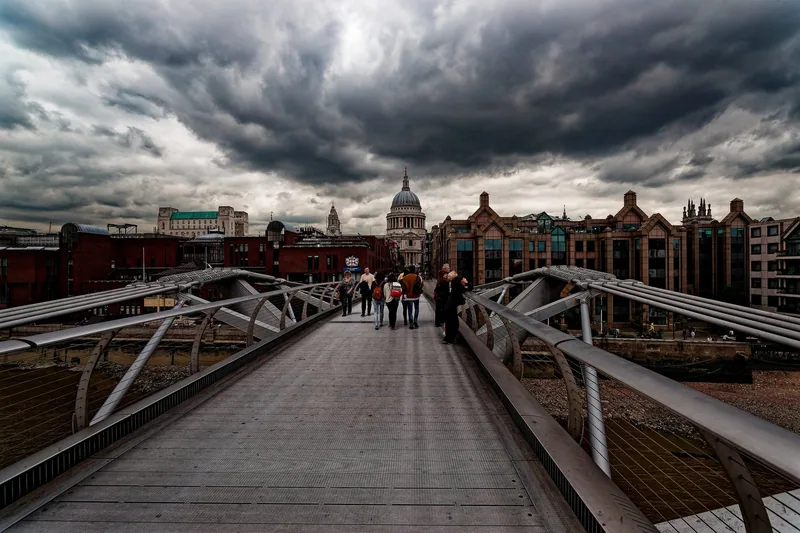
Photo: Txllxt TxllxT · CC BY-SA 4.0 · Wikimedia Commons · resized
Harry Potter: which parts are London and which are Hertfordshire
Almost everything that looks like a building in the Harry Potter films is a set at Warner Bros. Studios in Leavesden, which is in Hertfordshire rather than London. Hogwarts does not exist. Diagon Alley does not exist. The Great Hall is a set.
What does exist in London is a handful of exteriors and entrances, and they are genuinely worth an hour: the trolley at King's Cross, the covered Victorian arcade of Leadenhall Market, which stood in for the way into Diagon Alley and whose public areas are open around the clock, and the Millennium Bridge. Our dedicated guide covers each of them and how to string them together.
The sets themselves can be visited, at the Warner Bros. Studio Tour. Every ticket must be booked in advance and none are sold at the door. The 2026 adult price is £58.50, rising to £61.00 in 2027, with children aged five to fifteen at £47 and £48. The shuttle bus from Watford Junction is included in the ticket, and the average visit takes about three and a half hours.
That is the honest comparison: a free hour at two real London locations, or the best part of a day and £58.50 for the sets. Most families should do both, in that order.
Paddington: a statue you can hug and a house you should not knock on
Paddington is the film most likely to send visitors to the wrong place. The station is real, it is the bear's namesake, and Network Rail's own page for London Paddington tells arriving passengers not to forget a photograph with everyone's favourite bear. There is a statue, it is free, and it is on your way to the Heathrow trains anyway.
The Brown family's house is in a curved terrace of pastel-painted houses in Primrose Hill, north London. It is a private home. Somebody lives behind that door, has done for years, and did not choose to be a tourist attraction. We are not printing the address, and we would not go.
The street itself, if you happen to be walking over Primrose Hill anyway, is charming. It is not worth a journey, and it is certainly not worth ringing a doorbell. Our guide to Paddington and Bayswater covers the area around the station, which has more in it than most visitors notice.
Notting Hill: the bookshop, the door and the locked garden
This is the location trail that most needs untangling, because two of its three stops are misunderstood.
The bookshop is real, but it is not the filming location. The Notting Hill Bookshop at 13 Blenheim Crescent, W11 2EE, is a working independent bookshop whose own account is that its interior was copied for the film in 1999, after which visitors began arriving from all over the world. It is open every day from 9am to 7pm, it sells books rather than film memorabilia, and it is a pleasant shop on its own terms. Our guide to the best bookshops in London covers the rest.
The blue door is a private house. It is a front door on a residential street in Notting Hill, behind which people live. Photographs of strangers outside it appear online every day. We do not give the address.
The private garden is private. The communal garden in the film is one of Notting Hill's locked residents' gardens, accessible only to the households whose houses back onto it. There is no way in, and climbing the railings is not the charming gesture the film made it look.
What you can do freely is walk Portobello Road Market and the streets around it, which is the real reason to come to Notting Hill. Saturday is the big market day and it is crowded; a weekday morning gives you the same pastel terraces with nobody in the photograph.
People live at these addresses. The blue door in Notting Hill and the Paddington house in Primrose Hill are private homes on ordinary streets. Residents have put up with a decade of people photographing their front doors. If you do go, stay on the opposite pavement, do not block the path, and never ring the bell.
Spy films, and the buildings you can only look at
The London that appears behind Bond and every other British spy thriller is mostly composed of working government buildings on Whitehall and the river, the interiors of which are not open to anybody. What is filmed is the outside, from the street, and that is exactly as much as you can see too.
This is a category worth understanding rather than a list worth chasing. The genre's real London consists of pavements: the Thames embankments, the bridges, Whitehall and the approaches to Westminster. All of it is free, all of it is on a route you would walk anyway, and none of it requires a special journey. Our guide to the bridges of London covers the walk, and the South Bank covers the other side.
The interiors are studio work, at Pinewood and Elstree, and neither is open to visitors. If you want the behind-the-scenes half of the experience, the only studio in Britain with a permanent public tour is the Warner Bros. one described above, and the Old Royal Naval College's Sunday tour is built around exactly this genre.
The locations that are nothing to look at
Some famous shots were filmed in places that give a visitor nothing. Being told this in advance saves a wasted afternoon.
- Ordinary residential streets. A terrace is a terrace. Unless you are already walking past, the photograph is not worth the journey.
- Office lobbies and corporate atriums. Frequently used, almost never accessible, and staffed by security who have answered the question many times.
- Roads and junctions. Chase sequences are shot on closed roads that are indistinguishable from any other road when open.
- Interiors that were sets. If a room looks too perfect, it usually was built for the camera. The Indiscreet story above is the rule rather than the exception.
The Abbey Road crossing is the honourable exception to the "ordinary street" rule, because it is genuinely the place on the album cover, the studio maintains a live webcam pointed at it, and the walk from St John's Wood station takes a few minutes. It is still a pedestrian crossing on a working road, so wait for a gap in the traffic.
A film locations day that actually works
If you want to spend one day on this rather than chasing pins on a map, here is the version we would do.
- Morning in the City. Start at Leadenhall Market, which is free, covered and open early, then walk to the Millennium Bridge. About an hour.
- Late morning at King's Cross, or skip it if the queue for the trolley is long, which by mid-morning it usually is.
- Afternoon in Greenwich. Take the DLR or the river, book the Painted Hall, and take the film tour if it is a Saturday or Sunday. Three hours including the walk.
- Evening on the South Bank, which is the backdrop to more films than anywhere else in London and costs nothing at all.
That itinerary has one paid entry, two free ones and no private addresses in it. If you would rather somebody else did the explaining, see the BFI London Film Festival for the city's film calendar, and the Old Royal Naval College's own tours are the best-value guided film hour in London.
Frequently asked questions
Can you visit the Harry Potter film sets in London?
The sets are at Warner Bros. Studios in Leavesden, Hertfordshire, not in London, and they can be visited on the Warner Bros. Studio Tour. Every ticket must be booked in advance, the 2026 adult price is £58.50, and the shuttle from Watford Junction is included. The London locations are exteriors only.
Is the Notting Hill bookshop the one from the film?
Not exactly. The Notting Hill Bookshop at 13 Blenheim Crescent says its interior was copied for the film rather than used as the location, and it became famous afterwards. It is a real working bookshop, open daily from 9am to 7pm, and worth a visit on its own merits.
Can you see the blue door from Notting Hill?
From the pavement opposite, yes, but it is the front door of a private house where people live. We do not publish the address. If you find it, keep to the far side of the street, do not block the pavement and do not knock or ring the bell.
Which London location has been in the most films?
The Old Royal Naval College in Greenwich, which describes itself as the United Kingdom's leading heritage filming location and has been used since 1925. Its credits include Bridgerton, The Crown, Les Misérables, Four Weddings and a Funeral, Pirates of the Caribbean, Thor: The Dark World and Jurassic World: Rebirth.
Are there film location tours in London worth taking?
The Old Royal Naval College runs two of its own: a period drama tour on Saturdays and a spy and superhero tour on Sundays, both at 11:30 and 13:30, lasting an hour and a quarter for groups of up to twenty-five, with entry to the Painted Hall and Chapel included. Walking tours of the general locations are widely sold and vary greatly in quality.
Sources
- Old Royal Naval College - Film and TV location (checked September 2026)
- Old Royal Naval College - Films and TV productions (checked September 2026)
- Old Royal Naval College - Opening times (checked September 2026)
- The Notting Hill Bookshop - About us (checked September 2026)
- Network Rail - London Paddington (checked September 2026)
- Warner Bros. Studio Tour London - Tickets (checked September 2026)
- Abbey Road Studios - The crossing (checked September 2026)