
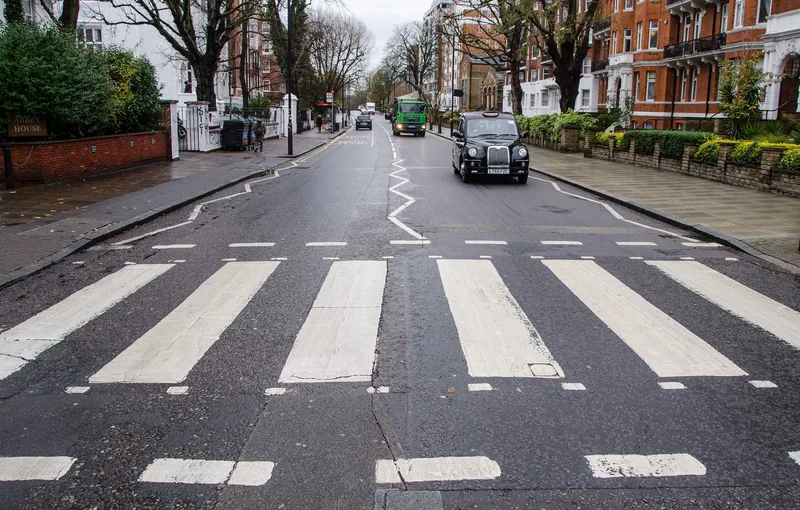
The Abbey Road crossing is the black-and-white zebra crossing outside Abbey Road Studios in St John's Wood, north-west London, where the Beatles were photographed for the cover of their 1969 album Abbey Road. It is free to visit at any time, a few minutes' walk from St John's Wood station on the Jubilee line, but it is a real road with real traffic, so the photo needs care.
Music fans come here every day to walk across in single file, just as John Lennon, Ringo Starr, Paul McCartney and George Harrison did on the album cover. There is no ticket, no queue barrier and no official photographer: you simply wait at the kerb for a gap and cross. Next to the crossing is Abbey Road Studios itself, where the Beatles recorded most of their music, with a wall covered in visitors' messages and a small official shop.
The whole visit takes 30 minutes to an hour. It suits Beatles fans, photographers and anyone curious to see a famous image in real life, but it is worth knowing in advance that there is not much else to do on the spot. The trick is to combine it with the parks, cricket and cafés nearby.
Abbey Road crossing: the essentials
- Address
- Outside Abbey Road Studios, 3 Abbey Road, London NW8 9AY
- Cost
- Free, open at all hours
- Nearest Tube
- St John's Wood (Jubilee line), a few minutes on foot
- Buses
- Routes 139 and 189 stop directly outside the studios
- Studio shop
- Monday to Saturday 9.30am-5.30pm, Sunday 10am-5pm
- Webcam
- Abbey Road Crossing Cam, live on the studios' website
- Wrong station to avoid
- Abbey Road DLR station, which is in east London
Why a zebra crossing became a landmark
On 8 August 1969 the Beatles stepped out of the studio for a short photo session. The photographer, Iain Macmillan, stood on a stepladder in the road and took a handful of pictures as the four men walked back and forth over the crossing. One of them became the cover of Abbey Road, released that September. It was one of the last albums the band recorded together.
The picture is simple: four figures in a line, a quiet tree-lined street, a white Volkswagen Beetle parked on the pavement. That simplicity is exactly why it has been copied so often. Bands, advertisers and cartoonists have recreated it for more than half a century, and fans from every country now repeat it daily.
In 2010 the crossing was given listed status by the government's heritage body, a protection normally reserved for historic buildings. It remains an ordinary working crossing, repainted and maintained like any other, which is part of its charm. The studios behind it, opened in the 1930s, are still one of the world's best-known recording studios and are used today by musicians and film-score orchestras.
Getting to Abbey Road from central London
The easiest way is the Jubilee line to St John's Wood. It is one stop north of Baker Street and a direct ride from Bond Street, Green Park, Westminster, Waterloo and London Bridge. Abbey Road Studios gives these directions from the station: cross the road onto Grove End Road, walk down the hill until you reach Abbey Road, turn right, and the crossing is in front of you.
Buses 139 and 189 stop directly outside the studios. The 139 is a handy route from the West End, and a single bus journey costs £1.75 with contactless or Oyster (rising to £1.85 on 1 November 2026). Our guide to riding London's buses explains how to pay and how the one-hour Hopper fare works.
If you plan to use the Tube several times on the same day, the daily cap limits what you pay. The details are in our explainer on Oyster, contactless and daily caps, and our Underground guide for visitors covers the basics of using the Tube.
Do not take the DLR to Abbey Road station. There is a station called Abbey Road on the Docklands Light Railway, but it is near West Ham and Stratford in east London, nowhere near the Beatles crossing. The station you want is St John's Wood on the Jubilee line. Our guide to the DLR and the Overground explains where those lines actually go.
How to take the photo without getting hurt
This is the part visitors most often underestimate. Abbey Road is a busy through road, used by buses, delivery vans, taxis and local drivers who see crowds of tourists every day and are not always patient. Drivers here are trying to get to work, not taking part in your photo.
The Highway Code, the official rulebook for road users in Great Britain, is clear about zebra crossings. Drivers should give way to people waiting to cross and must give way to people already on the crossing. But the Code also reminds pedestrians that traffic does not have to stop until someone has moved onto the crossing, and it tells you to wait until traffic has stopped from both directions, or the road is clear, before you step out.
- Decide the shot on the pavement. Agree who walks in which order and where the photographer will stand before anyone goes into the road.
- Let the photographer stay on the pavement. Never stand, crouch or lie in the road to get the famous angle. Use the zoom instead.
- Cross once, briskly, and keep walking. Walk in step across the whole crossing and onto the other pavement. Do not stop in the middle to pose.
- Let the traffic through between attempts. If you need another try, wait until the cars that stopped for you have gone.
- Watch both lanes. A car stopping in one direction does not mean the other lane has stopped. Remember that traffic drives on the left in Britain, so look right first.
Other visitors will be waiting for their own turn. Taking turns, stepping back after a couple of attempts and offering to take a photo for the next group keeps everyone happy. Our page on British manners for visitors explains why queuing and taking turns matter so much here.
Getting a good picture of the crossing
The album cover was taken from a raised position in the middle of the road, looking along the street, so the walkers pass straight across the frame. That exact angle is not safe to copy. The closest safe version is from the pavement a few metres back from the crossing, standing near the kerb and shooting along the road at a slight angle, with the camera at head height or a little above.
- Try both lenses. A wide setting fits the walkers and the trees in from close by; the zoom from further along the pavement flattens the scene and looks closer to the original.
- Use burst mode. Walking legs look best in mid-stride, so take a rapid series and pick the best frame later.
- Copy the details if you want a faithful version: study the album cover first for the order, the spacing and the length of stride.
- Accept the traffic. A clear, empty street is rare. A black cab or red bus in the background can make the photo feel more like London anyway.
The studio webcam gives you a free souvenir clip. Abbey Road Studios runs a live Crossing Cam on its website, pointed at the crossing. Wave as you walk across, then look up your time on the archive later. Nobody from your group has to stay behind to take the picture.
The studios, the graffiti wall and the shop
Abbey Road Studios is a working recording studio, with several studios in the building still used by artists and orchestras. The visitor information on its website covers the crossing, the wall, the outside of the building and the shop; it does not list public tours of the studios, so do not expect to go inside. You are welcome to photograph the white house and its front entrance from the pavement.
The low wall in front of the studios is covered in messages, song lyrics and signatures in dozens of languages. The studios themselves invite visitors to write a message there. It is painted over from time to time, so your note will not last forever, but adding one is part of the ritual for many fans. Keep it on the wall, not on the building, trees or street signs.
The official Abbey Road Shop is open Monday to Saturday from 9.30am to 5.30pm and on Sunday from 10am to 5pm. It sells clothing, prints and gifts connected to the studios and the music recorded there. For other ideas, our guide to London souvenirs worth buying suggests gifts that are less predictable.
When to go and how long to stay
The crossing is always there and always free, so you can visit at any hour. Early morning, before the local rush hour, is usually the quietest for photos, although you will share the road with commuters. Weekends and the summer holidays bring the biggest groups of fans.
In daylight, the trees and white-painted houses look much as they do on the album cover, and the light is best for photos. After dark the street is quieter but harder to photograph, and drivers see pedestrians less easily, so take extra care.
Allow 30 minutes for the crossing, the wall and a look at the studios, and up to an hour if you visit the shop or wait for a clear moment. Anything longer and you will be looking for somewhere to sit down, which is where the neighbourhood comes in.
What to do nearby in St John's Wood
St John's Wood is a quiet, well-off residential area of wide streets and large houses. Abbey Road Studios suggests walking over to St John's Wood High Street afterwards for a coffee or a light lunch. It is a pleasant, village-like street a short walk from the crossing.
- Lord's Cricket Ground is just down the road, and it offers guided tours; see our guide to watching cricket at Lord's and The Oval.
- Regent's Park and Primrose Hill are within walking distance. Primrose Hill has one of the finest free views of the London skyline; our guide to the two parks suggests routes.
- Baker Street is one stop away on the Jubilee line, home of the Sherlock Holmes Museum and a short walk from the shops and cafés of Marylebone.
- Camden Town, with its markets and live music, can be reached on foot through Primrose Hill; see our guide to Camden Town.
Other Beatles places in London
The crossing is the best-known Beatles site in London, but not the only one. The band's final public performance, the rooftop concert of January 1969, took place on the roof of their Apple Corps office at 3 Savile Row in Mayfair. The building is private, but many fans stop outside for a photo.
Several companies run guided Beatles walks that link these places with stories from the 1960s. They are a good choice if you want context rather than just a photo; our overview of London's best walking tours explains how to choose one. For today's music scene, see our guide to live music venues in London.
Frequently asked questions
Is it free to walk the Abbey Road crossing?
Yes. It is a public zebra crossing on an ordinary street, open at all hours, and there is no ticket or charge. You only pay if you choose to buy something in the Abbey Road Shop next to the studios.
Which Tube station is closest to the Abbey Road crossing?
St John's Wood on the Jubilee line is a few minutes' walk away. Do not go to Abbey Road station on the DLR, which is in east London and has nothing to do with the Beatles. Buses 139 and 189 also stop outside the studios.
Can you go inside Abbey Road Studios?
The studios are a working recording studio, and their website's visitor information does not list public tours. You can photograph the building from outside, write a message on the front wall and visit the official shop next door.
Is it safe to take photos on the Abbey Road crossing?
It can be, if you are careful. Abbey Road carries buses and heavy traffic, so wait for vehicles to stop in both directions, cross briskly without stopping in the middle, and let the photographer stay on the pavement. Never lie down or stand in the road.
When was the Abbey Road album cover photo taken?
The photo was taken on 8 August 1969 by Iain Macmillan, and the album was released in September 1969. The session was short, and the chosen picture shows the four Beatles walking across the crossing in single file.
Sources
- Abbey Road Studios - Visit us and Abbey Road Crossing Cam (checked September 2026)
- GOV.UK - The Highway Code: rules for pedestrians (Rule 19, zebra crossings) (checked September 2026)
- Transport for London - Bus and tram fares (checked September 2026)
- Mayor of London - MD3517 July 2026 fare changes (checked September 2026)