
Paddington is where trains from Heathrow and the west of England arrive, under one of the great iron roofs of Victorian Britain. Bayswater is the district immediately west of it: a grid of tall white terraces between the station and Kensington Gardens, filled with hotels, and with a high street of its own on Queensway.
If your question is whether to book a room here, our guide to staying near King's Cross, St Pancras and Paddington answers it directly and compares the two station districts. This page is about what the area is actually like once you have dropped your bags: the station building, the canal basin behind it, the park at the end of the street, and where to eat on Queensway.
The short version: Paddington is a good, practical base with almost nothing to see, and Bayswater is a pleasant fifteen-minute walk that ends in one of the best parks in London. Nobody makes a special journey here, and nobody who stays here regrets the location.
Paddington and Bayswater at a glance
- Best for
- Heathrow arrivals, hotels, Hyde Park access, Middle Eastern and Asian food
- Paddington station
- Bakerloo, Circle, District and Hammersmith & City lines, Elizabeth line, Great Western Railway, Heathrow Express
- Bayswater stations
- Bayswater (Circle, District), Queensway and Lancaster Gate (Central line)
- Elizabeth line to Heathrow
- 28 minutes; £14.60 to Terminals 2 and 3 (September 2026)
- Heathrow Express
- 15 minutes; £26.00 pay as you go, not included in the daily cap
- Hyde Park
- Free, 10 minutes' walk south from the station
- Zone
- 1
The station, and why it is worth looking at
Paddington station opened in 1854 to a design by Isambard Kingdom Brunel, and the main trainshed is still his: three wrought-iron arched spans, 210 metres long, with glazed roofs and decorative ironwork in the transepts. Stand at the buffer stops of platform 1 and look up. It is the most impressive piece of architecture in this guide and it costs nothing.
Two things to find on the concourse. On platform 1 is Charles Sargeant Jagger's bronze of a soldier reading a letter, the Great Western Railway's war memorial of 1922, one of the finest memorials in London. And on the way to the Lawn, a small bronze of Paddington Bear sits on a suitcase, at the spot where the character is found in Michael Bond's books. Expect a queue of families for a photograph. Our family guide to London covers the other quick photo stops that do not need a ticket.
The station is large and confusing on a first visit. Elizabeth line platforms are deep underground and reached from the eastern end of the concourse; Heathrow Express uses platforms 6 and 7; the Bakerloo line has its own entrance on Praed Street and is a long walk from the Circle line platforms.
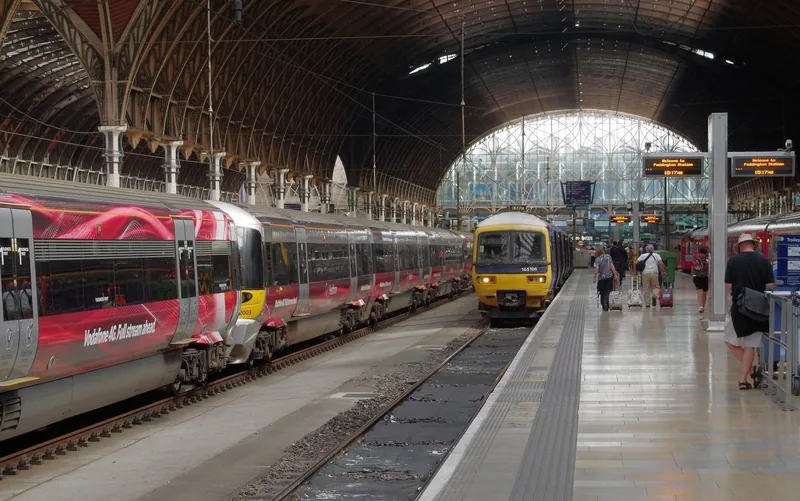
Photo: mattbuck (category) · CC BY-SA 4.0 · Wikimedia Commons · resized
Heathrow: the two trains and what they cost
Paddington is the London end of both rail links to Heathrow, and the choice between them is mostly about money.
| Elizabeth line | Heathrow Express | |
|---|---|---|
| Journey time | 28 minutes to Terminals 2 and 3 | 15 minutes to Terminals 2 and 3 |
| Frequency | Six trains an hour | Every 15 minutes |
| Pay as you go fare | £14.60 from Paddington | £26.00 from Paddington |
| Counts towards the daily cap? | Yes | No |
| Children | Under-11s free with an adult | Children 15 and under travel free |
| Terminal 5 | Two trains an hour, every 30 minutes | About 6 minutes beyond T2 and T3 |
For a family that changes the answer. Two adults and two 12-year-olds pay £58.40 on the Elizabeth line and £52.00 on Heathrow Express, because the Express carries under-16s free, and they arrive 13 minutes earlier. Two adults alone pay £29.20 against £52.00, and the Elizabeth line wins easily. Heathrow Express also sells advance discounted singles from £10 when bought 30 or more days ahead.
Our direct comparison of Heathrow Express and the Elizabeth line works through the luggage, the step-free access and the terminal transfers, and our overview of every route from Heathrow into central London covers the Piccadilly line, the coach and the taxi. Fares to and from Heathrow are charged at peak rates at all times.
Heathrow Express fares never count towards your daily cap. If you have already reached the Zones 1-2 cap of £8.90 that day, a Heathrow Express journey still adds £26.00 on top. The Elizabeth line fare of £14.60 counts towards the cap, so on a heavy travel day it can effectively cost less than the difference suggests.
Paddington Basin and the canal
Behind the station, the Grand Union Canal ends in Paddington Basin, a dead-end arm of water surrounded by offices and flats. It is a strange, quiet place two minutes from one of the busiest stations in Britain, with a wide towpath, moored boats and a run of cafés along the water.
Two small footbridges here are worth the detour if you like engineering. The Rolling Bridge, designed by Thomas Heatherwick, curls up into an octagon rather than lifting; the Fan Bridge opens as five separate blades. Both are operated on a published weekly schedule rather than on demand, so check the times posted on site or on the Merchant Square website before you wait for them.
Walk west along the towpath for ten minutes and you reach Little Venice, where the Grand Union meets the Regent's Canal at a wide pool with an island in it. Narrowboat trips run from here to Camden in summer. Our guide to Little Venice and the Regent's Canal has the boat operators and the walking route.
Bayswater and Queensway
Bayswater fills the space between Paddington and the north edge of Kensington Gardens. The streets are wide, the houses are tall white stucco terraces built in the 1840s and 1850s, and a very large share of them are hotels. It has always been the part of central London where new arrivals stayed, which is why the food is what it is.
Queensway, the main north-south street, runs from Bayswater station down to the park. It has Chinese, Malaysian, Lebanese, Korean and Japanese restaurants along its length, a large supermarket, and the rebuilt Whiteleys building, once London's first department store. Westbourne Grove, crossing it, turns increasingly expensive as it runs west towards Notting Hill.
Moscow Road holds the Greek Orthodox Cathedral of Saint Sophia, built in 1877 and decorated inside with mosaics; it is open to visitors outside services. The Porchester Centre on Queensway is a 1929 public baths building with a swimming pool and Turkish baths; the operator of the spa changed recently, so check who runs it before planning a visit.
For the Lebanese, Egyptian and Iranian restaurants on Edgware Road, ten minutes east of the station, see our guide to Middle Eastern food on Edgware Road.
Bayswater's character is worth stating plainly, because listings tend to talk it up. The terraces are handsome from the outside and often tired inside, the side streets are quiet, and the area empties of residents and fills with visitors in a way that makes it feel oddly impersonal. There is no cinema, no theatre and little nightlife. What it has instead is space: wide pavements, large squares, and a park at the end of almost every street running south.
Two stations serve it and they are easy to mix up. Bayswater, on the Circle and District lines, and Queensway, on the Central line, are about 200 metres apart on either side of Queensway itself, with different destinations. Check which line you need before you walk to one of them.
Hyde Park and Kensington Gardens from this side
The southern end of Bayswater runs along the top of Kensington Gardens, and most people staying here can be under trees within ten minutes. The Italian Gardens, a formal set of fountains and urns at the north-east corner, were built in the 1860s and are the nicest entrance on this side. The Serpentine, the lake that divides Hyde Park from Kensington Gardens, starts just east of them.
Entry is free and the parks open from 5am or 6am until midnight. Our guide to Hyde Park and Kensington Gardens covers the Diana Memorial Playground, the galleries and the Lido. Be aware that the Diana Memorial Fountain has been closed since July 2026 because of a fault in its water system.
St Mary's Hospital and the penicillin laboratory
St Mary's Hospital, on Praed Street opposite the station, is where Alexander Fleming noticed in 1928 that a mould had killed the bacteria in a petri dish left by an open window. The laboratory has been preserved as a small museum within the hospital. Its opening is limited and has changed more than once in recent years, so telephone or check with Imperial College Healthcare NHS Trust before making a journey specifically for it.
Practicalities
Bags can be left at the station office operated by the Excess Baggage Company. Network Rail's facilities listing gives it weekday hours only, 07:00 to 23:00, and says nothing about Saturday or Sunday, so phone 020 3468 4709 first if your flight is at the weekend. Our page on left luggage in London compares the station offices with the app-based alternatives.
Buying a long-distance ticket from here is covered in our guide to UK train tickets, advance fares and railcards. Great Western services from Paddington reach Oxford, Bath, Bristol, Cardiff and Cornwall, and advance fares released twelve weeks ahead are far cheaper than walk-up ones.
The streets immediately north and east of the station are busy and a little scruffy late at night, in the ordinary way of station districts. Praed Street and Craven Road are well lit; the mews behind them are not. For markets and a livelier evening, Portobello Road is 20 minutes' walk west, and Marylebone is a similar distance east. If Paddington is fully booked, Earl's Court and Victoria offer the same sort of value.
Frequently asked questions
Is the Elizabeth line or Heathrow Express better from Paddington?
For two adults, the Elizabeth line at £14.60 each is much better value than £26.00 each on Heathrow Express, and it counts towards the daily cap. For a family with children aged 11 to 15, Heathrow Express can work out cheaper because under-16s travel free.
How long does it take to walk from Paddington to Hyde Park?
About 10 minutes to the north edge of Kensington Gardens at the Italian Gardens, going south down Westbourne Terrace or Spring Street. The parks are free and open from early morning until midnight.
Is there anything to see at Paddington station itself?
Yes. Brunel's 1854 iron trainshed is one of the finest Victorian structures in London, and platform 1 holds the Great Western Railway war memorial. The Paddington Bear statue is nearby, usually with a queue of families waiting to photograph it.
What is Queensway like?
A long, busy high street running from Bayswater station down to Kensington Gardens, with Chinese, Malaysian, Lebanese, Korean and Japanese restaurants, a supermarket and the rebuilt Whiteleys building. It is the most practical place to eat if you are staying in a Bayswater hotel.
Can I store luggage at Paddington?
Yes, at the Excess Baggage Company office in the station. Only weekday hours are published, 07:00 to 23:00, with nothing listed for Saturday or Sunday, so telephone 020 3468 4709 before you plan a weekend departure around it.
Sources
- Transport for London - Heathrow on the Elizabeth line (checked September 2026)
- Heathrow Express - Fares and journey times (checked September 2026)
- Transport for London - Daily and weekly caps (checked September 2026)
- Network Rail - London Paddington station facilities (checked September 2026)
- The Royal Parks - Kensington Gardens (checked September 2026)