
A pantomime is a Christmas comedy, built loosely round a fairy story, in which shouting back at the stage is part of the job. It runs from late November to early January, lasts about two and a half hours, costs from around £10, and is aimed at families with children between roughly four and twelve. If you have never seen one, it will make no sense for the first ten minutes and then it will make complete sense.
Our guide to the London Christmas season places panto among the other December traditions. This page explains what actually happens in the theatre: the characters, the shouting, the songs, which London shows suit which age of child, and what the whole thing costs a family of four.
The form is genuinely strange, and nobody explains it to visitors because everyone in Britain absorbed it at the age of five. So here it is, plainly.
Pantomime at a glance
- Season
- Late November to early January. The London Palladium's Cinderella runs 5 December 2026 to 10 January 2027
- Length
- About 2 to 2 hours 30 minutes, with one interval
- Best age
- Roughly 4 to 12; younger children manage a matinee better than an evening
- Typical prices
- Hackney Empire's 2026 panto: £10 to £48, plus £1.50 per ticket booked online or by phone
- Language
- English, fast, and full of wordplay. Non-native speakers will follow the plot easily and miss some jokes
- Audience behaviour
- Shouting is required, not tolerated
What a pantomime is, and where it came from
Take a fairy tale everyone knows. Cinderella, Jack and the Beanstalk, Aladdin, Peter Pan, Sleeping Beauty. Strip out most of the plot. Add pop songs with rewritten lyrics, slapstick, a live band, local jokes about the neighbourhood the theatre stands in, and gags aimed over the children's heads at their parents. Cast an older comic actor as a grotesque female character. Then invite the audience to interrupt.
The form grew out of Italian commedia dell'arte and Victorian music hall, and the result is not really a play. It is closer to a variety show with a story loosely holding it together. British children see one most years, which is why adults in the audience know exactly when to shout and your family will not.
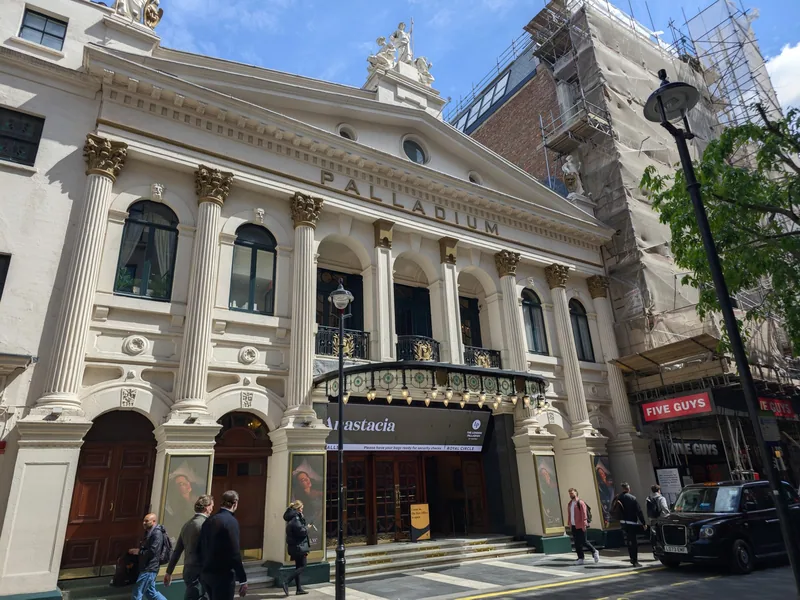
Photo: Celsoazevedo · CC BY 4.0 · Wikimedia Commons · resized
The characters you will meet
- The Dame. An older woman, played by a male comic actor in enormous wigs and a new ridiculous costume roughly every ten minutes. She is the mother, the nurse or the cook, she talks directly to the audience, and she is the comic engine of the evening. At Hackney Empire in 2026 the Olivier Award winner Clive Rowe plays Dame Trot in Jack and the Beanstalk, a role he has made his own over many seasons.
- The Principal Boy. The young hero. Traditionally played by a woman in a short costume, though many modern productions now cast a man.
- The Villain. Enters from the audience's left, in dark clothes, to organised booing. This is not rudeness. The villain will pause and wait for it.
- The Good Fairy. Enters from the right, often speaking in rhyme, and is cheered.
- The Comic. The hero's friend, who befriends the audience early on, usually by demanding a greeting every time he appears.
- The Animal. A cow, a horse or a goose played by two people in one costume, who will fall over.
The rules of shouting: a short script
There are four standard exchanges, and if you know them your children will be able to join in from the start.
- "It's behind you!" A character stands on stage while something dangerous or ridiculous appears behind their back. They turn; it moves. The audience shouts the warning, repeatedly, and the character insists nothing is there.
- "Oh no it isn't." / "Oh yes it is." A character contradicts the audience. The audience contradicts them back. This can go on for a while and is intended to.
- Booing and cheering. The villain gets booed and hissed at every entrance. The hero and the fairy get cheered. Children take to this immediately.
- The greeting. The comic character will teach the audience a phrase to shout back at him whenever he arrives, and will complain that you were not loud enough.
Nobody will look at you oddly for joining in, and the performers depend on it. The only genuinely disapproved behaviour is being quiet.
Tell children before the show that shouting is allowed. Families visiting from countries with quieter theatre customs often spend the first half stopping their children from calling out, which is exactly the wrong instruction. Explain in advance, and the children will be ahead of their parents within fifteen minutes.
The songs, and the bit at the end with the words
The music is mostly well-known pop and musical-theatre numbers with new lyrics fitted to the story, played by a live band. You will recognise more of it than you expect.
Near the end there is a set piece called the songsheet. The words of a simple, silly song are lowered on a banner or shown on a screen, the audience is divided into halves and made to compete over who can sing louder, and a small group of children is brought up on stage from the audience to be interviewed, gently teased and given a sweet. If your child wants to be chosen, sit near the front and wave. If your child would hate it, sit further back.
The jokes for adults, and how broad they get
Pantomime works on two levels at once. The children follow the story; the adults get double meanings, topical jokes and references they were not expecting. This is deliberate and long-established, and it is why parents go willingly.
How far it goes depends on the production. The big West End pantos, which sell to a mixed adult and family audience, tend to be the cheekiest. Pantos at local theatres and those advertised specifically at young families keep it milder. Nothing in a mainstream London panto is explicit, but a parent used to a strictly child-focused show may raise an eyebrow, and that is normal. If you want to gauge it, read the age guidance on the theatre's own listing rather than assuming.
Which London panto suits which family
London has two kinds of pantomime, and the choice matters more than the title.
The West End spectacle. The London Palladium's annual show is the largest of them, with a cast of famous names, big production numbers and prices to match. Cinderella runs there from Saturday 5 December 2026 to Sunday 10 January 2027. This is the version to choose if you want scale and star casting, and if your children are old enough to sit through a long evening in a big theatre.
The local theatre panto. Hackney Empire in east London has a long tradition of its own and casts from the community around it as well as from the profession; its 2026 show, Jack and the Beanstalk, runs from 21 November to 31 December. In the south-west, New Wimbledon Theatre stages Peter Pan and Richmond Theatre stages Jack and the Beanstalk, both from Saturday 5 December 2026 to Sunday 3 January 2027. These are warmer, smaller rooms where a four-year-old is closer to the stage and the whole thing is less overwhelming.
If you are staying centrally, the neighbourhood theatres are still easy: Richmond and Wimbledon are both straightforward journeys from the centre, and our guides to Richmond, Wimbledon and Hackney cover what else is nearby if you make a day of it.
What it costs a family, and the discounts nobody asks about
Hackney Empire's 2026 pantomime is a good worked example, because it publishes everything. Tickets run from £10 to £48, with £1.50 added per ticket booked online or by telephone. Concessions get £2 off any performance. Groups of five or more paid £25 each if they booked by 30 September; groups of ten or more get £3 off each ticket. Programmes are £4 if bought online with your tickets and £5 in the theatre on the night.
So a family of four at that theatre, choosing seats in the middle of the range, is looking at something in the region of £100 to £140 including booking fees, before anything bought inside. West End prices are higher, sometimes considerably. Our guide to cheaper theatre tickets in London explains the general tricks, and our West End theatre guide covers how booking works.
Midweek afternoons in early December are the cheapest seats of the whole run. Before the schools break up, weekday matinees are quieter and cheaper than anything in the Christmas fortnight, and a smaller audience is easier for a nervous small child. The trade-off is that a half-full house shouts less.
Relaxed, signed and described performances
Most London pantomimes now schedule adapted performances, and they are worth knowing about even if you were not looking for them.
- Relaxed performances keep the house lights slightly up, soften the loudest sound and lighting effects, and allow people to move around or leave and come back. New Wimbledon Theatre and Richmond Theatre both scheduled theirs for Wednesday 30 December 2026.
- British Sign Language interpreted performances have an interpreter at the side of the stage. Hackney Empire listed four in 2026: Saturday 5 December at 13:30 and 18:00, and Thursday 17 December at 13:30 and 19:00.
- Audio-described performances provide live commentary through a headset for blind and partially sighted audience members. Hackney's was Sunday 6 December at 13:00.
- Dementia-friendly performances are designed for older audiences and their carers, with a calmer environment and staff trained to help.
These dates are usually released with the rest of the run and sell out, so book them early. Access tickets normally need to be booked through the theatre's box office rather than online.
When to go, and how the school holidays change everything
English schools break up for Christmas in the week before the holiday: in 2026/27 that means most London children are off from around Monday 21 December to Friday 1 January. That fortnight is when pantomime is most crowded and most expensive, and when weekend matinees sell out first.
The quiet weeks are the last ten days of November and the first two weeks of December, and the first week of January once the schools have gone back. If your trip is flexible, those are the weeks to aim for. Our guide to London in the school holidays has the term dates in full, and our month guide to December in London covers what else is on.
Boxing Day and New Year's Day are odd days for theatre: some shows do not perform, others play twice. Check the specific performance calendar rather than assuming, and see our guide to bank holidays and opening hours for how the rest of the city behaves on those days.
Practical questions before you book
Ages and tickets. Policies differ: Hackney Empire welcomes all ages, lets children aged three and under sit on an adult's lap, and requires a ticket for children aged four and over. Most theatres have something similar, and a few set a minimum age. Check before you buy.
Length and interval. Two to two and a half hours, with a 20-minute interval in the middle. Small children usually manage a 13:30 matinee far better than a 19:00 performance, and the interval is a good moment to decide whether to stay.
What to expect in the room. Loud music, strobe and flashing effects in some scenes, smoke or dry ice, and often a moment when something is thrown or sprayed towards the front rows. Ice creams are sold in the interval at theatre prices. Most theatres now take cards only.
If a shouting match is not what your family wants at Christmas, the alternatives are a children's Christmas play, a carol service, or the ballet: our guide to the Royal Opera House covers The Nutcracker, and our guides to ice skating, Winter Wonderland, London with children and London with teenagers cover the rest of the season. For the wider question of how British audiences behave, see our notes on British etiquette.
Frequently asked questions
What is a pantomime and why does everyone shout?
It is a comic Christmas stage show, loosely built on a fairy story, mixing songs, slapstick and jokes aimed at the adults. Audience participation is built into the script: warning a character that something is behind them, contradicting them, and booing the villain. The performers pause and wait for it, so joining in is expected rather than merely allowed.
What age is pantomime suitable for?
Roughly four to twelve works best, though adults enjoy it too. Children under about four often find the volume and length difficult; an afternoon performance suits them better than an evening. Many theatres require a ticket from age four and allow younger children on an adult's lap, but policies vary.
How much does a pantomime cost in London?
Hackney Empire's 2026 show ran from £10 to £48 per ticket, with £1.50 added per ticket booked online or by phone, which puts a family of four somewhere around £100 to £140 including fees. West End pantomimes cost more. Concessions, group rates and early booking all reduce the price.
Which is the best pantomime in London for young children?
A local theatre panto rather than the West End spectacle. Smaller rooms put a small child closer to the stage, the show is usually milder, and an afternoon performance is shorter to sit through. Hackney Empire, Richmond Theatre and New Wimbledon Theatre all stage traditional family pantomimes each December.
Do I need to understand British culture to enjoy a panto?
No. The story is a fairy tale you already know, and the physical comedy needs no language at all. You will miss some topical and local jokes, and some wordplay, but so does everyone under ten in the audience. Knowing the four standard audience responses is enough preparation.
Sources
- LW Theatres - Pantomime at the London Palladium, Cinderella 2026/27 (checked September 2026)
- Hackney Empire - Jack and the Beanstalk 2026 (dates, prices, access performances) (checked September 2026)
- New Wimbledon Theatre - Peter Pan pantomime 2026/27 (checked September 2026)
- Richmond Theatre - Jack and the Beanstalk pantomime 2026/27 (checked September 2026)
- London Borough of Bexley - School term dates 2026 to 2027 (checked September 2026)