
There is no annual date. The State Opening happens on the first day of a new parliamentary session, or shortly after a general election, and the last one was Wednesday 13 May 2026. When it is held, the procession from Buckingham Palace to Westminster is free to watch from The Mall and Whitehall, and the ceremony inside runs from about 11:00 to 12:30.
The State Opening is the only regular occasion that brings the three parts of Parliament together: the Sovereign, the House of Lords and the House of Commons. The King reads a speech written by the government, setting out the laws it intends to pass, and the session of Parliament formally begins. Everything around it, the crown travelling in its own carriage, the slammed door, the search of the cellars, is ceremony that has accumulated over four centuries.
For a visitor the useful thing to understand is that this is not an event you can plan a trip around. It is announced a few weeks ahead, it is over by lunchtime, and you watch it from a pavement. Our guide to the Palace of Westminster covers the building itself.
State Opening of Parliament: what to expect
- Date
- No fixed date. Set for the first day of a new session; the last was Wednesday 13 May 2026
- Cost to watch outside
- Free, from the street
- Best places
- The Mall and Whitehall, for the procession in both directions
- Timings
- Main ceremony 11:00 to 12:30; the King arrives at 11:15, is seated at 11:30
- Can you go inside?
- No. The Lords chamber is for members, and the Royal Gallery holds about 600 invited guests
- Watch it properly
- Broadcast live on Parliament TV and on Parliament's own YouTube channels, including a British Sign Language version
- Nearest stations
- Westminster, St James's Park, Charing Cross, Green Park for the Mall end
Why nobody can tell you next year's date
A State Opening marks the start of a parliamentary session. Sessions are not a fixed length: they end when the government decides to prorogue Parliament, and the next one opens when the government is ready with a new legislative programme. That is why the gaps are irregular.
Parliament's own record of recent State Openings shows how uneven it is. The 7 November 2023 ceremony was the first under King Charles III. The next was Wednesday 17 July 2024, shortly after the general election, opening the current Parliament. Then came Wednesday 13 May 2026, which opened the session running at the time of writing.
So a visitor who wants to see one should watch Parliament's own news pages: the 2026 ceremony was announced there on 5 May for 13 May, eight days' notice. There is no ballot, no ticket and nothing to book, which at least means there is nothing to miss out on.
Eight days' notice is normal, so treat it as a bonus rather than a plan. If you are already in London and the date is announced, clear the morning. If you are choosing when to visit, pick your dates for something with a published date, such as Trooping the Colour in June, and treat a State Opening as luck.
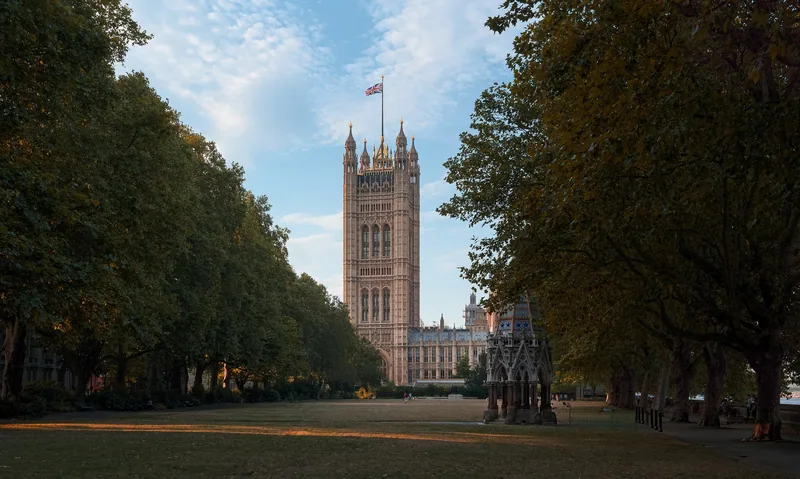
Photo: Julian Herzog (Website) · CC BY 4.0 · Wikimedia Commons · resized
The order of the morning
Parliament publishes the timetable, and it is tight. The main elements happen between 11:00 and 12:30:
| Time | What happens |
|---|---|
| Early morning | The ceremonial search of the cellars by the Yeomen of the Guard |
| Before 11:15 | The Imperial State Crown travels to Westminster ahead of the King and is placed on the Crown Cloth in the Royal Gallery |
| Around 11:00 | The King leaves Buckingham Palace in procession, escorted by the Household Cavalry |
| 11:15 | The King arrives at the Sovereign's Entrance and goes to the Robing Room |
| 11:27 | The Royal Procession moves through the Royal Gallery, the Great Sword of State and the Cap of Maintenance carried in front |
| 11:30 | The King is seated on the throne in the House of Lords. Black Rod is sent to summon the Commons |
| Then | The King's Speech, after which the procession returns to the Robing Room and departs |
That means the procession passes any given point twice inside about an hour and a half, which is the practical reason to stand on The Mall or in Whitehall rather than trying to be at Parliament itself.
Where to stand
The Royal Household's advice is simple: watch the procession from The Mall or from Whitehall. Both are wide, both are lined with crowd barriers on the day, and both give you the Household Cavalry escort at close range.
The Mall is the better choice if you want the carriages against the trees and Buckingham Palace at one end; arrive early and stand on the north side for the light. Whitehall is the better choice if you want the return leg and then somewhere to go afterwards, with Horse Guards and Whitehall and the Cenotaph on the same pavement and Trafalgar Square at the top.
Parliament Square itself is the place not to be. It is fenced for the occasion, the view is of the outside of a building, and the ceremony happens indoors where you cannot see it. If what you actually want is to see the chamber, book a tour on an ordinary day instead: Houses of Parliament tours explains how, and overseas visitors can book the paid guided tour on Saturdays year round and Monday to Saturday during recess.
The ceremonial search, and the rest you will not see
The day begins with the Yeomen of the Guard searching the cellars of the Palace of Westminster, a practice Parliament dates back more than 420 years to the Gunpowder Plot of 1605. The search now starts in the Prince's Chamber and moves into the Lords chamber, led by a member of parliamentary staff carrying a key to the cellars. It is broadcast, so it is watchable even though it is not public. The plot itself is the subject of our guide to Bonfire Night in London.
Inside, the Royal Gallery is filled with about 600 guests, and the Lords chamber holds members of the Lords along with judges, ambassadors and High Commissioners. None of this is open to the public, which is the honest answer to the most common question about the day.
Black Rod and the door
The moment everyone remembers is the summoning of the Commons. When the King is seated, he instructs the Lord Great Chamberlain to signal to Black Rod, the senior officer of the House of Lords, to fetch the MPs. The doors of the Commons chamber are shut in Black Rod's face, a practice Parliament traces to the Civil War and which stands for the Commons' independence from the Crown. Black Rod strikes the door three times with an ebony staff before it opens, and MPs then follow to the Lords, standing at the far end of the chamber, at the Bar of the House, to listen.
The speech itself is carried to the King by the Lord Chancellor in a silk bag and handed over on bended knee. The King reads it; the government wrote it. Afterwards both Houses debate it for several days, and the Commons votes on it.
Getting there, and what closes
Westminster station is the obvious one but the worst on the day, because it empties straight into the closed area. St James's Park on the District and Circle lines is better for the Whitehall end, Green Park for the top of The Mall, and Charing Cross for the middle. The procession route is closed to traffic either side of the ceremony, which means buses through Whitehall and Parliament Square are affected; check on the morning at TfL's live service status page, which lists diversions as they are put in place.
Plan the rest of the day away from the cordon. St James's Park and Green Park are on the right side of it, and the museums on the north bank are unaffected. Our notes on avoiding the crowds in London cover the general problem of a ceremonial morning in Westminster.
The other royal ceremonies, ranked for a visitor
If you are in London for a week and want one piece of state ceremony, the State Opening is not the one to chase, because you cannot know it will happen. In descending order of reliability:
- Changing of the Guard: several mornings a week, free, published a month ahead.
- Gun salutes: fixed royal anniversaries, free, and the horses are the point.
- Trooping the Colour: one Saturday in June, with two rehearsal parades on the preceding Saturdays.
- The Ceremony of the Keys: nightly, but ticketed and booked a month ahead.
- State Opening: irregular, announced about a week ahead.
All of them except the Ceremony of the Keys cost nothing, which puts them near the top of our list of free things to do in London.
Frequently asked questions
When is the next State Opening of Parliament?
No date has been announced. The State Opening happens on the first day of a new parliamentary session, and the last one was Wednesday 13 May 2026. Parliament announces the date on its own news pages, usually a week or two ahead, so check parliament.uk rather than relying on an annual pattern.
Can the public attend the State Opening of Parliament?
Not inside. The House of Lords chamber is for members and invited guests, and the Royal Gallery holds about 600 people by invitation. The public watches the procession from the street, free of charge, on The Mall and in Whitehall, or watches the whole ceremony live on Parliament TV.
What time does the State Opening start?
The main ceremony runs between 11:00 and 12:30. The King arrives at the Sovereign's Entrance at 11:15, the Royal Procession sets off through the Royal Gallery at 11:27, and he is seated on the throne at 11:30. Be in place on the procession route by about 10:15 for a front position.
Why is the door slammed in Black Rod's face?
It marks the independence of the elected House from the Crown. Parliament traces the practice to the Civil War period. Black Rod, an officer of the House of Lords, is sent to summon MPs, the Commons doors are closed, and Black Rod strikes them three times with an ebony staff before they are opened.
Is the Imperial State Crown worn in the procession?
Not on the journey. The crown travels to Westminster ahead of the King in a carriage of its own and is placed on the Crown Cloth in the Royal Gallery. The King puts on the Robe of State in the Robing Room and wears the crown for the procession into the Lords chamber and for the speech.
Sources
- UK Parliament - State Opening of Parliament (Internet Archive copy, 8 September 2026; parliament.uk blocks our requests) (checked September 2026)
- UK Parliament - State Opening: how it happens, with the timetable (Internet Archive copy, 8 September 2026) (checked September 2026)
- UK Parliament - State Opening of Parliament 2026, announced 5 May 2026 (Internet Archive copy) (checked September 2026)
- The Royal Family - State Opening of Parliament (checked September 2026)
- Transport for London - Live service status (checked September 2026)