
The Palace of Westminster is the building most people call the Houses of Parliament: a royal palace that became the home of the House of Commons and the House of Lords. You can see it from the pavement for nothing, and on most weekdays you can also go inside for nothing and sit in the public gallery while MPs or peers debate.
It helps to separate three things that visitors often merge. The Palace is the building. Parliament is the institution that meets in it. And the Elizabeth Tower, with the bell called Big Ben inside, is only one corner of the whole. Paid tours of the state rooms are a fourth thing again, and they are covered in our guide to Parliament tours and what they cost.
This page is about the building and the institution: why it looks the way it does, how the two Houses differ, and the free route in through the public galleries, which is the part almost no visitor uses.
The Palace at a glance
- What it is
- A former royal palace, now the seat of the UK Parliament
- Architects
- Charles Barry and Augustus Welby Pugin, rebuilt from 1840 after the fire of 1834
- Oldest part
- Westminster Hall, more than 900 years old
- World Heritage
- Inscribed by UNESCO in 1987, together with Westminster Abbey and St Margaret's Church
- House of Commons
- 650 seats, every member elected; green benches
- House of Lords
- 816 members in September 2026, none of them elected; red benches
- Public galleries
- Free, Monday to Thursday and some Fridays; enter at Cromwell Green
- Nearest station
- Westminster (Jubilee, District, Circle), step-free
A palace that stopped being a palace
Kings lived here from the 11th century. Westminster Hall, built for William II and re-roofed in the 1390s with the hammerbeam ceiling you can still stand under, is what survives of that palace. Parliament borrowed rooms in the complex for centuries, and after a fire in 1512 the monarch moved out and never properly came back.
The building that you photograph from the bridge is much younger. In October 1834 a clerk burned two cartloads of old wooden tally sticks in a furnace under the House of Lords, the flues overheated, and almost the entire medieval palace burned down in a night. Westminster Hall was saved. Nearly everything else was not.
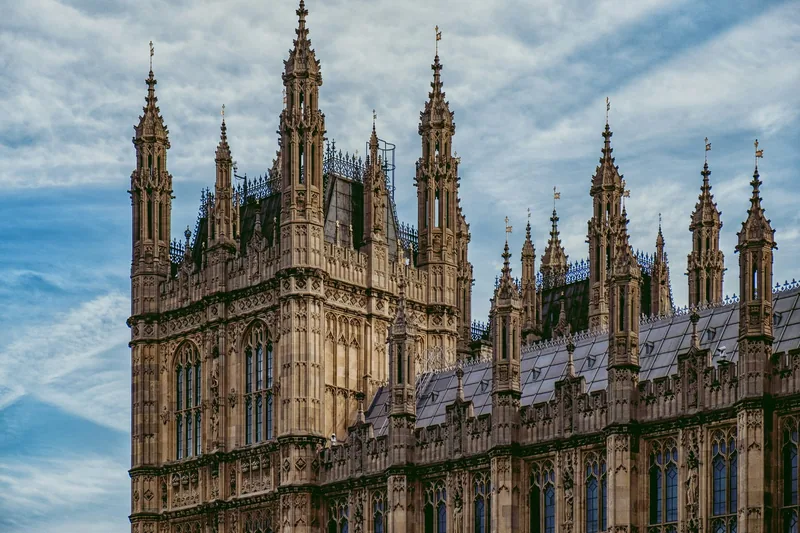
The replacement was designed by Charles Barry, with the Gothic detail, the wallpapers, the tiles and the furniture drawn by Augustus Welby Pugin. Work began in 1840 and carried on for thirty years. UNESCO, which added the Palace to the World Heritage List in 1987 alongside Westminster Abbey and St Margaret's Church, describes it as a fine example of neo-Gothic architecture, and credits the Abbey next door as its inspiration.
The effect from outside is one enormous cliff of pale stone along the river, with a tower at each end. The taller, squarer one at the south end is the Victoria Tower, and the state papers of Parliament are kept in it. The slimmer one at the north end, beside the bridge, is the Elizabeth Tower, which has its own guide: Big Ben and the Elizabeth Tower.
Commons and Lords: what is different about each
Two chambers sit in the same building and work in visibly different ways. Knowing which is which changes what you get out of an hour in a public gallery.
| House of Commons | House of Lords | |
|---|---|---|
| Members | 650 MPs, one per constituency | 816 in September 2026 |
| How they get there | Elected at a general election or a by-election | Appointed for life, plus 25 Church of England bishops |
| Benches | Green | Red |
| Chaired by | The Speaker | The Lord Speaker |
| Question Time | About an hour | Up to about 30 minutes |
| Tone in the chamber | Noisy, adversarial, party whips in charge | Quieter, no interruptions, members address the House rather than each other |
One thing changed recently and it is worth knowing before you look at those red benches. The House of Lords (Hereditary Peers) Act 2026 received Royal Assent on 18 March 2026, and the section that excludes the remaining hereditary peers came into force on 29 April 2026. Nobody now sits in the Lords because of a title they inherited. In September 2026 the membership consisted of 785 life peers, six judicial life peers and 25 bishops.
The Commons is the chamber with the power. It votes the money, it makes and unmakes governments, and the Lords can delay legislation but not indefinitely block it. That is why the Commons gallery has a queue and the Lords gallery usually does not.
The Lords is the easier ticket and often the better hour. Because visitors head for the Commons, you can frequently walk almost straight into the Lords gallery. The debates are slower, the speeches are longer, and you can actually hear what is said. For a first visit with limited time, we would take the Lords.
Watching a debate for nothing
Parliament's own position is plain: visitors from the UK and overseas are welcome in the public galleries of both Houses, and there is no charge to anyone. For ordinary debates there is also no ticket. You arrive, you queue, you go in.
The galleries take visitors from Monday through Thursday, plus a handful of Fridays. Times differ between the two Houses and from day to day, because the chambers do not start at the same hour. The Commons sits as follows when the House is meeting:
| Day | House of Commons sitting hours |
|---|---|
| Monday | 2.30pm to 10.30pm |
| Tuesday and Wednesday | 11.30am to 7.30pm |
| Thursday | 9.30am to 5.30pm |
| Sitting Fridays | 9.30am to 3pm |
Note the Monday afternoon start. Visitors turn up at eleven on a Monday morning expecting business and find the chamber empty. Note also that Parliament is away for long stretches, called recesses, and that the galleries are shut then. The parliamentary calendar shows what is happening on any given day, and it is worth checking the evening before rather than the week before.
Where to go and what to expect in the queue
Everyone watching a debate goes in at the Cromwell Green entrance, on the Westminster Bridge side of the building, in front of the statue of Oliver Cromwell. There is usually a line. Visitor assistants walk it and will tell you roughly how long the wait is and whether both chambers are open, which is the single most useful question to ask.
The queue is outdoors, so dress for the weather, and everything goes through airport-style screening. The screening rules, the size limit on bags and the list of items that will be confiscated or that will get you arrested are set out in our Parliament tours guide linked above, and they apply identically to gallery visitors. The short version: nothing bigger than a small day bag, and no cloakroom of any kind.
Prime Minister's Questions and the two kinds of ticket
Two sessions work differently from an ordinary debate.
- Prime Minister's Questions, on Wednesdays at noon, is ticketed, and the tickets are distributed by MPs to people who live in their constituencies. Anyone from abroad has to join the queue and take whatever space is left, which on many Wednesdays is none.
- Ministerial Question Time, which opens business from Monday to Thursday in both Houses, does not need a ticket, but Parliament says you may request one in advance and advises doing so because it gets busy. UK residents ask their MP; for the Lords, a request goes to a peer. Places are often available on the day anyway, first come, first served.
Question Time is the liveliest thing in the diary after PMQs, because ministers are on their feet answering short questions rather than reading speeches. If you can only stay an hour, aim for the start of business rather than the middle of the afternoon.
Thursday morning is the visitor's window. The Commons starts at 9.30am on Thursdays, the PMQs crowd has gone home, and the queue at Cromwell Green is usually short. Arrive at about 9.15am, and you can be in the gallery for the opening exchanges.
Westminster Hall debates and committee rooms
The Commons chamber is not the only place Commons business happens. A second set of debates runs in the Grand Committee Room, which opens off Westminster Hall itself, and these are confusingly known as Westminster Hall debates. They run on Tuesdays and Wednesdays from 9.30 to 11.30am and from 2.30 to 5.30pm, and on Mondays only when the Petitions Committee has sent a petition there for debate. Visitors are welcome.
They are quieter, more specialised and far less crowded than the main chamber, and because subjects are often raised by a single backbencher, you sometimes hear a better argument. Petition debates in particular tend to be about something a hundred thousand people cared enough to sign for.
Select committee hearings are also open to the public. These are the sessions where a minister, a regulator or a company executive is questioned across a table for two hours, and they are frequently the most substantial thing going on in the building. Committee business is listed on the same parliamentary calendar.
Reading the building from the pavement
If you are not going in, there is still a walk worth doing. Start on the far side of Westminster Bridge, on the South Bank, where the whole river front lines up. Cross the bridge, keep the Palace on your left and walk south past New Palace Yard and Westminster Hall.
Old Palace Yard, further along, is where the statue of Richard I stands and where the Victoria Tower rises straight out of the pavement. Turn the corner into Victoria Tower Gardens and you can sit on the grass with the whole south front above you, which is the best free view of the building and almost empty on a weekday.
Protests and demonstrations are a permanent feature of Parliament Square. They are normal, they are policed, and they occasionally lengthen the queue at Cromwell Green. Armed officers outside and inside the building are also normal, which is worth warning children about before you arrive.
What the scaffolding is for
The Palace is failing. Its services date in part from the 1940s, the stonework is decaying, and Parliament has been running a Restoration and Renewal programme for years to work out how to fix it without shutting down the country's legislature.
The current recommendation is a first package of works over seven years, with spending capped at £3 billion, an average of about £429 million a year before inflation. That phase covers temporary accommodation for both Houses, preparation for restoring the 500-year-old Cloister Court, refurbishment inside the Victoria Tower, underground construction and tunnel shafts, river platforms for future work, and a purpose-built store for the Palace's heritage collections away from the site.
Two bigger options remain on the table: moving both Houses out entirely while the work is done, or keeping the Commons in the building and moving the Lords out for a shorter period. A final decision is due by the middle of 2030. In practice this means scaffolding, hoardings and altered routes for the whole of the next decade. Check the official Restoration and Renewal site if you want to know what is currently covered up.
Getting there, and the half day around it
Westminster station sits directly opposite, on the Jubilee, District and Circle lines, and it is step-free from street to platform; our guide to the Underground explains how to get there from anywhere in the city. Riverboats call at Westminster Pier beside the bridge, and buses run along Whitehall and around Parliament Square.
An hour in a gallery combines naturally with the rest of the Westminster area: the Churchill War Rooms five minutes away, Banqueting House up Whitehall, and St James's Park between Parliament and the palace at the other end of the Mall. Trafalgar Square is a fifteen-minute walk north.
Visitors who like seeing British institutions at work can do a whole day of it for nothing. The Royal Courts of Justice on the Strand let anyone sit in on a civil case, and the public galleries at the Old Bailey do the same for criminal trials, with far stricter rules about what you may carry. Our list of free things to do in London has more, and our accessibility guide covers step-free routes around Westminster.
For a different sort of Westminster building, the Byzantine bulk of Westminster Cathedral is twelve minutes' walk towards Victoria, and the way the Square Mile keeps its own government is explained in our guide to the City of London.
Frequently asked questions
Can you go inside the Palace of Westminster for free?
Yes. Sitting in on a debate from either chamber's public gallery costs nothing, for British and overseas visitors alike, and ordinary debates need no ticket at all. Gallery access runs from Monday through Thursday, plus a few Fridays, and everyone goes in at the Cromwell Green entrance.
What is the difference between the Palace of Westminster and Big Ben?
The Palace of Westminster is the whole building where Parliament meets. The Elizabeth Tower is the clock tower at its northern end, and Big Ben is the name of the largest bell inside that tower. Most people use "Big Ben" for the tower, which is why the confusion persists.
Why is the Palace of Westminster covered in scaffolding?
Its services, stonework and roofs are decaying, and Parliament's Restoration and Renewal programme is preparing a major repair. A first phase of work over seven years, capped at £3 billion, covers temporary accommodation, tunnel shafts, river platforms and work inside the Victoria Tower. A final decision on the larger scheme is due by mid-2030.
How many members does the House of Lords have?
There were 816 members in September 2026: 785 life peers, six judicial life peers and 25 Church of England bishops. No hereditary peers remain, because the House of Lords (Hereditary Peers) Act 2026 removed the last of them with effect from 29 April 2026.
Which day is best for watching Parliament as a tourist?
Thursday morning. The Commons opens at 9.30am, the Wednesday crowd has gone, and the queue at Cromwell Green is usually short. Avoid Wednesday lunchtime, when Prime Minister's Questions is ticketed and overseas visitors rarely get in, and avoid Monday mornings, when the Commons does not sit until 2.30pm.
Sources
- UK Parliament - Attend debates (checked September 2026)
- UK Parliament - Ministerial Question Time (checked September 2026)
- UK Parliament - House of Commons business FAQs (sitting hours) (checked September 2026)
- UK Parliament Members data service (membership figures) (checked September 2026)
- legislation.gov.uk - House of Lords (Hereditary Peers) Act 2026 (checked September 2026)
- UNESCO World Heritage Centre - Palace of Westminster and Westminster Abbey including Saint Margaret's Church (checked September 2026)
- Houses of Parliament Restoration and Renewal - The recommended way forward (checked September 2026)