
You cannot walk down Downing Street, and you have not been able to for more than thirty-five years. What you get from the Whitehall pavement is a view through black steel gates down a short street, with an armed police officer standing in front of them. Ninety metres south, in the middle of the road, the Cenotaph is the national war memorial and it is free, open and always there.
Both are on the same 200-metre stretch of Whitehall, both take about ten minutes, and both are frequently a disappointment to people who did not know what to expect. This page explains what there is to see, what the record actually says about when the street closed, and why the Cenotaph is the more interesting of the two. The wider street is covered in our Westminster neighbourhood guide.
What you can see through the gates
Stand at the gates and you look east down a narrow cul-de-sac. The first stretch of pavement is visible, the lamp posts are visible, and on a good day you can make out the black railings and the police officer on the step further down. The famous black door of Number 10 is not visible from Whitehall: it faces the other way down the street and the angle defeats you. The television pictures that show the door are filmed from inside the closed zone, from the press pen on the opposite pavement.
So the honest summary is that this is a two-minute stop for a photograph of a gate. It does not need booking, it costs nothing, and it is on the way between Parliament Square and Trafalgar Square whether you plan it or not. Photography from the public pavement is fine; our guide to photography and drone rules in London covers the limits, and drones are out of the question anywhere near here.
The door you have seen on the news is not visible from the street. The camera positions are inside the security cordon. If a photograph of the door is what you came for, you will not get one from Whitehall at any time of day.
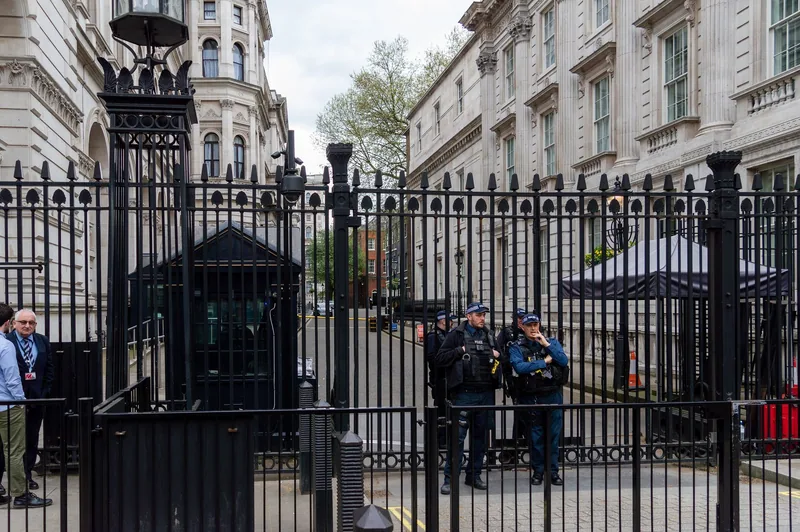
Photo: Tristan Surtel · CC BY-SA 4.0 · Wikimedia Commons · resized
When the street actually closed, and what the record says
The usual line is "since 1989", and the parliamentary record shows that is roughly but not exactly right. On 1 November 1989 MPs were asking the Secretary of State for the Environment about "the permanent gates to be erected across Downing street" and comparing them with "the present barrier", so on that date the gates did not yet exist and something less permanent was already blocking the road. By 7 March 1990 the questions had changed tense: an MP asked what opening and closing arrangements were under consideration "for the newly erected gates at the entrance of Downing street".
The gates therefore went up over the winter of 1989 to 1990, and public access had already been restricted before them. They arrived under Margaret Thatcher and were unpopular enough to be a standing joke in the Commons for years; Hansard for 1990 is full of MPs calling them by rude nicknames and promising to take them down. Nobody did.
If you want to see the gates in the context of the whole ceremonial street, our page on Horse Guards and Whitehall walks the length of it and lists what stands on each side.
Number 10 is much bigger than it looks
The frontage suggests a narrow terraced house. The building behind it is not. The Downing Street house was joined in the early eighteenth century to a much larger and more elegant house behind, which is where the Cabinet Room and the state rooms are. Number 10 also extends to the left of the front door and has taken over much of Number 12, reached by a corridor that runs through Number 11, the Chancellor of the Exchequer's official residence. Prime ministers have used the building since 1735.
The other surprise is the colour. During the rebuilding of the late 1950s and early 1960s it emerged that the familiar black facade was not black at all but yellow brick, darkened by two centuries of coal smoke. The cleaned yellow bricks were painted black so that the building would look the way people expected it to look.
Since 15 February 2011 the household has included Larry, recruited from Battersea Dogs and Cats Home and the first cat at Number 10 to hold the official title Chief Mouser to the Cabinet Office. He has his own page on the government's website, which is not a sentence we write often.
The Cenotaph: an empty tomb in the middle of a working road
Ninety metres south of the gates, the Cenotaph stands on an island in the carriageway. It is the United Kingdom's national war memorial, designed by Edwin Lutyens and unveiled in 1920. The word means empty tomb. It carries no religious symbol, no sculpture of a soldier and no list of names, only the words "The Glorious Dead" and the dates of the two world wars. Flags of the armed services hang from short poles on the long sides.
Its plainness is the point and it was deliberate. In 1919 a temporary version in wood and plaster was put up for a victory parade, and the public response to it was so strong that a permanent stone one followed. The design is extraordinarily subtle: there are almost no true verticals or horizontals in it, and the shallow curves are set out so that the upright faces would meet at a point a long way above the street and the horizontal ones at the centre of a very large circle. You cannot see any of that with the naked eye, which is rather the idea.
On an ordinary day there is no barrier, no ticket and nobody to stop you walking up to it. Wreaths from the previous November are usually still in place, along with more recent ones from regimental associations and visiting delegations. People read them; that is most of what happens here.
Crossing to it without getting run over
This is the practical failing of the Cenotaph as a sight. It sits in the middle of a busy road with traffic on both sides and no pedestrian crossing beside it. The safe approach is to use the signalled crossings at either end of the stretch, by King Charles Street to the south or by the Horse Guards entrance to the north, and then walk along the central island. Do not cross mid-block, which people do constantly and which is how the near-misses happen.
The other practical point is that photographing the Cenotaph well is hard because the background is traffic. Early morning, before about 08:00, is the only time the road is quiet enough for a clean picture, and it is also the only time you can stand back far enough to get the whole monument in.
The Memorial to the Women of World War II
A hundred metres north, also on the central island, stands a plain bronze block about seven metres long, hung with seventeen sets of clothing: a nurse's cape, a welder's overall, a WVS coat, a land girl's dungarees. There are no figures. The clothes stand for the women who wore them, and the effect of the empty uniforms is closer to the Cenotaph's restraint than anything else on Whitehall.
It was unveiled in 2005 after a long campaign by a charity set up for the purpose, and the National Heritage Memorial Fund put £934,115 into the cost, a figure given to Parliament in a written answer in February 2006. It is easy to walk past. Do not.
One day a year, this stretch changes completely
On the second Sunday of November the whole of Whitehall closes and the National Service of Remembrance is held at the Cenotaph, with a march past of about ten thousand veterans afterwards. It is free and unticketed but it is a different kind of visit entirely, with crowds, security and long standing. Everything you need for that day, including where the screens are and where to stand with children, is in our guide to Remembrance Sunday in London.
For the rest of the year the memorial is simply part of the street. That is worth knowing if you are here in, say, February and wondering whether there is a ceremony to catch. There is not.
What to do with the other fifty minutes
Neither of these stops fills an hour, so build them into something. The best ten-minute additions from the gates are:
- The Churchill War Rooms, whose entrance is on the far side of the Treasury building at the King Charles Street end, and which is the paid sight this stretch of Whitehall actually justifies.
- Parliament Square, two minutes south, for Big Ben and the Elizabeth Tower and the statues around the green.
- Trafalgar Square, seven minutes north at the top of Whitehall, with three free national collections on its edges.
- The riverside, five minutes east down Richmond Terrace, where Cleopatra's Needle and the Victoria Embankment make a better twenty-minute walk than Whitehall itself.
Buses are the underrated way to see this street, because the upper deck puts you level with the first-floor stonework of the ministries. Routes 11 and 24 both run the length of Whitehall and both appear in our list of bus routes worth riding for the view. Westminster, Embankment and Charing Cross stations are all within eight minutes on foot.
Security, behaviour and the one thing not to try
There are armed officers at the Downing Street gate and more on the pavement, and they are used to visitors and to cameras. Ask before photographing an individual officer, keep off the road, and do not lean on or climb the gates. The Cenotaph is a war memorial rather than street furniture, and climbing on it or sitting on the steps is taken badly by passers-by as well as by police.
Whitehall is one of the safest streets in London in the ordinary sense, but it is also crowded and slow-moving, which is exactly the environment pickpockets like; our guide to how safe London is has the general picture. Once a year in September the Open House Festival opens some of the government buildings along here, which is the only way most people ever get inside them.
Frequently asked questions
Can tourists walk down Downing Street?
No. The Whitehall end has been closed by gates since the winter of 1989 to 1990, and a barrier restricted access before that. You can stand at the gates on the public pavement and look down the street, but the road itself is inside a security cordon and the front door of Number 10 is not visible from there.
Is there anything to pay for at Downing Street or the Cenotaph?
Nothing at all. Both are on a public street, there is no ticket, no queue and no opening hours. The only paid attraction on this stretch is the Churchill War Rooms, whose entrance is a few minutes away at the King Charles Street end.
What does the Cenotaph commemorate?
It is the national memorial to the British and Commonwealth dead of the First World War and, after 1945, of the Second World War and later conflicts. It carries only the inscription "The Glorious Dead" and the war dates, with no names and no religious symbol, so that it can stand for everyone equally.
Is it disrespectful to photograph the Cenotaph?
No. People photograph it every day and nobody minds. What causes offence is climbing on it, sitting on the steps, or moving the wreaths for a better picture. Treat it as you would a grave and you will be fine.
How long do Downing Street and the Cenotaph take together?
Fifteen minutes, including the walk between them and the wait for a gap in the traffic. Add the Memorial to the Women of World War II and it is twenty. Nobody should plan a half-day around this, but it fits neatly into the walk from Parliament Square to Trafalgar Square.
Sources
- GOV.UK - History of 10 Downing Street (checked September 2026)
- UK Parliament, Hansard - written questions on the Downing Street gates, 1 November 1989 and 7 March 1990 (checked September 2026)
- UK Parliament, Hansard - written answer on monuments and statues, 16 February 2006 (checked September 2026)
- GOV.UK - King Charles Street (checked September 2026)