
Totally Thames is a month of river events spread along the whole London stretch of the Thames every September. Most of it is free, almost none of it needs booking, and it is deliberately scattered rather than concentrated in one place, so you are likely to walk into part of it without planning to.
It covers 42 miles of river, from the western suburbs out to the estuary. In one September you might find an art installation projected onto the columns of a railway bridge, a rowing race of three hundred boats, a Shakespeare production on a sixteenth-century ship, an audio walk across the bridges, and a table of medieval objects pulled out of the mud laid out in a cathedral.
If you want to be on the water rather than beside it, our guides to the river bus and to Thames river cruises cover the boats that run all year. This page is about the festival: who runs it, what the month contains, and how to find what is on during the days you are actually in London.
Totally Thames
- Organiser
- Thames Festival Trust
- When
- Throughout September, every year
- Where
- The 42-mile London stretch of the Thames, both banks
- Cost
- Most events are free; a minority are ticketed
- Website
- thamesfestivaltrust.org (the old totallythames.org address now forwards here)
- Exact dates
- The Trust publishes only "throughout September"; individual events have their own dates
Who runs it, and where the website went
Totally Thames is produced by the Thames Festival Trust, which launched it in 2014 as the successor to the Thames Festival, a large riverside event held from 1997 to 2013. The Trust also runs environmental and education programmes on the river through the rest of the year.
The change of name matters for one practical reason. The address totallythames.org now redirects to thamesfestivaltrust.org, and the programme lives there. Several listings sites still point at the old address, and older printed guides give it as the festival's home.
The Trust does not publish a single set of festival dates. Its own wording is that the festival runs throughout the month of September. Each event within it has its own dates, and some run for the whole month while others last a single afternoon.
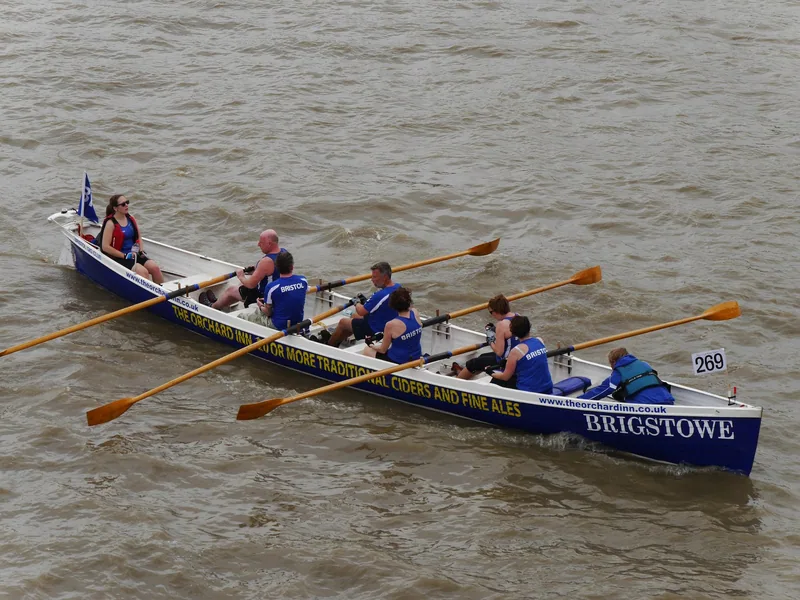
Photo: Edwardx · CC BY-SA 4.0 · Wikimedia Commons · resized
The shape of a typical month
The 2026 programme is a fair sample of how a September works. It contained, among other things:
- Exhibitions running the whole month, including work by young people from Newham, photographic montages, and a riverside photography exhibition
- A site-specific film installation projected onto the columns of Blackfriars Railway Bridge over four nights
- A self-guided audio walk across London's bridges, available through most of the month
- Historical riverside walks at Twickenham on several dates, and a guided history walk along the north bank from Blackfriars
- A theatrical walking tour through Southwark
- Shakespeare's The Tempest performed aboard the Golden Hinde in Southwark over a fortnight
- A traditional folk singing evening aboard a moored vessel
- Contemporary dance in the Brunel Museum's shaft at Rotherhithe
- Two weekend mudlarking exhibitions, one at St Paul's Cathedral and one at London Museum Docklands
- A pop-up art gallery at Tower Lifeboat Station
That mixture is characteristic. There is no single main event and no festival site with a gate. You choose two or three things that happen to fall on the days you are in London.
The Great River Race
The largest single event in the month is the Great River Race, and it is the one most worth building a day around.
Close to 300 crews row 21.6 miles upriver from Millwall Slip in the Docklands to a finish below Ham House at Richmond, in every kind of traditional boat: Cornish pilot gigs, Hawaiian outrigger canoes, Chinese dragon boats, Thames skiffs, Viking longboats. In 2026 it was held on 12 September.
The start time is set by the tide and changes from year to year, so take it from the event listing rather than from a guidebook. In 2026 the first boats left Millwall in the late morning and the leading crew was expected at Richmond in the early afternoon, with the rest arriving over the following hours.
It is run as a handicap race, slowest crews first and fastest last, which produces the best feature of the day: the boats are strung out along miles of river for hours, so there is something to watch from almost any point on the bank for a long stretch of the afternoon, and the fastest crews come through picking off the others.
Practically, that means you can watch from the Isle of Dogs at the start, from anywhere along the central river, or at the finish in Richmond, where the crews arrive over several hours and the riverside has room to sit. It is free from the bank.
Tidefest and getting down to the foreshore
Tidefest is the family end of the festival: a free day at Strand-on-the-Green in Chiswick, held in 2026 on 6 September, with live music, kayaking and paddleboarding, guided foreshore walks, children's activities and what the organisers describe as London's largest fishing competition.
The foreshore walks are the unusual part. At low tide the Thames exposes a wide beach of shingle, brick and broken clay pipe, and much of London's archaeology is lying on it. Guided walks during the festival are led by people who can tell you what you are looking at.
If you want to search the foreshore yourself, that is regulated: a permit from the Port of London Authority is required even to scratch the surface, and the rules are strict. Our guide to mudlarking on the Thames foreshore explains how the permits work and where access is allowed.
The tide on the Thames comes in faster than you can walk. The river rises around seven metres between low and high water in central London and the foreshore floods quickly, with few sets of stairs. Never go down without checking the tide table, and never go down alone.
Art, film and installations
The Trust commissions work each year and in 2026 the headline artist was the Turner Prize-nominated Catherine Yass. The installations tend to be sited where the river itself is the subject: bridge piers, foreshore walls, moorings, and riverside buildings.
Because several of them run for the whole month and are outdoors, they are the easiest part of the festival to catch. Check the programme for what is up during your dates and then treat it as a reason to walk a stretch of river you would not otherwise choose, such as the north bank east of the Tower or the Wandsworth and Battersea reaches.
Our guide to walking London's bridges is a good spine for a day built this way, and the South Bank and Wapping and Rotherhithe pages cover the riverside neighbourhoods in between.
Walks and talks, which are the underrated part
Every year the programme contains more guided walks and talks than anything else, and they are where the festival earns its reputation.
These are not the standard tourist walking tours. They are led by local historians, archaeologists, archivists and river workers, on subjects narrow enough that nobody would run them commercially: the working history of one reach of the river, the archaeology of a single stretch of foreshore, the story of a set of wharves that no longer exist.
Groups are small, which is part of the point and also means the ticketed ones fill up. If you see a walk that matches your interest, book it as soon as the programme appears rather than deciding later in the month.
The self-guided audio walks are the alternative if your dates do not line up. They run for weeks rather than on a single date, they are free, and you do them at your own pace with headphones, which suits an afternoon on the river better than following a raised umbrella.
What it costs and how to book
Most of the programme is free. Some of the performances, boat trips and guided walks are ticketed, and the individual event listing says so.
The Trust's programme pages do not always make free and paid listings easy to tell apart at a glance, so open the listing for anything you plan to attend and check before you travel across London for it. Ticketed events with small capacities, particularly anything on a boat, sell out.
Because there is no central festival site, there is no festival ticket and nothing to book in advance as a whole.
Planning a day around it
The festival's scattered structure is its weakness for a visitor with three days in London and its strength for anyone staying longer.
The approach that works is to pick one reach of the river and spend a day on it. The central stretch from Westminster to Tower Bridge has the greatest density of listings and is walkable end to end in an afternoon. Greenwich and the Docklands have the maritime history and the lifeboat station. The western reaches, Chiswick to Richmond, have the foreshore events and the quiet.
Combining the festival with a boat journey is the obvious move: take the river bus one way and walk back, which gives you the river from both the water and the bank. Greenwich works particularly well for this. If you want to be on the water yourself rather than on a timetabled boat, our page on boat hire in London covers the options, though none of them are on the tidal Thames, which is not a river for beginners.
September is a good month for this in general: the light is softer than in high summer, the weather is often settled, and the crowds have thinned. Open House falls in the same month, and between the two there is a great deal to do for nothing, as our page on free things to do in London sets out. Our guide to London in September covers the month's other events.
2027
The Trust had published nothing about 2027 when we checked in September 2026. The festival has run every September since 2014 and there is no suggestion that will change, but the programme for a given year appears only in the summer, and individual event dates come with it.
The Great River Race and Tidefest have their own organisers and announce separately, often earlier. If either of those is the reason for your trip, check their pages directly rather than waiting for the full festival programme.
The river's other great free spectator event, the Boat Race, is in April and has nothing to do with this festival, though it uses part of the same stretch of water.
Frequently asked questions
When is Totally Thames?
Throughout September each year. The Thames Festival Trust does not publish a single start and end date for the festival; each event within it has its own dates, and some run for the whole month. The 2027 programme had not been published as of September 2026.
Is Totally Thames free?
Most of it is, including the outdoor art, the Great River Race from the riverbank, and Tidefest. Some performances, boat trips and guided walks are ticketed. Check each individual listing, because the programme pages mix the two.
What is the Great River Race?
A 21.6-mile rowing race for traditional boats, from Millwall Slip in the Docklands to Richmond. Around 300 crews take part in everything from Cornish gigs to dragon boats. It is run as a handicap, slowest away first, so the field spreads out along miles of river and there is something to watch from the bank for hours.
Can I go down onto the Thames foreshore during the festival?
Guided foreshore walks are part of the programme and are the safe way to do it. Searching the foreshore yourself requires a permit from the Port of London Authority, and access is only allowed at certain points. The tide rises fast and the foreshore floods, so never go down without checking the tide table.
Where do I find the programme?
At thamesfestivaltrust.org. The old totallythames.org address now redirects there. The programme for each September is published during the summer.
Sources
- Thames Festival Trust - Totally Thames (checked September 2026)
- Thames Festival Trust - What's on (checked September 2026)
- Thames Festival Trust - Tidefest 2026 (checked September 2026)
- Thames Festival Trust - 2026 programme announcement (checked September 2026)