
The Courtauld charges £14 for an adult, and lets in anyone under 19 and any student free. For that you get Manet's A Bar at the Folies-Bergère, Van Gogh's Self-Portrait with Bandaged Ear and one of the best small groups of Impressionist and Post-Impressionist paintings anywhere, in a set of rooms you can see properly in two hours.
It occupies the north wing of Somerset House on the Strand, and you go in through the Strand entrance rather than the courtyard. It is open seven days a week, 10.00 until 18.00, and the last people are admitted at 17.15.
London's big free galleries are covered elsewhere: our guides to the National Gallery and the National Portrait Gallery have the state-funded collections on Trafalgar Square. The Courtauld belongs to a university, charges accordingly, and is the better place to actually look at a painting, because there is nobody standing in front of it.
The Courtauld Gallery at a glance
- Address
- Somerset House, Strand, London WC2R 0RN, via the Strand entrance
- Adult ticket
- £14, or £16 with the optional donation (September 2026)
- Free
- Anyone 18 or under; students; Universal or Pension Credit; Art Fund; ICOM; teachers; Museums Association
- Open
- Daily, 10.00 until 18.00; last admission 17.15
- Payment
- Cashless throughout, including the shop and café
- Time to allow
- Two hours
Students and under-19s pay nothing
This is the fact worth acting on. Entry to the permanent collection is free for everyone aged 18 and under, for students, for anyone receiving Universal Credit or Pension Credit, for a disabled visitor's companion, and for Art Fund, ICOM, teacher and Museums Association cardholders. You still book or collect a ticket, but you do not pay.
For a family, that means two adults and any number of children under 19 come to £28, and a student on a city break pays nothing at all. Our guide to London on a student budget has more in that vein.
| Ticket | Permanent collection | With the temporary exhibition |
|---|---|---|
| Adult, 19 and over | £14 (£16 with donation) | £16 (£18 with donation) |
| Student, Universal or Pension Credit | Free | £7 |
| Teacher | Free | £8.50 |
| Museums Association | Free | £8 |
| 18 and under | Free | Free |
| Art Fund / National Art Pass | Free | No discount |
Note the last line. The National Art Pass gives unlimited free entry to the permanent collection, the Drawings Gallery and the changing displays, but not a penny off the main temporary exhibition. ICOM cards work at any time for the permanent collection but not in the first or last fortnight of a special exhibition.
Tickets cannot be bought over the telephone. They are sold online and at the ticket desk, and the gallery holds back a small number each day for walk-up visitors wanting the permanent collection. They are non-changeable and non-refundable once bought, so check the date. If you miss your slot because of a delayed train, entry is at the discretion of the visitor experience team, and they will usually be reasonable if the gallery is not full.
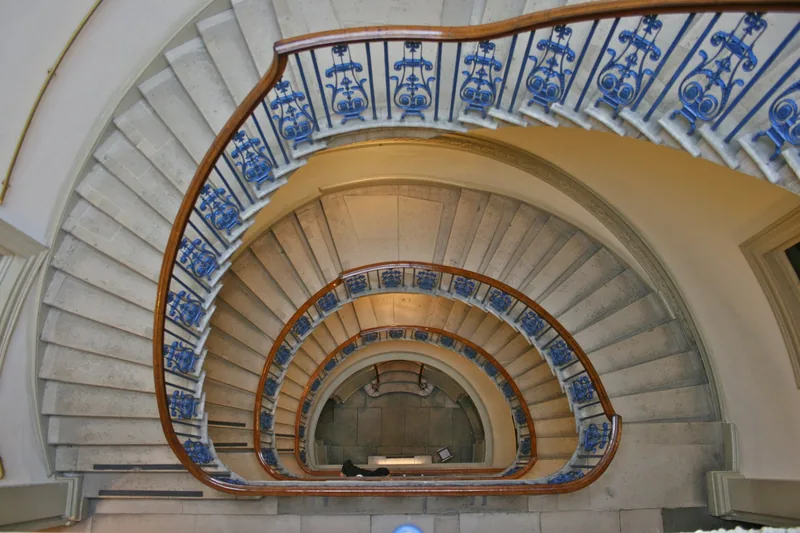
Photograph by Mike Peel (www.mikepeel.net) · CC BY-SA 4.0 · Wikimedia Commons · resized
The paintings people come for
Manet's A Bar at the Folies-Bergère, painted in 1882, is the single most famous object here. A barmaid faces you; behind her a mirror shows the crowded music hall and, in the wrong place entirely, her own back and the man she is serving. Art historians have argued about the geometry of that reflection for well over a century. Stand in front of it for five minutes rather than one.
Van Gogh's Self-Portrait with Bandaged Ear is the other headline, painted at Arles not long after the injury it records. The gallery also holds his Peach Trees in Blossom.
Beyond those two, a list that would be the pride of a national museum: Seurat's Young Woman Powdering Herself, Degas's After the Bath and his small bronze Dancer Looking at the Sole of her Right Foot, Cézanne including Apples, Bottle and Chairback, and Renoir. The collection is not only Impressionist: Cranach the Elder's Adam and Eve is here, and by the gallery's own account one of the largest and finest of the more than fifty versions his workshop made of the subject. There is also Michelangelo's drawing Il Sogno, a pair of Florentine marriage chests of 1472 known as the Nerli Chest, and Vanessa Bell's A Conversation.
The whole collection runs to more than 33,000 objects, from the medieval period to the present, and it is searchable free online.
Do not travel for one particular painting without checking. The Courtauld states plainly that what is on display is under continuous review, so any individual work may be off the wall, on loan or in conservation when you arrive. If you are coming for the Manet or the Van Gogh specifically, ask the gallery before you buy a ticket.
The building, and the rooms
Somerset House was built in the eighteenth century, and its north wing was designed to house the Royal Academy, the Royal Society and the Society of Antiquaries. The Courtauld's Blavatnik Fine Rooms are those original spaces, which means you look at eighteenth-century paintings in an eighteenth-century picture gallery, hung as such a room was meant to be hung.
Elsewhere in the building are the Impressionist and Post-Impressionist rooms and a Drawings Gallery, which shows changing selections from a very large holding of works on paper. Our guide to Somerset House covers the rest of the building, including the courtyard fountains and the ice rink in winter.
The Courtauld Gallery is the public face of the Courtauld Institute of Art, an independent college of the University of London specialising in art history and conservation, which is why the labelling is unusually good and the free public lectures are worth checking.
Two hours, and how to spend them
The gallery is arranged over several floors and is genuinely small. Two hours is the right allowance: about forty minutes in the Impressionist rooms, half an hour in the Fine Rooms, twenty minutes in whatever is in the Drawings Gallery, and the rest wandering back to things you want to see again.
That last part is the argument for the Courtauld over a bigger museum. In a collection this size you can return to a painting twice in one visit without walking half a mile, and the rooms are quiet enough to do it.
The current temporary exhibition, Salman Toor: Someone Like You, runs from 2 October 2026 to 10 January 2027 and needs the combined ticket. Temporary shows here are small and focused rather than blockbuster in scale, which is part of the appeal.
Bags, sketching and the rules
Luggage is the practical problem. There are a few lockers on the lower ground floor, operated by a key and needing no coin, but the gallery cannot take large luggage, rucksacks or suitcases at all. The nearest paid storage is at Charing Cross station, ten minutes away; our guide to left luggage in London lists the alternatives.
Sketching is positively welcomed, which is rarer than it should be, but the materials list is specific. Graphite and coloured pencils, an enclosed sharpener, erasers and paper up to A3 are allowed. Pens and markers of any kind, wax crayons, charcoal, pastels, paints, watercolours, fixatives, glues, scissors, correction fluid, carbon paper and portable easels are all prohibited.
Photographs and video for your own use are fine, without flash and without a selfie stick, and at a sensible distance from the works. Everything in the building is cashless.
The café and the shop are open to everyone, ticket or not. The Courtauld Café sits on the ground floor opposite the main entrance and needs no gallery ticket. If you want the shop, ask at the ticket desk and staff will issue a shop-only ticket. Useful if one of your party is not coming in.
Getting to the Strand entrance
Four Underground stations are within a few minutes: Temple on the Circle and District lines, Charing Cross on the Bakerloo and Northern lines, Embankment on four lines, and Covent Garden on the Piccadilly line. By main-line rail, Charing Cross is the nearest and Waterloo is a walk across Waterloo Bridge.
Buses are the complication. The pedestrianisation of the Strand has changed many routes, and the gallery advises checking your route on the Transport for London site rather than relying on an old map. Cycle parking sits opposite the main entrance to Somerset House, with a Santander docking station opposite the Lyceum theatre on Wellington Street.
If you take a taxi, ask for "the Courtauld at Somerset House". Somerset House is a large building with several entrances and drivers routinely take visitors to the wrong one. The nearest public car parks are at Drury Lane to the north and the Southbank Centre across the river.
What to do either side of it
The gallery's position makes it easy to attach to something else. Covent Garden is five minutes north and the South Bank is straight over the bridge, where the Southbank Centre has free foyers and a river walk. Keep going west along the river and you reach Tate Modern in about twenty minutes, or take a bus south for Tate Britain.
For a second small, quiet collection in a historic interior, the Wallace Collection in Marylebone is the closest thing in London and is free. The Foundling Museum in Bloomsbury is the other paid small museum worth the money.
If the budget is the deciding factor, our list of free museums in London and our breakdown of what a trip to London costs will help you decide where the £14 is best spent. For evening visits generally, see our guide to museum late openings.
Frequently asked questions
How much does the Courtauld Gallery cost?
£14 for an adult, or £16 if you add the optional donation, for the permanent collection in September 2026. A combined ticket with the temporary exhibition is £16, or £18 with the donation. Students and everyone aged 18 and under go free.
Is the Courtauld Gallery free for students?
Yes, for the permanent collection, the Drawings Gallery and the changing displays. Students pay £7 for the combined ticket that includes the main temporary exhibition. The same free entry applies to visitors on Universal Credit or Pension Credit, teachers and Museums Association members.
Which famous paintings are at the Courtauld?
Manet's A Bar at the Folies-Bergère and Van Gogh's Self-Portrait with Bandaged Ear are the best known, alongside Seurat, Degas, Cézanne, Renoir, Gauguin, Cranach's Adam and Eve and a Michelangelo drawing. What hangs is reviewed continuously, so check before travelling for one work.
How long does the Courtauld Gallery take?
Two hours is right for a first visit and covers everything without rushing. That is the gallery's great advantage over the national collections: it is small enough to see properly, and quiet enough to go back to a painting twice.
Can I take a suitcase into the Courtauld Gallery?
No. Large luggage, rucksacks and suitcases cannot be accommodated. A few key-operated lockers on the lower ground floor take smaller items at no charge. The nearest paid luggage storage is at Charing Cross station, about ten minutes' walk away.
Sources
- The Courtauld Gallery - Plan your visit and ticket prices (checked September 2026)
- The Courtauld Gallery - Gallery FAQs (checked September 2026)
- The Courtauld Gallery - The Collection (checked September 2026)
- The Courtauld Gallery - What's on (checked September 2026)