
The Foundling Museum charges £14.50 for an adult, or £13.50 booked online, and lets in everyone aged 21 and under for nothing. The ticket is valid for a year of return visits. It is a small museum and an hour and a half is enough, but it is the most affecting hour and a half in Bloomsbury.
The subject is the Foundling Hospital, opened in the 1740s as Britain's first children's charity, which took in babies whose mothers could not keep them. Mothers who left a child were asked to leave a small object with it, so that the two could be matched again if the mother's circumstances ever changed. Most never came back. The tokens survive in their hundreds.
Bloomsbury's other museums are enormous and free; our guide to the British Museum covers the biggest of them. This one is the opposite in every way, and the comparison is the point: you pay a modest sum, you see a manageable number of things, and you leave thinking about them.
The Foundling Museum at a glance
- Address
- 40 Brunswick Square, London WC1N 1AZ
- Adult ticket
- £14.50 at the door, £13.50 online (September 2026)
- Free
- Everyone aged 21 and under; care-experienced visitors; members
- Ticket validity
- Free entry for a year from the date of your visit
- Open
- Tuesday to Saturday 10am to 5pm, Sunday 11am to 5pm; closed Monday
- Nearest station
- Russell Square, 4 minutes; King's Cross St Pancras and Euston, 10 minutes
Everyone under 22 gets in free
This is the detail that changes the sums for families and for young travellers, and the museum does not shout about it. The free category is not "children" but "21 and under", which covers teenagers, students and anyone on a gap year. A couple in their thirties with two teenagers pay £27 online between them, not £54.
The other discounts are narrower. A student aged 22 or over pays £13, or £12 online, as does anyone on the reduced-price rate. Care-experienced visitors and museum members go in free, and carers accompanying a disabled visitor are admitted free while the disabled visitor pays the concessionary rate. Booking online saves £1 on every adult ticket.
The year's free return is genuinely useful if you are in London for a week: the museum's temporary exhibition programme is good, it is five minutes from three main-line stations, and a second visit costs nothing. Set against the big ticketed attractions, £14.50 is modest; the cost of a London trip is broken down elsewhere on the site.
Two adults and two teenagers get in for £27. Because the free age limit runs to 21 rather than to 16, this is one of the cheapest museums in central London for a family with older children, and one of the very few where the teenagers cost nothing at all.
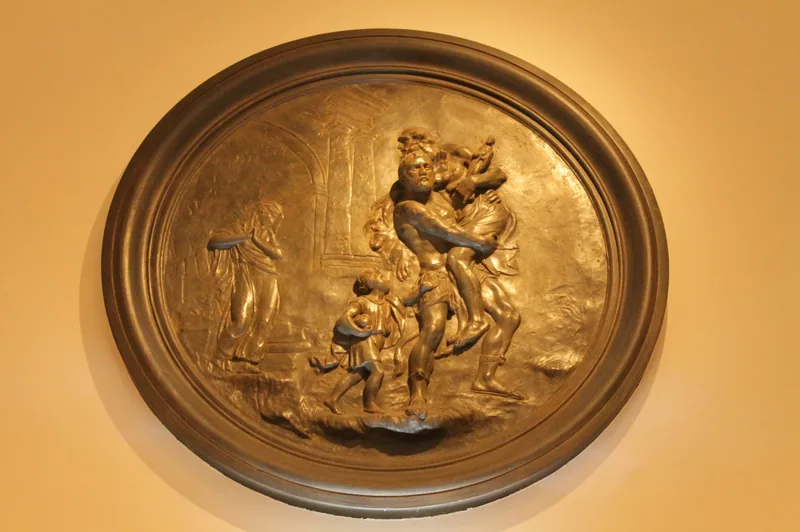
Photo: Stephencdickson · CC BY-SA 4.0 · Wikimedia Commons · resized
The tokens
The tokens are in the Introductory Gallery, and they are small. A halved medallion showing Isaac Newton, so that the two pieces could be matched. A beaded ribbon that once had the words Cruelle Separation embroidered on it. A black hand amulet, worn against evil. A child's ring. A piece of mother-of-pearl engraved by hand. A heart cut from paper and cloth, because embroidery was one of the few ways a woman with nothing could make an object that belonged to no one else.
Alongside them the gallery shows the Hospital's Royal Charter, on loan from the children's charity Coram, objects from the daily life of the children, and recorded voices telling individual stories. The token was, in most cases, the last connection a mother had with her child, and it was never claimed.
Take the time to read the labels. The museum has resisted the urge to over-explain, and the objects do the work, but the stories attached to them are what people remember years later.
The historic rooms, and the first public art gallery in Britain
Beyond the Introductory Gallery the museum recreates and preserves rooms from the original Foundling Hospital building. The Court Room Gallery holds the paintings, plasterwork and furniture given by the leading artists and craftsmen of the eighteenth century, and the Picture Gallery holds the portraits of the Hospital's supporters, including William Hogarth's portrait of Thomas Coram, the retired sea captain whose years of campaigning brought the Hospital into being.
Hogarth persuaded his friends to donate works, and the public came to look at them. That is how Britain's first public art gallery came into being: as a fundraising exhibition inside a children's home. Gainsborough and Reynolds gave pictures too. Anyone interested in the wider story of British art should also see Tate Britain, which has more Hogarth, but this is where the idea of showing art to the public began.
Contemporary work runs through the building alongside the historic collection, with pieces by artists including Yinka Shonibare, Tracey Emin and Michael Craig-Martin responding to the same themes of care, separation and belonging.
Handel, and the room where you sit down
George Frideric Handel led fundraising concerts at the Hospital and bequeathed it a manuscript score of Messiah. Both his will and that score are in the museum's Handel Gallery, which draws on the Gerald Coke Handel Collection.
The gallery has armchairs with headphones, and the intended way to use it is to sit in one and listen for twenty minutes. Most visitors walk through in three. If you do only one thing here beyond the tokens, sit down. Our guide to classical music in London has the concert halls; this is where a lot of the city's charitable concert tradition started.
What the museum does not have
There is no café. That sounds trivial and it is not, because the museum also does not allow food or drink to be consumed anywhere inside it. Plan around that, particularly with children.
The solutions are all outdoors and all within a few minutes. Brunswick Square, directly opposite, takes picnics in decent weather. Coram's Fields, a five-minute walk away, has a café and space to sit; it is a children's playground on the land where the Hospital once stood, and our guide to London's city farms and playgrounds covers it. The museum also has an arrangement with several local cafés and restaurants that gives a discount on food and drink; ask at the front desk for the details.
The cloakroom has closed, and the museum asks visitors not to arrive with large bags. There are a limited number of lockers for small bags and coats. If you are carrying luggage, telephone ahead on 020 7841 3600 to ask whether it can be accommodated, rather than turning up and hoping.
Check the amended opening hours before a November visit. The museum publishes one-off changes on its visit page. In 2026 the Court Room closed from 3pm on 11 September, the whole museum closed from 1pm on 14 November, and the first floor was shut on 25 November. It also closes from 24 to 28 December and on 1 January.
Families, pushchairs and access
Pushchairs and prams can be taken through the galleries using the lift, but space at reception is limited and they must be folded if you leave them there. Baby changing is on the ground floor. Breastfeeding and bottle feeding are welcome, there is seating on every floor, and staff will find you a private room if one is free.
Visitors with disabilities are admitted at the concessionary rate and carers come in free. Photography and filming for personal use are allowed without flash, although some temporary exhibitions restrict it, in which case it will be signposted.
For younger children, be honest with yourself about the subject matter. The museum is gentle in how it tells the story, but the story is about mothers giving up babies, and a thoughtful eight-year-old will ask questions. There are lighter options for an afternoon nearby in our family guide to London.
Getting to Brunswick Square
Russell Square, on the Piccadilly line, is four minutes away. King's Cross St Pancras and Euston are both about ten minutes on foot, which makes this one of the better ways to fill a gap before a train; our guide to London's main railway stations explains how they connect.
Buses 1, 68, 91 and the N91 night bus stop by Russell Square station. Santander Cycles docking stations sit on Brunswick Square itself and at Russell Square station. There is no museum car park; the nearest public parking is under the Brunswick Centre.
Making a morning or an afternoon of it
The Foundling is small enough that it needs a companion. The obvious one is Wellcome Collection, ten minutes north-west on the Euston Road, which is free and closes on Mondays like this one. Bloomsbury itself is worth an hour of walking between the squares, and our guide to staying in Bloomsbury covers the area if you are based here.
For a paid museum of similar size and ambition, the Courtauld Gallery at Somerset House is twenty-five minutes south. For a free one, Sir John Soane's Museum is a fifteen-minute walk towards Holborn, and both are covered in our survey of London's small museums. If the weather has turned, there are more suggestions within the same square mile in what to do in London when it rains.
Frequently asked questions
What does a ticket to the Foundling Museum cost?
£14.50 for an adult at the door and £13.50 booked online, as at September 2026. Students aged 22 and over and reduced-rate visitors pay £13, or £12 online. Everyone aged 21 and under enters free, as do care-experienced visitors and members.
Is the Foundling Museum worth visiting?
If you want an hour and a half that stays with you, yes. It is small, and it charges in a city full of free museums, but the tokens the mothers left, the Handel manuscripts and the eighteenth-century rooms are not like anything else in London. The ticket also covers a year of return visits.
What are the Foundling Hospital tokens?
Small objects left by mothers with the babies they gave up, so that a child could be identified if the mother's circumstances improved and she came back for them. They include halved coins, ribbons, rings, amulets and hand-embroidered hearts. Very few reunions ever took place.
Does the Foundling Museum have a café?
No, and eating and drinking inside the museum is not allowed. Brunswick Square opposite is a good picnic spot in fine weather, Coram's Fields nearby has a café, and the museum has a discount arrangement with several local cafés; ask at the front desk.
Is the Foundling Museum suitable for children?
Under-22s go in free and the galleries are lift-accessible with a pushchair, but the subject is mothers giving up their babies. Older children who like history will find it powerful; very young children will find little to do, and there is no café to retreat to.
Sources
- The Foundling Museum - Visit us (checked September 2026)
- The Foundling Museum - What you'll see (checked September 2026)
- The Foundling Museum - Our story (checked September 2026)