
The National Portrait Gallery, just behind the National Gallery off Trafalgar Square, shows the faces of British history, from Tudor kings and queens to today's writers, scientists, musicians and athletes. It is free to enter, open daily from 10:30, and stays open until 21:00 on Fridays and Saturdays.
The idea is simple: the gallery collects portraits of people who mattered in British life, and it chooses them for who the sitter was, not for who painted them. So a Tudor panel painting and a photograph taken a few years ago can hang in the same building. For visitors, it is one of the quickest ways to put names and faces to the history you meet everywhere else in London.
It is also the easiest big gallery to pair with something else. The building is small enough to see in about an hour and a half, its entrance is two minutes' walk from the National Gallery, and its late opening on Fridays and Saturdays fits neatly before dinner or a West End show.
National Portrait Gallery: quick facts
- Price
- Free; some exhibitions are paid
- Booking
- Free advance booking recommended to guarantee entry
- Hours
- Sunday-Thursday 10:30-18:00 (last entry 17:30); Friday and Saturday 10:30-21:00 (last entry 20:30)
- Address
- St Martin's Place, London WC2H 0HE
- Main entrance
- Ross Place, near the corner of Orange Street and Charing Cross Road; all entrances step-free
- Nearest stations
- Leicester Square (about 195 m), Charing Cross Underground (about 230 m), Charing Cross rail (about 320 m)
- Cloakroom
- £2.50 or £5 per item
How the gallery is laid out: start at the top
The portraits hang in date order, and the best way to follow them is to begin at the top of the building and work down. The gallery itself suggests taking the lifts or escalator straight up to Floor 3 and then walking down through the centuries.
| Floor | Rooms | What you will find |
|---|---|---|
| Floor 4 | - | The Portrait Restaurant, with views over the rooftops |
| Floor 3 | 1-18 | Portraits from about 1300 to 1850: Tudors, Stuarts, Georgians and the Romantic poets |
| Floor 2 | 19-28 | 1850 to 2000: Victorians, the two world wars, the 20th century; also exhibition space |
| Floor 1 | 29-32 | 2000 to today |
| Floor 0 | 33 | History Makers display, exhibitions, ticket desk, cloakroom and shop |
| Floors -1 to -3 | - | Cafés, learning centre, toilets and Changing Places toilet |
Some rooms close from time to time for changes of display. In autumn 2026 the gallery listed Room 32 (Life and Death: Masks) as closed from 24 August to 8 October 2026, with Rooms 30 and 31 also closed from 21 September until 8 October. If the recent portraits on Floor 1 are what you want to see, check the official visit page before you go.
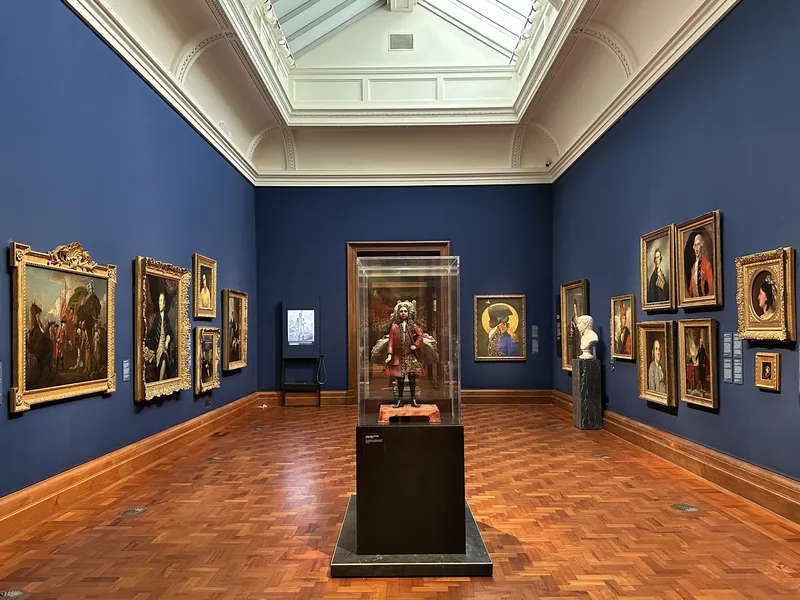
Photo: APK · CC BY 4.0 · Wikimedia Commons · resized
Famous faces from the Tudors to today
The gallery owns more than 12,000 portraits in its main collection, plus a huge photographic archive, and it usually has over 1,000 on display at any one time. Displays rotate regularly, so no single portrait is guaranteed to be on the wall on the day you visit. Use the online collection search to check a particular picture first.
Floor 3: kings, queens and poets
This is the floor most first-time visitors come for. The Tudor rooms bring you face to face with Henry VIII, his wives and his children, including Elizabeth I in the elaborate, jewelled costumes she used as political statements. Among the best-known works in the collection are the full-length Ditchley portrait of Elizabeth I standing on a map of England, and the so-called Chandos portrait, long believed to show William Shakespeare, which was the first portrait the gallery acquired when it was founded in 1856.
Further on come the Stuarts and the Civil War, then the Georgian age of politicians, actresses and explorers, and finally the Romantic poets and novelists. The painting of the three Brontë sisters by their brother Branwell, with his own figure painted out, is one of the collection's most moving pictures.
Floor 2: Victorians to the 20th century
The middle floor moves from Victorian scientists, engineers and reformers through the suffragettes and the two world wars to post-war Britain. Here the portraits start to include photographs, and the range of people widens sharply: politicians and generals sit alongside pop stars, sports figures and campaigners.
Floors 1 and 0: Britain now
The lower floors show portraits made since 2000, in painting, photography, sculpture and film. Expect to recognise some faces from the news, from sport and from television. The History Makers display in Room 33, on the ground floor, is a good place to finish.
Take the escalator up before you look at anything. The main entrance brings you in at the bottom of the building, among the most recent portraits. If you start browsing there you will be walking backwards through history. Head straight up to Floor 3 and let the story unfold in the right order as you come down.
Tickets, free booking and paid exhibitions
Entry to the collection is free for everyone. The gallery recommends booking a free general admission ticket in advance to guarantee entry and receive updates before your visit, which is worth doing at weekends and in school holidays. On quieter weekdays you can usually walk in.
Temporary exhibitions are on Floors 0 and 2 and usually charge. In September 2026 the annual Herbert Smith Freehills Kramer Portrait Award 2026, the gallery's long-running painted portrait competition, was on show until 7 October 2026, and the gallery's photographic portrait prize exhibition was listed for 5 November 2026 to 17 January 2027. Check prices on the gallery's website.
Useful discounts for exhibitions: children under 12 in family groups go free, students and disabled visitors get 10% off (with free entry for one carer), and groups of ten or more get 10% off. There is no booking fee online, by phone or in person, and last entry to exhibitions is one hour before closing.
Late openings on Fridays and Saturdays
The gallery stays open until 21:00 on Fridays and Saturdays, with last entry at 20:30. That makes it one of the few London galleries you can visit on a Saturday evening, and the rooms tend to be calmer after about 18:00.
A simple evening plan: see the National Gallery in the afternoon (it is open until 21:00 on Fridays too), walk round the corner to the Portrait Gallery at about 18:00, and finish with dinner in Chinatown or Covent Garden. Our guide to museum late openings lists other evening options across the city.
Bags, photography and practical details
You may take photographs and film in the main galleries for personal, non-commercial use, but not in some exhibitions or displays that include loans. Please do not photograph staff or other visitors without asking.
In the main galleries, backpacks must be worn on your front or carried in your hand; otherwise you must check them in. Backpacks and large bags (more than 35 x 25 x 15 cm) are not allowed into temporary exhibitions at all. The cloakroom on Floor 0 charges £2.50 or £5 per item and has limited space, so travel light. Food and drink may not be consumed in the galleries.
There is free Wi-Fi throughout, and a free digital guide with audio tours on the Bloomberg Connects app; bring headphones. Sketching with pencil on paper no bigger than A3 is welcome.
The nearest Tube stations have no lifts. The gallery points out that Leicester Square, Charing Cross Underground and Embankment stations do not have a lift. Wheelchair users are advised to arrive by taxi or car, set down at the corner of Orange Street and Charing Cross Road, and use the ramp to the main entrance on Ross Place.
Access and facilities
All entrances are step-free, and there are lifts between the floors. A limited number of manual wheelchairs can be borrowed free from the ticket desk on Floor 0; the gallery recommends booking one in advance. Toilets are on Floors -2, -3 and 4, and there is a Changing Places toilet on Floor -2 (bring your own sling). Our guide to accessible London covers step-free routes and other attractions with good access.
For food, the Audrey Green café is at street level on Floor -1, Larry's dining and bar is on Floor -3, and the Portrait Restaurant on Floor 4 has panoramic views over the rooftops. A separate café, the Portrait Pavilion, is opposite the main entrance on Charing Cross Road.
Getting there
The gallery is at the top of Trafalgar Square, on St Martin's Place, facing the church of St Martin-in-the-Fields. Leicester Square station (Northern and Piccadilly lines) is about 195 metres away and Charing Cross Underground (Northern and Bakerloo lines) about 230 metres. Charing Cross mainline station is about 320 metres and Embankment about 490 metres. Our guide to the London Underground explains fares and touching in and out.
Many buses stop around Trafalgar Square; the gallery's nearest stop is Bus Stop K. Bike racks are nearby, but folding bikes are not allowed inside, even in the cloakroom. There is no car park.
A Trafalgar Square day built around the gallery
The Portrait Gallery shares a building block with the National Gallery, and seeing both on the same day is easy: allow about two hours for the paintings and an hour and a half for the portraits. In front of them, Trafalgar Square has Nelson's Column and the Fourth Plinth, where Tschabalala Self's Lady in Blue was unveiled on 10 September 2026.
From the square, The Mall leads under Admiralty Arch towards Buckingham Palace, with St James's Park alongside for a picnic. Whitehall runs south to Westminster, where you can see the tombs of Elizabeth I and Mary, Queen of Scots in Westminster Abbey, a fitting follow-up to the Tudor rooms. And if the Tudors are your main interest, the Tower of London fills in the darker side of the story.
North of the gallery, Charing Cross Road is lined with bookshops (see our guide to London's best bookshops), and Chinatown and Covent Garden are both within five to ten minutes' walk for dinner. For last-minute seats at a musical after your Saturday evening visit, read our tips on cheap theatre tickets.
Portrait Gallery or Madame Tussauds?
Both are about famous faces, but they are very different. The Portrait Gallery is free, historical and quiet, and every portrait is a real work of art from its time. Madame Tussauds is a paid attraction built around wax figures of current celebrities, with photo opportunities as the main point. Families with younger children may prefer the waxworks; anyone curious about British history will get more from the gallery, and it costs nothing.
Frequently asked questions
Is the National Portrait Gallery free?
Yes. Entry to the National Portrait Gallery's collection is free for everyone. Some temporary exhibitions charge, and children under 12 in family groups go free to those. The gallery recommends booking a free general admission ticket online to guarantee entry, especially at busy times.
What time does the National Portrait Gallery open?
The gallery opens daily at 10:30. It closes at 18:00 from Sunday to Thursday, with last entry at 17:30, and at 21:00 on Fridays and Saturdays, with last entry at 20:30. Staff begin closing the rooms ten minutes before the stated time.
How long does it take to see the National Portrait Gallery?
About 90 minutes is enough to walk through all the collection floors, from the Tudors on Floor 3 down to the present day. History enthusiasts can easily spend half a day, especially if they add a paid exhibition or stop for lunch.
Is the National Portrait Gallery the same as the National Gallery?
No. They are separate museums next to each other on Trafalgar Square. The National Gallery shows European paintings chosen for their artistic importance. The National Portrait Gallery shows portraits of notable British people, chosen for who they depict. Both are free.
Can you take photos in the National Portrait Gallery?
Yes, for personal and non-commercial use in the main galleries. Photography is not allowed in some temporary exhibitions and displays that include loans, so look for signs. The gallery asks visitors not to photograph staff or other visitors without permission.
Sources
- National Portrait Gallery - Visit (Internet Archive copy, 28 August 2026) (checked September 2026)
- National Portrait Gallery - Floor plans (Internet Archive copy, 26 June 2026) (checked September 2026)
- National Portrait Gallery - Frequently asked questions (Internet Archive copy, 14 August 2026) (checked September 2026)
- Mayor of London - Lady in Blue unveiled on London's Fourth Plinth (checked September 2026)