
Dulwich Picture Gallery opens Tuesday to Sunday, 10am to 5pm, and is closed every Monday. A collection ticket costs £10 for an adult with the optional donation, under-18s go free, and the Sculpture Garden outside is free to everyone seven days a week. Allow ninety minutes.
The gallery calls itself Britain's first purpose-built public art gallery, and it is the building as much as the paintings that people come for: Sir John Soane designed it, the foundations went in on 19 October 1811, and it opened to the public in 1817. Our guide to Herne Hill and Dulwich covers the village around it and gives the current ticket table; this page is about what is inside and how to use it.
Getting there is easier than the postcode suggests. The gallery says it is about fifteen minutes from central London by train, with services roughly every fifteen minutes from Victoria to West Dulwich or from London Bridge to North Dulwich, and both stations are a ten-minute walk away. Door to door from the West End, allow half an hour.
Dulwich Picture Gallery: the practical frame
- Days
- Tuesday to Sunday, including bank holidays. Closed Mondays
- Hours
- Gallery and shop 10am to 5pm; Sculpture Garden 8am to 5pm daily
- Collection ticket
- £10 adult with donation; student or disabled visitor £5, companion free; under-30s £5; under-18s free; Art Fund members free
- Exhibition ticket
- From £20 adult with donation (it varies by show); under-30s and students £10; under-18s free
- Address
- Gallery Road and College Road, London SE21 7AD
- Stations
- West Dulwich (from Victoria) and North Dulwich (from London Bridge), both about 10 minutes on foot
- How long
- 1 hour for the collection; 1.5 to 2 hours with an exhibition and the garden
What Soane actually did here
Bourgeois, one of the three founders, left £2,000 to build a permanent home for his collection, and asked Soane to include a mausoleum and almshouses in it. The first plan was to hang the paintings in a wing of nearby Dulwich College, but Soane found the building in disrepair and proposed a new one instead. His plans were approved in July 1811.
The decisions that matter are all about light and money. Soane lit the rooms from above, through roof-lanterns that spill a diffused top light down the walls, which both suits oil paintings and leaves the whole wall free for hanging. Nobody had done that in a public gallery before, and gallery architects have been copying it ever since. He built in cheap London stock brick and spent the Portland stone only on the lantern, the frieze and the base. He was criticised at the time for using a material thought too humble for the job. He also did not charge a fee.
Soane's own house in Holborn is the other half of this story and is free: see Sir John Soane's Museum. Visiting both in the same week is the clearest way to see how one mind produced a domestic maze and a perfectly calm public gallery.
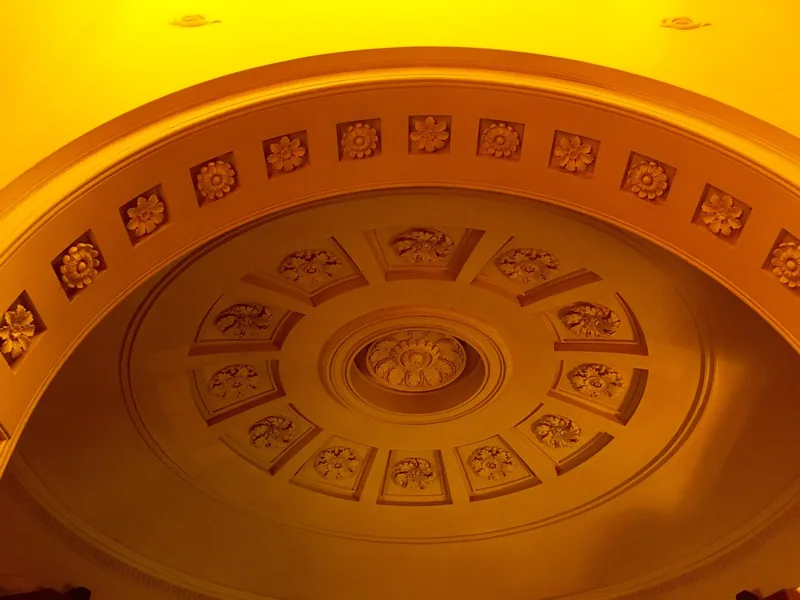
Photo: No Swan So Fine · CC BY-SA 4.0 · Wikimedia Commons · resized
The mausoleum, and the amber light in it
Off the main run of rooms is a mausoleum holding the three founders: the dealer Noël Desenfans, the painter Sir Francis Bourgeois, and Margaret Desenfans, the only founder still alive when the building went up. Soane glazed its high windows in amber, so the room glows a thick yellow whatever the weather outside.
From the garden the shape is a funeral monument, with urns on the roof, sarcophagi over the doors and altars at the corners. It takes two minutes to see and it is the single strangest thing in any London art gallery. Do not walk past it looking for the Rembrandt.
Five rooms that became fourteen
Soane's gallery was originally five rooms linked by arches, set in a line so that you could see the whole length at once. That run is still the spine of the visit. In 1884 the old almshouses were converted into what are now the temporary exhibition galleries, rooms were added between 1910 and 1937, and after the building was badly bomb-damaged in 1944 it was rebuilt in replica. Rick Mather's extension of 2000 added the entrance area and the modern facilities.
The practical consequence: the permanent collection and the paid exhibition are in different parts of the building, and you can buy a ticket for one without the other. Walk the enfilade first, then the exhibition, then the garden.
Come in through College Road and out through the shop. There is level access at the College Road entrance and a level exit through the shop onto Gallery Road, which the gallery says is the step-free route through the whole building.
The paintings, and how small a good collection can be
The collection is described by the gallery as especially strong in French, Italian and Spanish Baroque painting and in British portraits from Tudor times to the 19th century. It is small. You can see all of it properly in an hour, which is the opposite of the experience the big national museums offer and a large part of why people keep coming back.
The picture most visitors come for is Rembrandt's Girl at a Window of 1645, a servant girl leaning on a stone ledge, looking straight out at you with the beginnings of a smile. It hangs at eye level in a room you can stand back in. There is Poussin, Canaletto, Gainsborough's portrait of Elizabeth and Mary Linley, Van Dyck, and a portrait of Margaret Desenfans in the building she helped pay for.
If this is the kind of collection you like, the two obvious comparisons are the Courtauld Gallery on the Strand and the Wallace Collection in Marylebone. All three are small, hung generously and quiet on a weekday; only the Wallace is free.
Two ticket types, and which one you need
| Ticket (September 2026, with the optional donation) | Adult | Covers |
|---|---|---|
| Collection | £10 | The permanent collection and the free displays |
| Exhibition | From £20 | The exhibition plus the collection and displays |
| Under-18s | Free | Both ticket types |
| Under-30s (registered) | £5 / £10 | Collection / exhibition |
| Universal Credit or Pension Credit | Free / £1 | Collection / exhibition |
| Group of 10 or more | £16.50 per person | £26.50 with an exhibition or a tour |
| Sculpture Garden and grounds | Free | 8am to 5pm, seven days a week |
Exhibition prices are set per show, so treat "from £20" as a floor rather than a figure. In August 2026 the gallery listed its American photography exhibition at £16, or £14.40 booked online, and the Hokusai show from £21.50. Booking online is usually cheaper, and advance booking is recommended rather than required.
What is on, and when the free exhibition is
The 2026 to 2027 programme announced by the gallery runs: Portrait of a City: A Century of American Photography to 4 October 2026; Hokusai: Thirty-six Views of Mount Fuji from the Iuchi Collection, the complete series, from 20 October 2026 to 17 January 2027; Charlie Mackesy: The Boy, the Mole, the Fox, the Horse...and You from 3 November 2026 to 7 February 2027; then Jacqueline Marval from 2 February 2027 and a Sahara Longe display from 16 February 2027.
Note the one that costs nothing extra. The Mackesy show is included with gallery admission, not sold as a separate exhibition ticket, so between November 2026 and February 2027 a £10 collection ticket gets you the drawings as well. That is the best value the gallery offers all year, and it is the show most likely to be busy with families.
The Sculpture Garden, and the part with no ticket
Three acres of grounds around the building hold a trail of contemporary sculpture, and it is all free and open 8am to 5pm every day, Mondays included. The 2025 rebuilding project added the Lovington Sculpture Meadow, a new play space and a ground source heat pump; the gallery calls it the biggest redevelopment in twenty years.
On the last Sunday of each month a farmers' market runs in the garden. The café and takeaway counter are also outside the ticket barrier, which our round-up of museum and gallery cafés singles out as unusual for a gallery that charges. Their hours are shorter than the garden's and shift with the school terms, so check on the morning.
With children under eight
The ArtPlay Pavilion is a sensory play space for under-eights built around the paintings: a bridge taken from a Canaletto, clouds taken from a Poussin. It is open 9am to 4.45pm, seven days a week, which means it is the one part of the site that works on a Monday when the gallery itself is shut. Sessions cost £9 and include free entry for up to two adults per child.
There are also free Art Sundays for families on the last Sunday of the month, and paid monthly sessions for younger children. For what else is nearby, Dulwich Park is directly opposite the College Road entrance, with a boating lake and a playground.
Getting there, and the mistake drivers make
By train from Victoria to West Dulwich or from London Bridge to North Dulwich, then ten minutes on foot. Both are National Rail stations inside the London zones, so contactless pay as you go works at the barriers; how the zones work explains the fare side. From Brixton, the P4 bus stops directly outside the gallery café, which is the easiest option if you are already on the Victoria line and want to visit Brixton the same day. From Peckham Rye the 37 bus runs to North Dulwich.
Driving is the trap. There is free on-street parking on Gallery Road and College Road and paid parking in Dulwich Park, but Gallery Road is inside the 24-hour Ultra Low Emission Zone, and Dulwich Village is a Low Traffic Neighbourhood with weekday restrictions that will route you a long way round or fine you. Read the ULEZ and Congestion Charge rules before you decide, or take the train.
A Monday in Dulwich still works, just not inside the gallery. The Sculpture Garden, the grounds and the ArtPlay Pavilion are all open on Mondays. The gallery, the shop and the main café are not.
How long, and what to do afterwards
An hour for the collection, half an hour for a temporary exhibition, twenty minutes for the garden and the mausoleum: ninety minutes to two hours all in. That leaves an afternoon, and the obvious continuation is east to the Horniman Museum in Forest Hill, which is free and about twenty minutes away by bus, or a walk through the village. Our page on south London's big estates and parks covers the greener version of the same day.
A last argument for going. Almost nothing in central London lets you stand back three metres from a Rembrandt on a Wednesday morning without queueing. This does, for £10, and the reason is simply that it is fifteen minutes further out than most visitors are willing to travel. Our guide to avoiding the crowds in London makes the same case for several other places.
Frequently asked questions
Is Dulwich Picture Gallery free?
No, the gallery charges. A collection ticket was £10 for an adult with the optional donation in September 2026, and exhibition tickets start higher and vary by show. Under-18s enter free, as do Art Fund members, and visitors on Universal Credit or Pension Credit pay nothing for the collection. The Sculpture Garden and grounds are free to everyone.
Is Dulwich Picture Gallery open on Mondays?
The gallery, the shop and the main café are closed on Mondays. The Sculpture Garden and grounds are open 8am to 5pm every day, and the ArtPlay Pavilion for under-eights is open 9am to 4.45pm seven days a week, so a Monday trip is not wasted, but you cannot see the paintings.
How do I get to Dulwich Picture Gallery from central London?
Take a train from London Victoria to West Dulwich or from London Bridge to North Dulwich, roughly every fifteen minutes, then walk about ten minutes. The gallery quotes fifteen minutes from central London for the train itself. Alternatively take the Victoria line to Brixton and the P4 bus, which stops outside the gallery café.
What is the most famous painting at Dulwich Picture Gallery?
Rembrandt's Girl at a Window, painted in 1645 and signed and dated in the lower right corner. The collection also holds work by Poussin, Canaletto, Van Dyck and Gainsborough, and it is small enough to see properly in about an hour.
How long does Dulwich Picture Gallery take?
About an hour for the permanent collection, ninety minutes to two hours if you add a temporary exhibition, the mausoleum and a walk round the Sculpture Garden. It is one of the few London galleries where a short visit does not feel like a compromise.
Sources
- Dulwich Picture Gallery - Visit us: prices, opening hours and getting here (read via an Internet Archive copy of 2 July 2026; the live site blocks our requests)
- Dulwich Picture Gallery - Our architecture (read via an Internet Archive copy, 2026)
- Dulwich Picture Gallery - History of our collection (read via an Internet Archive copy, 2026)
- Dulwich Picture Gallery - Rembrandt, Girl at a Window (DPG163) (read via an Internet Archive copy, 2026)
- Dulwich Picture Gallery - exhibition programme 2026-27 (read via an Internet Archive copy of 31 August 2026)
- Transport for London - Ultra Low Emission Zone (checked September 2026)