
Before you plan a trip to Forest Hill, one thing has to be said. The Horniman's famous over-stuffed walrus is not on display, and has not been since March 2024. The Natural History Gallery that houses it is being rebuilt and is due to reopen in early 2027. Everything else about the place is open, free and very good, but if the walrus is the reason you were going, wait.
What remains is still a proper day out: a free world cultures gallery, a free musical instruments gallery, several acres of gardens on a south London hilltop with a long view across the city, a free farmyard walk, a paid aquarium and a paid butterfly house. Entry to the museum and gardens costs nothing.
Our survey of London's smaller museums introduces the Horniman in a paragraph. This page has the current prices, the opening times that vary between five different parts of the site, and an honest view of whether the journey is worth it while the best-known gallery is shut.
The Horniman at a glance
- Address
- 100 London Road, Forest Hill, London SE23 3PQ
- Museum and Gardens
- Free, no ticket needed
- Museum hours
- 10am to 5.30pm daily
- Aquarium
- Adult £6.50, child £3.50, family of four £15.20 (September 2026)
- Butterfly House
- Adult £9.90, child £6.50, family of four £26 (September 2026)
- Closed until 2027
- The Natural History Gallery, including the walrus
The walrus: where it is and when it comes back
The story told about it is that the Victorian taxidermist had never set eyes on a living walrus and simply kept stuffing until every wrinkle was smooth. Whatever the truth of that, the result is a drum-tight animal that looks almost nothing like a walrus and has become, entirely by accident, the mascot of south London.
It sits in the Natural History Gallery, which closed in March 2024 for a project the museum calls Nature + Love. The gallery is listed inside, so the historic showcases around the perimeter are being kept and renovated rather than replaced, with a new central spine of cases and five themed groups. The museum has said explicitly that the walrus will stay on open display when the gallery returns, and that the much-loved character of the old room will survive.
The reopening is scheduled for early 2027, which will round off the museum's 125th anniversary celebrations; the purpose-built building first opened in June 1901. At the time of writing the museum was running a crowdfunder for the last £30,000 needed to reopen the gallery and bring the natural sciences collection back on show.
Any guidebook that promises you the walrus is out of date. The Natural History Gallery has been shut since March 2024 and is not expected back until early 2027. The adjacent Nature Base is also closed while it becomes a new space for families. Check the museum's own site before travelling if this is your reason for going.
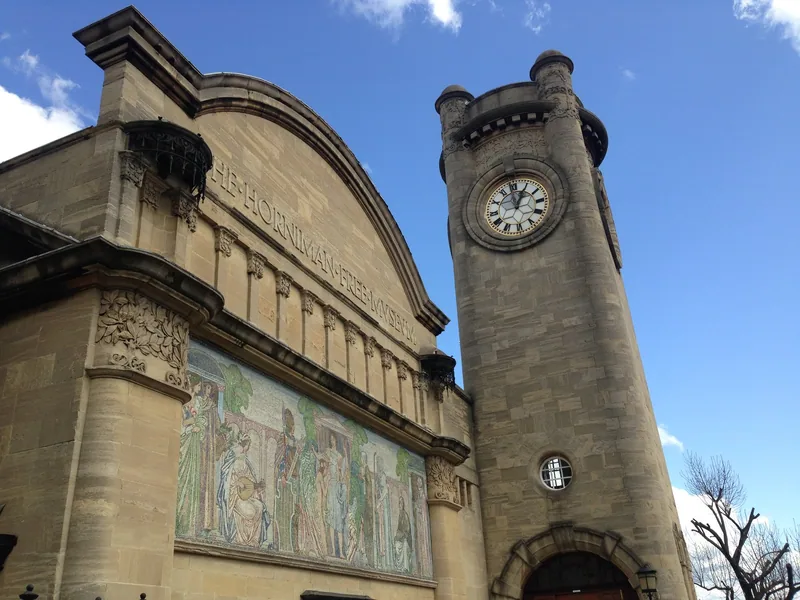
Photo: No Swan So Fine · CC BY-SA 4.0 · Wikimedia Commons · resized
What is free, and what is not
The distinction is simple: buildings and gardens are free, live animals and temporary exhibitions are paid.
| Part of the Horniman | Price | Hours |
|---|---|---|
| World Gallery | Free | 10am to 5.30pm |
| Music Gallery | Free | 10am to 5.30pm |
| Gardens | Free | From 7.15am (8am Sunday and bank holidays) until sunset |
| Animal Walk | Free | 12.30pm to 4pm daily |
| Nature Trail | Free | 9am to 4pm, February to October 2026 |
| Aquarium | Adult £6.50, child £3.50 | 10.30am to 5.30pm, last entry 4.45pm |
| Butterfly House | Adult £9.90, child £6.50 | 10.30am to 4pm, last entry 3.30pm |
Child tickets cover ages 3 to 16 and under-threes go in free. Family tickets are applied automatically in the basket: a family of three, meaning one adult, and a family of four, meaning up to two adults. Adding the optional 10% Gift Aid donation takes the adult aquarium ticket to £7.25 and the butterfly house to £11.
There is also a £2 ticket for each paid attraction, up to four per visit, for anyone receiving Universal Credit, Employment and Support Allowance, Income Support, Jobseeker's Allowance, Pension Credit or Personal Independence Payment. Bring proof and photographic identification.
The temporary exhibition in autumn 2026 was Voyage to the Deep – Underwater Adventures, inspired by Jules Verne, running until 1 November and priced up to £30 for a family. Alongside it, and free, was the British Wildlife Photography Awards, on until 21 February 2027.
The Animal Walk costs nothing and opens at half past twelve. Goats, sheep, alpacas, chickens, rabbits and guinea pigs, in a paddock at the top of the gardens, free to everyone, daily from 12.30pm to 4pm. For families choosing where to spend money, it does much of the work the paid attractions do.
The aquarium and the butterfly house: worth the money?
The aquarium is in the basement and is small, with fifteen exhibits running from a British pond to a Fijian coral reef, plus poison dart frogs, jellyfish and seahorses. It is also a working conservation facility: Project Coral, the museum's coral-spawning research, happens here. At £6.50 an adult and £3.50 a child it is a fraction of the price of a commercial aquarium, and the quality per pound is very high. Our guide to the SEA LIFE London Aquarium covers the alternative on the South Bank, which is bigger and several times the price.
The Butterfly House, out in the gardens, is a planted tropical glasshouse where butterflies fly freely around you. At £9.90 an adult it is the more expensive of the two and the less reliable, because it closes at short notice in very high temperatures, as does the Animal Walk. Go early on a hot day or accept the risk.
If you are only buying one, buy the aquarium: it is cheaper, it is indoors, it does not close in the heat, and it stays open two hours later.
The World Gallery and the musical instruments
The World Gallery holds the anthropology collection, begun by the Victorian tea trader Frederick Horniman and added to ever since, and it is free. It closes for the odd maintenance day, which the museum lists on its site, so check if it is the main reason for your trip.
The Music Gallery is the one most visitors do not expect. It displays instruments from all over the world, in numbers, with ways to hear what they sound like rather than only to look at them. Anyone who plays anything will lose half an hour in there. Also free.
Beyond them, the Library is free and open on varying dates from 10am to 4.30pm, and the Hands on Base, where the handling collection lives, opens during specific events rather than daily.
The gardens, and the view
The gardens are the reason locals come, and they are open from very early: 7.15am Monday to Saturday and 8am on Sundays and bank holidays, closing at sunset, which the museum gives as anything between 4.20pm and 8.30pm depending on the season.
The site runs down a hill, so the terrace in front of the museum gives a wide view north over London, with the towers of the City and Canary Wharf on the skyline. It is one of the better free viewpoints in the capital and costs nothing at all; our guide to London's best free viewpoints has the others.
Within the gardens are the Sunken and Display Gardens, laid out in 1936, a bandstand of 1912 restored in the 2012 redevelopment, a Grasslands Garden, a Community Garden, the Kusuma Nature Play Area for children, and the Horniman Nature Trail, a strip of wild but managed woodland opened in 1973. The trail is open 9am to 4pm in the 2026 season and you cannot leave it at the Langton Rise end.
Dogs are welcome in the gardens on leads, but not on the Nature Trail, not in the play area, and not inside the museum.
Practicalities, including the weather rule
Paths through the gardens are tarmac or concrete but some of them are steep, and the museum warns that they can be unsuitable for wheelchair users or anyone unsteady when wet or frosty. Buggy parking is in Gallery Square. Toilets with baby changing are in Gallery Square and in the gardens near the Bandstand.
The weather rule is unusual enough to be worth spelling out. High winds can close the gardens and the Nature Trail at short notice, and if the Avenue through the gardens closes, the museum closes too; ticket holders are refunded. On a wild day in February, telephone or check the site before setting out.
Cafés on site include the main Café, open 9am to 5pm daily, the Gardens Café with seasonal hours, and a Bandstand Kiosk on Sundays and holidays, weather permitting. The gardens are closed on 31 October and 25 December; the museum, aquarium and butterfly house close from 24 to 26 December.
Getting to Forest Hill
Forest Hill station is on the Overground's Windrush line and about fifteen minutes from London Bridge by train, which is a great deal quicker than most people assume for somewhere that feels this far out. Our guide to the Overground and the DLR explains how the line fits into the network.
From the station the museum is a walk of a few minutes uphill along London Road, and several bus routes stop directly outside, which is the easier option with a pushchair. Driving is possible but parking around London Road is restricted, and the whole of London is inside the Ultra Low Emission Zone.
Note that the museum warned in September 2026 that it was having telephone and internet problems and asked visitors to book tickets online in advance where possible.
Making a day of it in south London
The Horniman on its own is a half day: two free galleries, the gardens, the Animal Walk and one paid attraction comes to about three hours with children. To fill the rest, Crystal Palace Park with its Victorian dinosaurs is a short ride further south on the same Overground branch, and Peckham is fifteen minutes north for food and rooftop bars.
If you are comparing it with other museums, be clear about what it is not. It is not a substitute for the Natural History Museum, particularly while the natural sciences are off display, and it does not do interactive science in the way the Science Museum does. For gardens on a grander scale, Kew is the comparison, and it charges accordingly.
What the Horniman has that none of them do is the combination: a museum, a farm, an aquarium and a hillside garden on one free site. For families it is one of the best-value days in London, and our guides to London with children and to city farms and playgrounds have more in the same spirit. Everything free is listed under things to do in London that cost nothing.
Frequently asked questions
Is the Horniman Museum free?
The museum galleries and the gardens are free and need no ticket. The Aquarium, the Butterfly House and the temporary exhibitions are paid, with adult tickets at £6.50 and £9.90 respectively in September 2026, and a £2 rate for visitors on qualifying benefits.
Can you see the Horniman walrus?
Not at present. The Natural History Gallery, where it lives, closed in March 2024 for a full redisplay and is due to reopen in early 2027. The museum has confirmed the walrus will return to open display when it does.
How do you get to the Horniman Museum from central London?
Take an Overground Windrush line train to Forest Hill, which is about fifteen minutes from London Bridge, then walk a few minutes uphill along London Road. Several buses stop directly outside the museum, which is easier with a pushchair.
Is the Horniman Aquarium worth paying for?
For the price, yes. Fifteen exhibits covering habitats from a British pond to a Fijian reef, for £6.50 an adult and £3.50 a child, is a fraction of what a commercial aquarium charges, and the museum runs coral conservation research on the same site.
How long do you need at the Horniman?
About three hours covers the free galleries, the gardens, the Animal Walk and one paid attraction. Families with young children easily spend a whole day, because the gardens, the play area and the farm animals cost nothing and the site is large.
Sources
- Horniman Museum and Gardens - Plan your visit (checked September 2026)
- Horniman Museum and Gardens - Ticket information (checked September 2026)
- Horniman Museum and Gardens - Around the Horniman (checked September 2026)
- Horniman Museum and Gardens - Aquarium (checked September 2026)
- Horniman Museum and Gardens - Butterfly House (checked September 2026)
- Horniman Museum and Gardens - Nature + Love project (checked September 2026)
- Horniman Museum and Gardens - Our history (checked September 2026)