
Because most of London's big museums and galleries are free to enter, most of their cafés are free to walk into as well: you can sit down, order a coffee and leave again without going near a gallery. The useful question is therefore not "where can I eat", but which rooms are worth eating in, which have a view, and which of the paid museums keep their café on the free side of the ticket desk.
A museum café is a practical thing. It exists because people get tired halfway through the Egyptian galleries, and it is priced accordingly: usually a little above a high-street chain and a long way below a restaurant. A few, though, are destinations in their own right, in rooms that are more interesting than anything on the menu.
This page assumes you already know which museums you want to see. Our list of London's free museums covers that, and this site has a separate page for each of the big museums. What follows is only about eating and drinking in them.
The short answer
- Best room
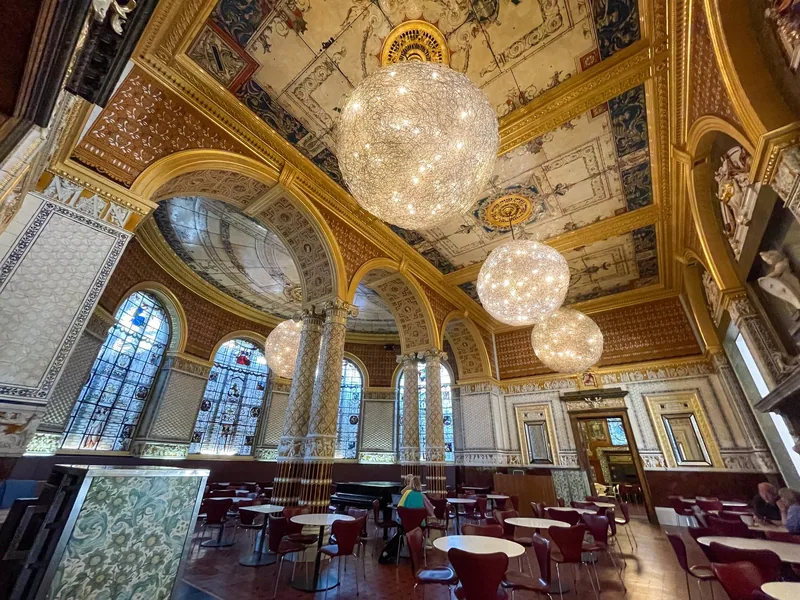
- The V&A's Victorian refreshment rooms in South Kensington
- Best view
- Levels 6 and 10 at Tate Modern; Level 4 at the National Portrait Gallery
- Best paid museum with a free café
- Dulwich Picture Gallery
- Free to enter?
- Yes, at every national museum and gallery, café included
- Behind the ticket
- Kew Gardens, the Tower of London, London Zoo and the royal palaces
- Bring your own?
- Allowed at some, banned at others; never in the cafés themselves
The one rule that decides whether the café is free
Every national museum and gallery in London charges nothing for its permanent collection. That includes the British Museum, the National Gallery, the National Portrait Gallery, Tate Modern, Tate Britain, the V&A, the Natural History Museum, the Science Museum, Imperial War Museum London and the National Maritime Museum, along with independent free museums such as the Wallace Collection and the Wellcome Collection. If entry is free, everything inside the building is free to reach, and that includes the counter, the tables and the toilets.
At a paid attraction the question is where the ticket check stands. Almost always, the shop sits on the public side of the barrier and the café sits next to the shop. If you can reach the shop without a ticket, you can usually reach the café too. It is not a universal rule, but it is the right thing to look for when you arrive.
The café is a legitimate reason to walk into a free museum for twenty minutes. Nobody at the door will ask what you intend to do. On a wet afternoon, the Great Court at the British Museum or the ground floor of Tate Modern is a warmer and quieter place to sit than a station concourse, and the coffee is no dearer.
Photograph by Mike Peel (www.mikepeel.net) · CC BY-SA 4.0 · Wikimedia Commons · resized
Dulwich Picture Gallery: the paid gallery whose café is free
This is the clearest example of a ticketed museum where you can eat without paying. The gallery in Dulwich Village charges for the collection, but its café and its sculpture garden sit outside that, and the grounds are open to anyone from 8am to 5pm, seven days a week. The gallery itself opens 10am to 5pm, Tuesday to Sunday, and an adult ticket for the collection was £10 with the optional donation in September 2026, with under-18s free.
The café hours are shorter than the garden's and change with the school terms, so check the gallery's own visit page on the morning you go. The building is by Sir John Soane, the garden has sculpture in it, and a coffee among the trees there is a much better twenty minutes than the same coffee on a high street. Our guide to Herne Hill and Dulwich explains how to get out there, which takes about fifteen minutes from central London by train.
Kenwood: a free house, a free café and a Rembrandt
Kenwood, on the northern edge of Hampstead Heath, is run by English Heritage and is free to enter, house and art collection included, though booking online guarantees you a slot. The Brew House café is in the old service wing with tables in the courtyard and the garden, and it is open all year even when the house is not.
The combination is unusual: you can look at Rembrandt and Vermeer, then eat outdoors in a walled garden, and pay only for the food. The house opens daily 10am to 5pm, with last entry at 4.30pm. Our page on Hampstead Heath covers the walk up from the ponds, which is the right way to arrive.
The two rooms with a view
Two museum dining rooms in London are worth choosing for the window alone.
Tate Modern, Level 6. The restaurant and bar at the top of the Natalie Bell Building looks north across the Thames to St Paul's. Tate Modern is free, so the lift up costs nothing; the meal does not. There is also an espresso bar on Level 3, a terrace café on Level 1 of the Blavatnik Building, and the Level 10 café at the top of the same building, all cheaper. Our Tate Modern guide explains how the two buildings fit together, which is worth reading before you go looking for a lift.
National Portrait Gallery, Level 4. The Portrait Restaurant sits at the top of the gallery with a wide window over Trafalgar Square, Nelson's Column and, beyond them, Big Ben and the London Eye. It opens from midday, until 5.30pm on Sunday to Tuesday and 10.30pm from Wednesday to Saturday, and you should book. Downstairs, in the gallery's vaults, Larry's serves all day and runs live music on some evenings. Entry to the gallery itself is free, so this is one of the cheapest ways to get a high window over central London without buying a ticket for a viewing platform.
Tate Modern has two high rooms with a view, in two different buildings. Level 6 of the Natalie Bell Building is the restaurant and bar. Level 10 of the Blavatnik Building is a viewing level with a café serving drinks and snacks, it costs nothing to stand there, and the lift to it runs only from Levels 0 to 4. Take the wrong lift and you will not find it.
The V&A: the oldest museum café in the world, and still the best room
The V&A in South Kensington invented the idea. Its first refreshment room opened in 1856, the first anywhere in a museum, on Henry Cole's theory that people would come for culture if they could also be fed. Three larger rooms followed in 1868, decorated by James Gamble, Edward Poynter and William Morris, and those are still the rooms you eat in: tiled, gilded, stained-glass, enormously over-decorated and completely free to sit in.
The café is open 10am to 5pm, and until 9pm on Fridays when the museum stays open late. Food is counter service, so you queue with a tray and then find a seat in whichever of the three rooms has space. Go on a weekday morning if you want to photograph the ceilings without people in the way. Our guide to the V&A has the gallery closures you need to know about before planning a route.
The Wallace Collection: lunch in a glass courtyard
The Wallace Collection, in a townhouse behind Oxford Street, roofed over its central courtyard and put a restaurant in it. The museum is free and open daily 10am to 5pm; the restaurant serves from 10am with last orders at 4.30pm. You can walk in without booking and take a table if one is free, or reserve for the set lunch and à la carte service between midday and 2.30pm, or for afternoon tea, which runs until late afternoon.
This is the closest London comes to a hotel dining room inside a museum, and it is a sensible alternative to a hotel if you want afternoon tea without the ceremony and the deposit. Book ahead at weekends. The Wallace Collection page covers the armour and the paintings upstairs.
The National Gallery, and the difference between a café and a brasserie
The National Gallery has two very different things under one roof, and visitors regularly end up in the wrong one. Ochre is a proper brasserie with table service, open daily from 11.30am to 5.45pm and until 9pm on Friday, with set menus from £24.50 (September 2026). The Espresso Bar is a counter for coffee, sandwiches and cake, and is what most people actually want after an hour of Italian altarpieces.
Entry to the National Gallery is free and so is reaching either of them. One warning: you may bring your own food into the building, but you may not eat it at the gallery's own tables. Check current prices on the gallery's website before you commit to the set menu.
Where the café is behind the ticket
At these places there is no free café, and you should plan the day knowing it.
| Place | Adult entry (September 2026) | What that means for eating |
|---|---|---|
| Kew Gardens | From £25 online in the peak season, £28 at the gate | All the cafés and the restaurant are inside the gates; there is nothing to eat at the station end |
| Tower of London | £37.00, or £40.70 with the optional donation | Food is inside the walls; the ticket allows one entry only, so leaving to eat ends your visit |
| Hampton Court Palace | £29.00 on weekdays, £32.00 at weekends until 27 November 2026 | The ticket covers the gardens as well, so you can eat and then go back outside |
| Churchill War Rooms | £34.00 | Underground site with no re-entry; eat before or after, in St James's Park |
Prices change, and Kew in particular has a cheap winter season and £10 Tuesdays running from September to the end of December 2026. Check each site's own ticket page. Our guides to Kew Gardens and the Tower of London go into what the ticket covers.
Bringing your own food, which is not always allowed
Museums differ more than you would expect, and the difference matters to a family.
- The Science Museum is the most family-friendly of them all: there are picnic areas, and a lunch ordered ahead can be collected from the café on level 0 rather than queued for. See our Science Museum guide for the free-ticket rules at the door.
- The National Gallery allows your own food in the building but not at its tables, and there is little space to sit.
- The Foundling Museum has no café at all and does not allow food or drink anywhere inside. Brunswick Square, opposite, is where people eat instead. Our page on the Foundling Museum explains the local café discount it offers instead.
- The British Museum has cafés in the Great Court and elsewhere, and the Great Court is also the easiest place in the building to sit down and wait for someone. The British Museum guide has the bag rules, which do affect what you can carry in.
When the café is full, and what to do instead
Museum cafés fill at exactly the same time as each other: between 12.30pm and 2pm, and much earlier and harder in the school holidays. If you are at a big free museum at lunchtime with children, either eat at 11.45am or eat at 2.15pm.
The alternative is to leave. Most of the big museums sit within a few minutes of ordinary streets with cheaper food: South Kensington has a row of cafés on Exhibition Road and Thurloe Street, Bloomsbury has Marchmont Street and Lamb's Conduit Street, and Trafalgar Square is a short walk from St Martin's Lane. Our page on cheap eating in London covers the supermarket and market options, and our explainer on the chains you will see on every high street tells you which of the familiar names is which.
Late openings change the café as well as the galleries. On a Friday evening at the V&A, or at a Tate Modern late, the food service runs later and the atmosphere is completely different from a Tuesday lunchtime: fewer pushchairs, more of a bar. Our guide to museum late openings lists which nights are which.
Paying, tipping and what things generally cost
Counter cafés in museums are cashless or close to it, take contactless, and do not expect a tip. Table-service restaurants inside museums behave like any other London restaurant: a discretionary service charge, often around 12.5%, may appear on the bill, and the law now obliges employers to hand that money over to their workers in full. It is discretionary, and you may ask for it to be removed. Our page on tipping in London sets out what the rules actually say.
One small piece of arithmetic worth knowing: anything you eat sitting down carries 20% VAT, while cold food taken away does not. That is why the same sandwich costs less in a paper bag than on a plate, in a museum as anywhere else.
Frequently asked questions
Do you have to pay to enter a museum to use its café in London?
Usually not. All the national museums and galleries in London are free to enter, so their cafés are free to reach and you can leave again without seeing a single object. At paid attractions such as Kew Gardens or the Tower of London the café is inside the ticket barrier, but Dulwich Picture Gallery and Kenwood are two paid or bookable sites where you can eat without a gallery ticket.
Which London museum café has the best view?
Level 6 at Tate Modern looks north across the Thames to St Paul's, and the Portrait Restaurant on Level 4 of the National Portrait Gallery looks over Trafalgar Square towards Big Ben and the London Eye. Both museums are free to enter, so only the food and drink cost money. Book a table at the National Portrait Gallery.
Can you take your own food into London museums?
It varies. The Science Museum has picnic areas and lets you pre-order a collection lunch, the National Gallery allows your own food in the building but not at its tables, and the Foundling Museum bans food and drink entirely. No museum lets you eat your own food in its café. Check the museum's own visit page if a packed lunch matters to your plans.
Which is the oldest museum café in London?
The V&A's. The museum opened the first refreshment room in any museum in the world in 1856, and the three decorated rooms that followed in 1868, by Gamble, Poynter and Morris, are still in use as the museum café today. They are free to sit in, and the ceilings are the reason to go.
Are museum cafés in London expensive?
Counter cafés are priced a little above a high-street chain and well below a restaurant, and the table-service restaurants inside museums are priced like ordinary London restaurants, with set menus at the National Gallery from £24.50 in September 2026. Check the current figures on each museum's website, and remember that eating in carries 20% VAT while cold takeaway food does not.
Sources
- Victoria and Albert Museum - V&A Café (checked September 2026)
- Tate - Food and drink at Tate Modern (checked September 2026)
- National Portrait Gallery - The Portrait Restaurant (checked September 2026)
- The Wallace Collection - Food and drink (checked September 2026)
- National Gallery - Eat and drink (checked September 2026)
- Dulwich Picture Gallery - Visit and tickets (checked September 2026)
- English Heritage - Kenwood (checked September 2026)
- HM Revenue & Customs - Catering, takeaway food (VAT Notice 709/1) (checked September 2026)