
A wooden operating table stands in the middle of a raked timber theatre in the roof of a church, where surgeons once cut into conscious patients while students watched from the stands. The museum calls it Europe's oldest surviving operating theatre. You reach it by climbing a narrow spiral staircase of 52 steps, and there is no other way up.
It opens Thursday to Sunday only, from 10.30am to 5pm, with last admission at 4.15pm. An adult ticket is £10, and the museum puts the typical visit at around 45 minutes. There are no lavatories on the premises, and human remains are on display.
Those facts between them decide whether you should go. Our survey of London's small museums sets it alongside a dozen others; this page is about what the climb is actually like, what the museum contains, and how a garret full of drying herbs became an operating theatre in the first place.
The Old Operating Theatre at a glance
- Address
- St Thomas' Church, 9a St Thomas Street, London SE1 9RY
- Adult ticket
- £10 including the voluntary donation (September 2026)
- Family ticket
- £22, covering either two adults with two children or a single adult with three
- Open
- Thursday to Sunday, 10.30am to 5pm; last admission 4.15pm
- Closed
- Monday, Tuesday and Wednesday
- Access
- 52-step narrow spiral staircase; uneven floors; no public lift
The staircase, and the traffic light at the bottom
The entrance is an unremarkable door on St Thomas Street, a minute from London Bridge station. Behind it is the stair: 52 steps, spiralling, narrow enough that two people cannot pass comfortably.
Because of that, the museum runs a traffic-light system at the entrance to manage the flow of people up and down. If the light is red when you arrive, you wait until it turns green. It is a sensible piece of engineering and it is the reason a small museum can handle a busy Saturday at all, but it means that at peak times you queue at street level before you start climbing.
Inside, the floors are uneven, the ceilings are low and the timbers are original. It is a 320-year-old church attic, and it has not been made comfortable.
There are no toilets in the building at all. None. Use the facilities at London Bridge station or in Borough Market before you climb, because coming back down and going up again is not a small undertaking.
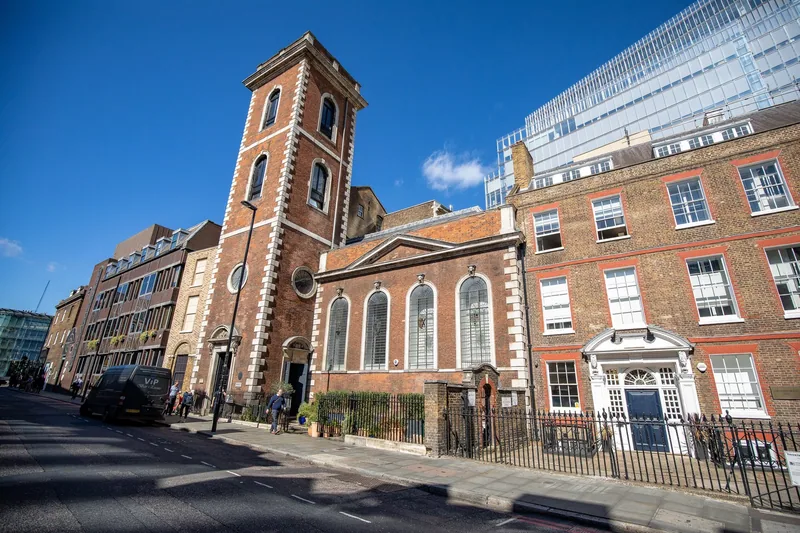
Photo: Jwslubbock · CC BY-SA 4.0 · Wikimedia Commons · resized
What is up there
Two connected spaces. The Herb Garret is the larger, a long attic under the church roof where the hospital's apothecary once dried the medicinal plants used to make up remedies. It now displays herbs, pharmacy equipment and the objects of pre-modern medicine.
Beyond it is the operating theatre itself: a wooden operating table, with tiered standing space rising around it where medical students crowded in to watch. Everything about the room was arranged for teaching rather than for the patient, and the audience stood close enough to see exactly what the surgeon's hands were doing.
The collection around them includes surgical instruments, medical artefacts and anatomical specimens, among them preserved prosections. Human remains are on display, and the museum asks visitors to behave accordingly. If you are squeamish, this is the point at which to decide.
How a herb loft became an operating theatre
St Thomas' Church opened in 1703 and is the oldest surviving structure from St Thomas' Hospital's original site in Southwark. Through the eighteenth century its roof space served as the hospital's herb garret.
In 1822 the space was converted into an operating theatre for women, connected directly to the neighbouring Dorcas Ward. Operations were carried out in front of medical students, which was the teaching method of the period, and they were carried out without anaesthesia, without antisepsis and without effective pain relief. Speed was the surgeon's principal skill.
In 1862 the hospital left Southwark for Lambeth, after its site was compulsorily purchased so that London Bridge railway station could expand. The garret was boarded up and forgotten for almost a hundred years. It was rediscovered in 1956, recognised as an unusually complete survival, and has operated as an independent museum since 1962 under the Lord Brock Trust.
That sequence is why the room exists at all. Nobody preserved it; it was simply sealed and left, and the railway that swallowed the hospital is the reason the theatre survived.
Prices, and the discounts that apply
| Ticket | Price |
|---|---|
| Adult | £10 |
| Concession | £8 |
| Child, 16 and under | £6.50 |
| Child, 5 and under | Free |
| Family: two adults with two children, or one adult with three | £22, plus £1 per further child |
| Carer, or Museums Association member | Free |
Those prices include the voluntary 10% Gift Aid donation, which allows the museum to reclaim an extra 25p in every pound from the government at no cost to a UK taxpayer. Tickets can be bought at the door or booked in advance online.
Two local cards get you two entries for the price of one: the Southwark Presents Card and the Team LondonBridge DealCard. Museums Association cardholders should book online and show the card on arrival. ICOM cards are not accepted here, which is unusual and worth noting if that is how you normally get into museums.
A family of four pays £22, and a fifth child costs £1. The family ticket is one of the better bargains among London's paid museums, and the £1 supplement for each extra child is genuinely unusual. Whether a small child will enjoy a room full of surgical instruments is another question entirely.
Timing the visit
Four opening days and one narrow staircase mean the museum concentrates its visitors. Thursday and Friday mornings are the easiest; Saturday and Sunday afternoons are when the light at the bottom of the stairs spends most of its time red.
Last admission is 4.15pm, which is three quarters of an hour before closing and exactly the length of an average visit, so arriving at 4.10 gives you the whole thing but no margin. If you want to linger among the instruments, come before three.
Tickets can be bought on the door, and for most of the year that is the simplest approach. Booking ahead is worth doing at weekends and in school holidays, partly to fix a time and partly because the museum is small enough to reach capacity. Before you set off, download the audio tour, the sensory map or the visual story from the museum's access page; they are free, and mobile signal inside a church roof is not dependable.
Access, and being honest about it
This is a museum in the roof of a listed church, reached by a narrow spiral stair, with uneven floors above it. There is no public lift. The museum is clear that it can occasionally use a small lift for visitors who need it, but this has to be arranged by telephoning 020 7188 2679 or emailing before you visit, not on arrival.
What the museum does provide is substantial: a concessionary rate of £8 for disabled visitors, free tickets for personal assistants and carers, display information in audio and in braille, ear defenders to borrow, and downloadable sensory maps, visual stories and an audio tour. It recommends that visitors who cannot walk unaided come with a companion, in case of emergency.
Pushchairs are not allowed up, because of the space, but staff will store one in the foyer if you speak to them when you arrive. Only handbags and small backpacks come up the stairs; suitcases and large bags are refused, and there is no luggage storage. Animals are not admitted except guide dogs.
Photography for personal use is permitted. Our guide to accessible London covers what to expect at historic sites more generally.
Who it is for
Go if
- You are interested in the history of medicine, surgery or public health
- You like small, strange, atmospheric places more than big collections
- You are already going to Borough Market or London Bridge and have 45 minutes
- You have teenagers who will find the pre-anaesthetic detail fascinating rather than upsetting
Do not go if
- Stairs, tight spaces or heights are a problem for you
- Preserved human tissue would distress you or a child in your party
- You need a lavatory within the next hour
- It is Monday, Tuesday or Wednesday, when it is shut
For medicine on a larger scale and with more room, the Science Museum covers the history of medical technology at length and is free, and Wellcome Collection near Euston approaches health and the body through contemporary art. Neither gives you a real operating theatre.
Getting there and what is around it
The museum is about a minute from London Bridge station, which is served by the Jubilee and Northern lines and by main-line trains from the south-east; our guide to London's terminus stations explains where those trains go. The street entrance is small and easy to walk past, so look for the number rather than for a grand facade.
Everything else worth doing is within five minutes. Borough Market is round the corner and is the obvious lunch, The Shard is directly above the station, and HMS Belfast is moored a few minutes downstream. Walk west along the river and you reach Tate Modern in about fifteen minutes.
The wider area is covered in our guides to Borough and Bermondsey and Southwark and Bankside. Because the museum opens Thursday to Sunday and takes only three quarters of an hour, it fits neatly into a day built around something else rather than justifying its own trip, and it is a good stop on a wet day in London.
Frequently asked questions
How many steps are there at the Old Operating Theatre?
Fifty-two, in a narrow spiral staircase, and it is the only public way in. The museum runs a traffic-light system at the bottom to manage people going up and down, so you may wait at street level before you start climbing.
What days is the Old Operating Theatre Museum open?
Thursday to Sunday, 10.30am to 5pm, with last admission at 4.15pm. It is closed on Mondays, Tuesdays and Wednesdays, which catches out a lot of visitors who assume a small museum will at least open midweek.
Is the Old Operating Theatre suitable for children?
Children aged 16 and under pay £6.50 and under-fives are free, and the family ticket is good value. But human remains including preserved prosections are on display, the subject is surgery without anaesthetic, and pushchairs cannot come up. Judge your own child.
Is the Old Operating Theatre wheelchair accessible?
Not in the ordinary sense. There is no public lift and the only route is a 52-step spiral stair with uneven floors above it. The museum can sometimes arrange use of a small lift, but this must be discussed in advance by telephone or email rather than on the day.
How long does a visit take?
The museum's own figure is about 45 minutes, and that is accurate for most people. There is no time limit, so anyone genuinely interested in the instruments and the herb garret can stay longer, up to closing time.
Sources
- The Old Operating Theatre Museum - Visit (checked September 2026)
- The Old Operating Theatre Museum - Access (checked September 2026)
- The Old Operating Theatre Museum - Our history (checked September 2026)
- The Old Operating Theatre Museum and Herb Garret (checked September 2026)