
Crystal Palace Park is 200 acres of hillside in south-east London, free to enter, and the only place in the world where you can see the first full-size models of extinct animals ever built. The Crystal Palace Dinosaurs went up in 1854, they are still standing, and looking at them costs nothing.
Despite the name there is no palace here, and there never was a royal one. The Crystal Palace was the vast iron and glass building put up in Hyde Park for the Great Exhibition of 1851, then dismantled and rebuilt on this hill at Sydenham in 1854 as a permanent pleasure and exhibition ground. It burnt down on the night of 30 November 1936 and was never replaced. What survives is the park it stood in: terraces, sphinxes, lakes, a maze, a farm, a Victorian subway and the dinosaurs.
Two hours is enough for the dinosaurs, the maze and a walk up to the terraces. A family with young children could easily spend half a day, because the playground and the farm are both here and both free.
Crystal Palace Park at a glance
- Entry
- Free, including the dinosaurs, the maze and the farm
- Opening
- Every day from 7.30am; closing time changes each month, from 4.30pm in December to 9.30pm in June and July
- Size
- 200 acres
- Nearest stations
- Crystal Palace and Penge West, both 5 to 10 minutes' walk; Anerley and Penge East also within walking distance
- Dinosaurs
- In the Lower Lakes at the south end of the park; nearest entrance Penge Gate
- Parking
- Four car parks, charged; free for Blue Badge holders
The dinosaurs, and what the Victorians got wrong
There are about 30 figures, not all of them dinosaurs: the group includes amphibians, reptiles and extinct mammals, spread across islands in the lakes on the Penge side of the park. Benjamin Waterhouse Hawkins made them between 1853 and 1855, modelling each animal in clay, taking moulds and casting the sections in cement. Many of the larger ones are hollow, with brick interiors.
They were the first serious attempt anywhere to reconstruct extinct animals at full scale from fossil evidence, and that is what makes them important rather than accurate. The Iguanodon has a horn on its nose that we now know was a thumb spike. The Megalosaurus stands on four legs like a lizard. The whole group is a snapshot of what the best scientific minds of the 1850s believed, frozen in cement, and it is far more interesting for being wrong.
The sculptures are Grade I listed. Because of that and their position on the lake islands, you view them from the bank at a short distance rather than walking up to them. Both the figures and the surrounding landscape and waterways have been restored as part of the park's regeneration, and Historic England has taken them off its Heritage at Risk Register as a result.
The dinosaurs are free and never close. There is no ticket, no queue and no time slot, unlike every dinosaur exhibit at the Natural History Museum. If you are travelling with a dinosaur-obsessed six-year-old and your budget is under pressure, this is the best value hour in London.
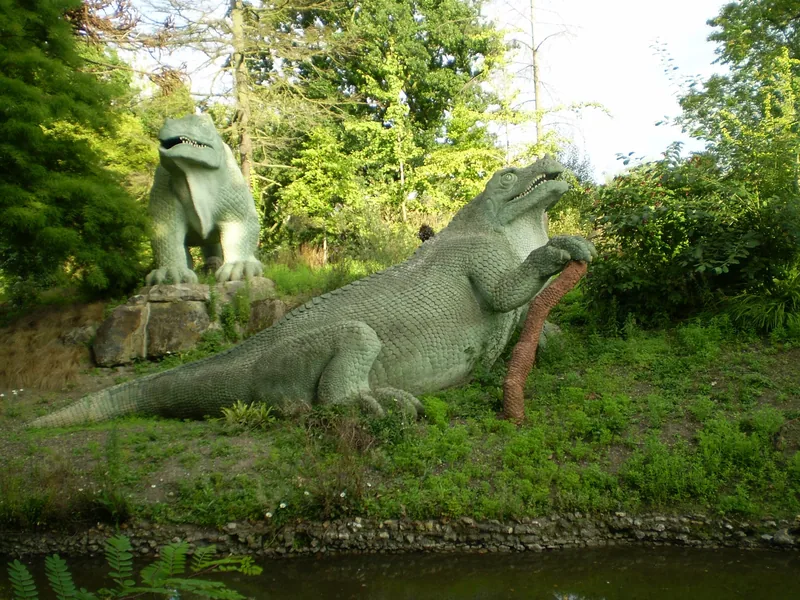
Photo: VirtuallyLondonBecky · CC BY-SA 4.0 · Wikimedia Commons · resized
The maze
The Crystal Palace Park Maze is 49 metres across, which makes it one of the largest in London, and it has been confusing visitors since the 1870s. It is free, open whenever the park is, and made of tall hedges rather than low box, so children genuinely cannot see over it.
It was redesigned and replanted in 2009 for the centenary of Girlguiding, and the connection is real: the first Scout Rally was held in this park on 4 September 1909, and a group of girls who turned up there asked Robert Baden-Powell to start something for them. There is a sign outside the maze with its history and a map, which is useful if you have twenty minutes rather than an hour.
The maze is in the north section of the park, a long way from the dinosaurs, so plan the two into one walk rather than doubling back.
The subway, the sphinxes and the terraces
The Crystal Palace Subway is the park's strangest survival: a Grade II* listed Victorian pedestrian underpass in fan-vaulted brick, built to bring first-class railway passengers up into the palace. It is a cathedral-like space under a road, and it opens to the public only occasionally, so check before you make a journey for it.
Above it, the terraces where the palace stood still climb the hill, lined with stone sphinxes and balustrades. There is nothing left of the building itself except foundations and steps, which gives the top of the park a curiously abandoned feel. It is also the high ground: from the terraces you look north over a great deal of London, and the transmitter mast behind you is one of the landmarks you can pick out from half the city. Our round-up of the best free viewpoints in London covers the hills with clearer panoramas.
The farm, the playground and the boating lake
Three things here make this a strong family park, and none of them costs anything except the boats.
- Crystal Palace Park Farm is run by Capel Manor College and is free. It opens daily from 12pm to 3.30pm, and on bank holidays, but is closed on Wednesdays. It is a working farm with a wide range of animals, hand-washing facilities throughout and its own toilets, close to the National Sports Centre. See our guide to city farms and playgrounds for the others across London.
- The Dinosaur Playground is built around the park's theme, with climbing and discovery equipment. It opens during park hours and closes at dusk.
- The boating lake hires pedalos and rowing boats in the warmer months, beside the dinosaurs. Our guide to boat hire and pedalos in London explains how these operations work and why they close.
There is also a 1,100 square metre skate park, on the site where the first major national skateboarding competition in Britain was held in 1977, and the National Sports Centre, which has a public leisure centre and an outdoor athletics stadium.
Concerts in the Bowl
Crystal Palace Park was London's original outdoor concert venue, and the Crystal Palace Bowl, with its concrete concert platform, has hosted Bob Marley, Pink Floyd and the Beach Boys over the decades. The platform's angular shape has earned it the local nickname the Rusty Laptop.
The park still programmes a summer season: the 2026 line-up included Alanis Morissette, Snow Patrol, Grace Jones, Tom Jones, Lenny Kravitz and Bastille. Concert days close parts of the park, so check the park's own events listing before planning a quiet afternoon in June or July. Our guide to live music venues in London covers the indoor alternatives.
Opening times that change every month
The park opens at 7.30am every day, but the closing time is set month by month rather than by dusk, and it is worth knowing before you plan an evening walk.
| Month | Park closes | Month | Park closes |
|---|---|---|---|
| January | 5pm | July | 9.30pm |
| February | 6pm | August | 9pm |
| March | 8pm in BST, 6.30pm in GMT | September | 8pm |
| April | 8.30pm | October | 7pm in BST, 5pm in GMT |
| May | 9pm | November | 5pm |
| June | 9.30pm | December | 4.30pm |
Other opening hours inside the park are shorter still. The Visitor Centre and shop open Wednesday to Sunday, 10am to 4pm. The Crystal Palace Museum opens only on Fridays and Sundays, 10am to 4pm. The Brown & Green café opens 8.30am to 4.30pm on weekdays and 8.30am to 5pm at weekends. There is also a Sunday food market.
Getting there, and which entrance to use
The park has entrances all the way round, and choosing the right one saves a long walk across a hill.
- For the dinosaurs, use Penge Gate at the southern end. Penge West station is the closest, 5 to 10 minutes away.
- For the terraces, the maze and the north of the park, use Crystal Palace station, also 5 to 10 minutes.
- Trains: Crystal Palace and Penge West are served by London Overground on the Windrush line and by Southern, with regular trains from central and south London. Anerley and Penge East are also walkable.
- Buses serve every side of the park: routes 3, 157, 227, 322, 358, 410 and 417 at the Crystal Palace bus station, 176, 197 and 227 on Crystal Palace Park Road, 354 on Thicket Road, and 122, 227 and 450 on Westwood Hill.
- Driving: four car parks, reached from Thicket Road, Anerley Hill and Crystal Palace Park Road, with charges. Blue Badge holders park free.
Our guide to the DLR and the London Overground explains how the Overground lines were renamed and where the Windrush line runs. The park is hilly, with slopes and uneven ground in places, so check the accessibility information if that matters to you.
What else is nearby
The Horniman Museum in Forest Hill is about 20 minutes away by bus, free, and has gardens with another view over London. Brockwell Park and its lido are north-west, and Peckham is on the way back into town.
For a different kind of big London park, compare Greenwich Park, which has the view and the history, or Richmond Park, which has the deer and the space. For a day out with children that costs almost nothing, this park belongs with the ideas in London with kids and free things to do in London.
Frequently asked questions
Are the Crystal Palace dinosaurs free to see?
Yes. They stand on islands in the Lower Lakes at the south end of the park, they are visible whenever the park is open, and there is no ticket. The nearest entrance is Penge Gate, and Penge West station is 5 to 10 minutes away.
How old are the Crystal Palace dinosaurs?
They were made by Benjamin Waterhouse Hawkins between 1853 and 1855 and first unveiled in 1854, which makes them more than 170 years old. They were the first attempt anywhere to model extinct animals at full size from fossil evidence, and they are now Grade I listed.
Is there still a palace at Crystal Palace?
No. The Crystal Palace was the iron and glass building from the 1851 Great Exhibition in Hyde Park, rebuilt on this hill in 1854 and destroyed by fire on 30 November 1936. Only the terraces, steps, sphinxes and foundations remain, and the area around the park took its name.
What time does Crystal Palace Park close?
It opens every day at 7.30am, and the closing time is set by month, from 4.30pm in December to 9.30pm in June and July. In September it closes at 8pm. Individual facilities such as the museum, visitor centre and farm keep much shorter hours.
Can you visit the Crystal Palace Subway?
Only at certain times. The Grade II* listed Victorian subway is not open every day, and access is arranged through occasional public openings and events, so check the park's own listings before travelling specially to see it.
Sources
- Crystal Palace Park Trust - the park's own site, for the dinosaurs, the maze, the farm, opening times and getting here (checked September 2026; the site answers automated requests with a redirect loop, so the individual pages cannot be linked directly and were read in a browser)
- Historic England - Crystal Palace Park, registered park and garden, grade II*, list entry 1000373 (checked September 2026)