
The Petrie Museum holds more than 80,000 objects from ancient Egypt and Sudan in two crowded rooms on the UCL campus, and charges nothing to see them. It opens Tuesday to Saturday from 1pm to 5pm, needs no booking, and on most afternoons you will share it with a handful of other people.
Its full name is now the Petrie Museum of Egyptian and Sudanese Archaeology, which is worth knowing because the Sudanese half of the collection is substantial and often overlooked. It was set up as a teaching resource at University College London in 1892 and is named after Flinders Petrie, the archaeologist who excavated much of it and who effectively invented the practice of recording everyday objects rather than only the spectacular ones.
That is the difference between this place and the Egyptian galleries ten minutes south. The British Museum shows you monumental sculpture and the objects of kings. The Petrie shows you what people wore, ate with, wrote on and buried their relatives in.
The Petrie Museum at a glance
- Address
- Malet Place, University College London, London WC1E 6BT
- Open
- Tuesday to Saturday, 1pm to 5pm. Closed Sunday and Monday
- Price
- Free, no booking. Under-16s must be accompanied by an adult
- Groups
- Booking essential for eight or more; maximum 20
- Time needed
- An hour is plenty for most visitors; there is no limit
- Nearest stations
- Goodge Street and Euston, both 320 metres; Euston Square 480 metres
Afternoons only, and why
The museum opens for four hours a day, five days a week: 1pm to 5pm, Tuesday to Saturday. Mornings are reserved for booked research visits, which is how a university collection of this size keeps working. On Mondays the museum is open to researchers from 10:30 to 13:00 and 14:00 to 16:30 by appointment, and on Tuesday mornings to UCL students only.
For a visitor, that means the Petrie belongs in the second half of your day, and it pairs naturally with the Grant Museum of Zoology seven minutes away on University Street, which keeps exactly the same hours. UCL publishes a walking route between its museums, and the two together make a satisfying afternoon: animals in one room, ancient Egypt in the other, neither costing anything.
No ticket, no queue, no donation box in your face. Entry is free and unbooked, and self-guided group visits are free too. Bring a water bottle: there is no café, but staff will refill it for nothing.
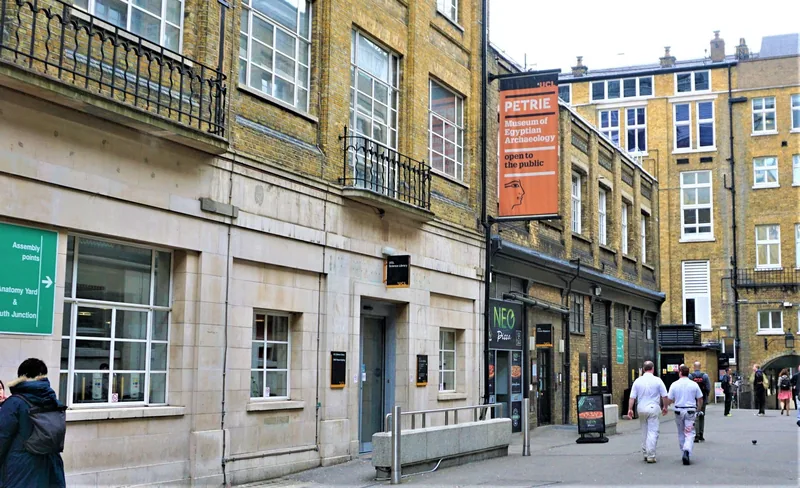
Photo: Joyofmuseums · CC BY-SA 4.0 · Wikimedia Commons · resized
What to look for in the cases
The displays are dense and the labelling is scholarly, so it helps to arrive with a short list. The museum's own highlights are a good starting point.
The Tarkhan dress. A linen garment from the cemetery at Tarkhan, dating from around the time Egypt was unified about 3000 BCE. Clothes almost never survive from that depth of antiquity; this one did, and it is displayed as an ordinary object rather than a relic, which somehow makes it stranger.
The bead-net dress. A dress of threaded beads from Dynasty 5, about 2400 BCE, thought to have been worn for dancing. It was reconstructed from loose beads, which is a story in itself.
The Hawara mummy portraits. Painted panels found by Petrie at Hawara in 1888–89 and 1910–11, from the period of Roman rule. They are painted faces of real people, looking straight out, and they are the objects most visitors stop in front of longest.
The Amarna material. A fragment of alabaster relief showing a headless Akhenaten followed by Nefertiti and their daughter Meritaten at an offering table, plus faience tiles and inlays from the same short-lived city.
One Day in Lahun. A display built from the finds of a single town at the pyramid site of Senusret II in the Fayum, about a hundred miles south of Cairo. It is the clearest demonstration of what Petrie's method was for: not treasure, but a day in a working settlement.
The Sudanese objects. Among them a faience ankh from Meroe inscribed with the name of King Aspelta — a reminder that the Nile valley did not stop at Egypt's southern border, and the reason the museum changed its name.
There is also a pyramid text, among the oldest religious writing in the world, and a carved wooden cosmetic spoon in the shape of a dancing girl, used for mixing perfumes and make-up.
Where these objects came from
This is an excavated collection, assembled largely in the late 19th and early 20th centuries under the terms of the time. That is not a footnote. It means the material was dug out of settlements, temples and graves in Egypt and Sudan, and that human remains form part of what a collection like this contains.
If you would rather not encounter human remains, say so at the welcome desk when you arrive and staff will tell you what is currently on display and where. Nobody will think it odd. Photography is allowed for personal use only, without flash, tripods, selfie sticks or live streaming, and UCL asks that images are not used commercially.
The museum's own programme takes the question of origins seriously: recent event series have focused on the makers of the objects and on what coffins and grave goods can tell us about the people who made and used them rather than about the collectors who removed them.
The second-hand Egyptology bookshop
The shop is small and sells the usual postcards and papyrus, but it also runs a second-hand bookshop of Egyptological titles, from general introductions to scarce academic volumes, with the stock refreshed regularly. For anyone with a serious interest, it is one of the few places in London where you can find out-of-print excavation reports at sensible prices, and it is worth ten minutes at the end of your visit.
The museum also publishes a downloadable guide and has its own app, both of which are more useful than the gallery labels if you are not an Egyptologist. Download them before you arrive; phone signal inside the building is patchy.
Practical details inside the museum
There is no café. Bottled water and baby bottles are allowed in the galleries; all other food and drink is not. There is no cloakroom, so avoid arriving with a large bag or a suitcase, and bikes cannot come inside, although UCL has bike storage around the campus.
Toilets are reached by key access from the museum (ask at the welcome desk), and there is a gender-neutral accessible toilet on the ground floor of the Science Library next door. Breastfeeding and bottle feeding are welcome in the museum spaces, and staff will find a quieter corner if you ask.
Groups of eight or more must book, and twenty is the maximum the rooms can take. External guiding is not allowed inside, so a walking-tour company cannot bring a group in and lecture to them; private tours have to be arranged through UCL.
Under-16s need an adult with them here. Unlike most free museums, the Petrie asks that children are accompanied. It is not a rule about behaviour: the cases are close together and the room is easy to lose someone in.
Getting to Malet Place
Goodge Street on the Northern line and Euston on the Northern, Victoria and National Rail are both about 320 metres away. Euston Square is 480 metres, and Warren Street and Russell Square are both around 650 metres. Buses 1, 18, 24, 29, 30, 68, 73, 91 and 134 stop within walking distance. Our Underground guide covers the lines; Malet Place itself is a pedestrian lane off Torrington Place, and the museum entrance is easy to walk past.
Driving is not practical: vehicle access to the UCL campus is restricted, and the nearest options are pay-and-display car parks around the university. Limited accessible parking on site can be booked in advance.
What else to see nearby
The immediate neighbours are the best. The Grant Museum is seven minutes away with identical hours, and Wellcome Collection on Euston Road is five minutes north, free, and open on Sundays when both UCL museums are shut. The British Museum is ten minutes south.
Further afield, Sir John Soane's Museum in Holborn holds Egyptian material collected in a completely different spirit (the sarcophagus of Seti I in a basement full of antiquities), and it is free too. For world cultures on a family scale, the Horniman Museum is the south London alternative.
The surrounding streets are covered in our guides to Bloomsbury and Fitzrovia, where the lunch options are better than anything on campus. A visit here belongs on any list of free things to do in London, and if the weather turns, our rainy-day guide has more indoor ideas. Teenagers tend to get more out of this museum than younger children; see our list of museums that work for teenagers. More one-room collections appear in our piece on the capital's small museums.
Is it for you?
Go if
- You have done the British Museum and want the everyday objects it does not show
- You like dense, old-fashioned cases with hand-written cards and no interactives
- You want an hour of ancient Egypt without a queue, a ticket or a crowd
- You collect books and want a second-hand Egyptology shelf worth browsing
Do not bother if
- You are free only in the morning, on a Sunday or on a Monday
- You want scale and spectacle: there are no colossal statues here
- You are with young children who need something to press or pull
- You would find excavated burial material distressing and would rather not ask about it at the door
Frequently asked questions
Is the Petrie Museum free?
Yes, entry is free and there is no need to book. Self-guided group visits are also free, though groups of eight or more must reserve a slot in advance and the maximum group size is twenty. Donations are welcome but not pressed.
What are the Petrie Museum's opening hours?
Tuesday to Saturday, 1pm to 5pm. It is closed on Sundays and Mondays and does not open to the public in the mornings, which are kept for booked research visits. The Grant Museum of Zoology nearby keeps the same hours.
How is it different from the British Museum's Egyptian collection?
The British Museum concentrates on monumental sculpture and the objects of rulers. The Petrie was built as an archaeological teaching collection and is strongest on everyday life: clothing, tools, pottery, cosmetics and the finds from single settlements. It is also far quieter, with no queues at the door.
Does the museum contain human remains?
It is an excavated collection that includes material from burials, and human remains form part of what a collection of this kind holds. Ask at the welcome desk when you arrive if you would rather avoid them, and staff will tell you what is on display.
Why is it called the Museum of Egyptian and Sudanese Archaeology?
Because a significant part of the collection comes from sites in what is now Sudan, including material from the kingdom of Meroe. The name reflects the full geographical range of the objects rather than only the Egyptian half.
Sources
- UCL - Visit the Petrie Museum (checked September 2026)
- UCL - Top objects in the Petrie Museum (checked September 2026)
- UCL - About the Petrie Museum (checked September 2026)