
The Bank of England Museum is free, needs no ticket, and sits inside the Bank itself, with its own entrance on Bartholomew Lane. It takes about an hour, and the thing everybody remembers is the real gold bar you are invited to lift out of its case.
It is one of the very few places where a visitor can get inside one of the City's working institutions. The museum occupies rooms within the Bank's Grade I listed headquarters, including a recreation of the Stock Office as it looked around two hundred years ago, and it explains what the Bank does (keeping prices stable and the financial system sound) in language aimed at people who have never thought about it.
Our guide to free museums in London lists it among the City's no-cost options. This page is about the practical detail: the weekday-only hours, the monthly late opening, what is in each room, and the unusual way wheelchair users get in.
Bank of England Museum at a glance
- Entrance
- Bartholomew Lane, London EC2R 8AH, round the corner to the right of the Bank's main Threadneedle Street doors
- Open
- Monday to Friday, 10am to 5pm, last entry 4.30pm
- Late opening
- Until 8pm on the third Thursday of every month, last entry 7.30pm
- Closed
- Weekends and all bank holidays
- Price
- Free, no ticket or booking. Groups over 15 must notify the museum in advance
- Time needed
- About an hour
Weekdays only: the mistake most visitors make
This is a working central bank, and the museum keeps office hours. Monday to Friday, 10am to 5pm, with last entry at 4.30pm. It does not open at weekends and it does not open on bank holidays. Given the name, that causes more confusion than any other closure in London.
The exception is the third Thursday of each month, when the museum stays open until 8pm with last entry at 7.30pm. All the events it runs are free, though some need advance booking. That evening is the best time to come if you are in London on business and your days are full; the rooms are quieter and the atmosphere in the empty City outside is worth the trip on its own. Our guide to museum late openings in London lists the others.
Before travelling, check the museum's planned closures page. The Bank occasionally shuts the museum for operational reasons at short notice.
The Bank of England Museum shuts on bank holidays. So does the rest of the Square Mile, which empties out completely at weekends. If your only free day is a Saturday, look at the City's churches and Leadenhall Market instead, and save this for a weekday.
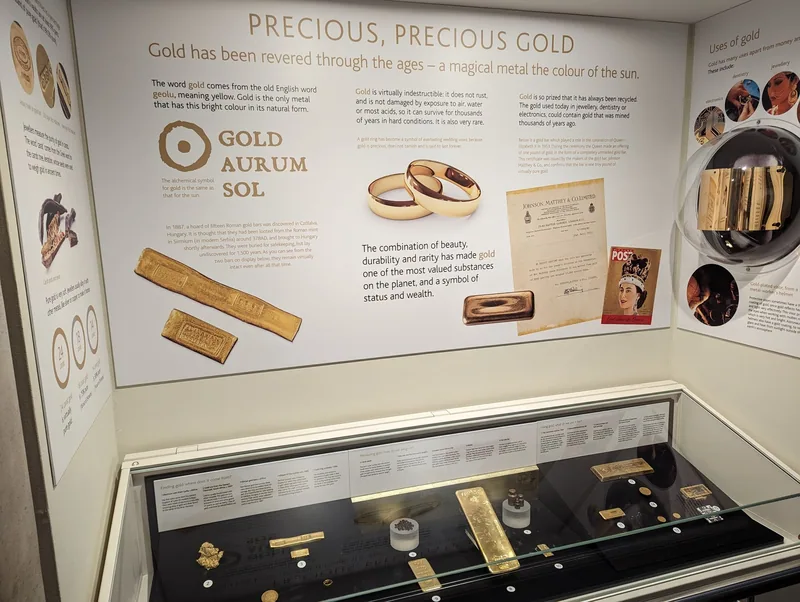
Photo: Avelludo · CC BY-SA 4.0 · Wikimedia Commons · resized
The gold bar, and what happens when you lift it
In the Rotunda there is a case with an opening in the side, and inside it a genuine gold bar. You put your hand in and try to pick it up. Most people are surprised, because a standard bar weighs around twelve and a half kilograms and does not move the way a metal object that size looks as though it should.
It is the single most photographed object in the City, and it is free. There is usually a short wait at lunchtime on weekdays, when City workers bring visiting relatives. The museum also encourages a photograph in its gold corridor, and staff ask only that you use hand sanitiser before and after the interactives, since a great many people touch them.
Nearby, the Modern Economy room explains why the Bank holds around 400,000 gold bars in vaults beneath the building — not the Bank's own gold, for the most part, but other countries' reserves and commercial holdings stored here.
Room by room
The Stock Office. The heart of the museum: a reconstruction of the Bank's public office as it looked about two hundred years ago, with the counters where the public once dealt with clerks in person. It is the closest thing London has to a Georgian banking hall you can stand in.
The Early Years and Rotunda rooms. Three hundred years of the Bank's history, the events that shaped it and the people who ran it, plus the architecture of the building itself. Sir John Soane rebuilt the Bank in his own idiom, and if you find the spaces here striking, his own house in Holborn is the next stop.
The Banknote Gallery. How notes have changed over three centuries and why they are so hard to forge: the security features explained properly rather than in a leaflet. Useful preparation for handling real money in Britain; our guide to money in London covers the polymer notes now in circulation.
Temporary exhibitions. There is always at least one running, and they are included, as are the talks and tours listed on the museum's What's On page.
Visiting with children
This works better with children than it sounds. Free activity sheets are graded by age and picked up at the information desk: I spy in the Bank for under-fives, Explore the Bank for 5 to 7, Investigate the Bank for 8 to 11, Discover the Bank for 12 to 14 and Understand the Bank for 15 to 17. Several can be printed at home beforehand.
The gold bar and a safe-cracking interactive carry most of the visit for younger children, and the museum runs family events in the school holidays. Under-16s must be accompanied by an adult. Baby changing is in the accessible toilet, and you may feed a baby anywhere in the museum.
There is no cloakroom, which is the one practical problem for families: buggies, pushchairs and scooters cannot be left anywhere, so you may be asked to take them round with you. Our guide to London with kids has more on which free museums handle pushchairs well.
Everything here costs nothing, including the talks. Entry, activity sheets, printed guides, wi-fi and the events programme are all free. In an area where a rooftop drink costs £18, that is worth knowing.
Access: ring the bell at Threadneedle Street
The route in for wheelchair users is not the museum door. There are three steps up to the Bartholomew Lane entrance and three more inside, so wheelchair users are asked to go to the Bank's main entrance on Threadneedle Street and press the large button marked with a wheelchair symbol, at wheelchair height near the left-hand rail. Security staff operate the lift and museum staff escort you in.
Inside, the galleries sit on several different ground levels because of the listed building, and three small sets of steps are crossed using portable ramps that staff put down. The Bank is straightforward about the limitation: those ramps are steeper than current accessibility recommendations and cannot be re-engineered without major structural work, which restricts the types of mobility equipment that can be used safely. There is space for up to six wheelchairs in the museum at a time, and one wheelchair that can be borrowed. Bring a companion, because no one can be provided to push it.
There is an accessible toilet, without a hoist. A hearing loop is available at the information desk; switch your aid to the T setting. There is no quiet room, but child and adult ear defenders can be borrowed free of charge. British Sign Language versions of all the audio tours, and a BSL welcome video, are on the free Bloomberg Connects digital guide, reached by a QR code on your own device. See our guide to accessible London for the wider picture.
Food, bags and the small print
There is no café, and eating and drinking are not allowed in the galleries. Sandwich shops and coffee places surround the Bank, though many close early and at weekends. The museum shop sells Bank-related items and closes at 4:40pm, twenty minutes before the museum.
There are no lockers and nowhere to store bags, luggage or prams, so everything stays with you. Free wi-fi covers the museum. Photography is allowed without flash, for personal use, and you may not photograph other people without their consent or record video.
Printed guides are free at the information desk, and the phone line on 020 3461 5545 is monitored from 10am to 4pm on weekdays if you need to ask about access or a group visit.
Getting to Bartholomew Lane
Bank station, served by the Central, Northern and Waterloo & City lines and the DLR, is the closest. Monument, Cannon Street, Mansion House and Moorgate are all within a few minutes. Liverpool Street, Fenchurch Street and Cannon Street mainline stations are a ten-minute walk. Our Underground guide explains the interchange at Bank, which is large and confusing; follow signs for Threadneedle Street and turn right.
There is a Santander Cycles docking station on Bartholomew Lane itself, but no cycle parking inside the museum. Driving into the City means the Congestion Charge and very few spaces; the nearest car parks are at Bell Wharf Lane and Aldersgate Street.
What to do with the other half of the day
The museum is an hour, and it sits in the densest square mile of free sights in London. The Royal Exchange and Bank junction are immediately outside the door. Five minutes north, Guildhall and the Roman amphitheatre beneath it are also free. The Monument is ten minutes south-east if you want a climb, and the City's skyscrapers start a few streets east.
For another institution that opens its doors, the Postal Museum and Mail Rail at Mount Pleasant is twenty minutes away and paid. If the Soane connection interests you, both his museum and the free Hunterian Museum face each other on Lincoln's Inn Fields, fifteen minutes west. Our explainer on the City of London covers why this square mile has its own government, and our City neighbourhood guide covers where to eat. If you are exchanging currency while you are here, read our guide to changing money in London first.
Frequently asked questions
Is the Bank of England Museum free?
Yes. Entry is free, no ticket or booking is needed, and the talks, tours and events are free as well, although some need to be reserved in advance. Groups larger than fifteen are asked to notify the museum beforehand.
Can you really lift a gold bar?
Yes. A real gold bar sits in a case in the Rotunda with an opening in the side, and you are invited to reach in and try to pick it up. It weighs about twelve and a half kilograms, which is why most people cannot lift it cleanly with one hand.
Is the museum open at weekends?
No. It opens Monday to Friday only, from 10am to 5pm with last entry at 4.30pm, and closes on all bank holidays. The one extension is the third Thursday of each month, when it stays open until 8pm with last entry at 7.30pm.
How long does a visit take?
The museum says most people take about an hour, and that matches how the rooms are laid out. Allow a little longer if you are doing an activity sheet with children or if a temporary exhibition is running.
How do wheelchair users get into the museum?
Not through the Bartholomew Lane door, which has steps. Go to the Bank's main entrance on Threadneedle Street and press the large button with a wheelchair symbol near the left-hand rail; security staff operate the lift and museum staff escort you. There is room for six wheelchairs at a time and one can be borrowed.
Sources
- Bank of England Museum - Plan your visit (checked September 2026)
- Bank of England Museum - Inside the museum (checked September 2026)
- Bank of England Museum - Accessibility (checked September 2026)
- Bank of England Museum - Families (checked September 2026)