
The Museum of Brands in Notting Hill is built around one long, winding corridor called the Time Tunnel, which runs chronologically from Victorian Britain to the present through the packaging, toys, magazines and advertising of each decade. An adult ticket costs £14, and since January 2026 it lets you come back free for a year.
It exists because of one man's obsession. Robert Opie began saving packaging as a teenager, worked for sixteen years in market research, showed his collection as an exhibition called The Pack Age at the V&A in 1975, and opened his first museum in Gloucester in 1984. The material eventually came to London, and it is now arranged so that you walk forward through time rather than round a gallery.
The effect is unlike any other museum in the city. Nothing here is rare or valuable. Everything is something somebody threw away, and every visitor over a certain age stops at the decade of their own childhood and starts pointing.
Museum of Brands at a glance
- Address
- 111–117 Lancaster Road, Notting Hill, London W11 1QT
- Open
- Monday to Saturday 10am to 5pm; Sunday 11am to 5pm
- Adult ticket
- £14 (ages 26–59). Concession £10, child 7–16 £8, family £36 (September 2026)
- Return visits
- Tickets bought from 1 January 2026 allow unlimited return visits for twelve months
- Payment
- Card only. No cash, and American Express is not accepted
- Nearest station
- Ladbroke Grove (Circle, Hammersmith & City), five minutes' walk
The annual ticket changes the maths
From 1 January 2026, every ticket bought from the museum became an annual pass. Keep the ticket or the QR code and you can return as often as you like within twelve months, including to any temporary exhibition that opens in the meantime.
That turns a £14 adult ticket from a one-off charge into something closer to a small membership. If you live in London or visit regularly it is straightforward value. If you are here for four days it makes no difference at all, and £14 for an hour and a half is the honest price to judge it on.
The full 2026 price list is unusually finely graded. Adult £14 covers ages 26 to 59. The £10 concession covers over-60s and anyone aged 17 to 25 — a rare museum where a 24-year-old pays less than a 30-year-old. Children aged 7 to 16 pay £8 and younger children go free. A family ticket for two adults and two children is £36. An accessible ticket for visitors with access needs is £10.
There is also a £1 ticket for people receiving Universal Credit, Income Support, Jobseeker's Allowance, Employment and Support Allowance, Pension Credit or Personal Independence Payment, with £1 for each of up to four accompanying children aged 7 to 16, on production of evidence. Discounts apply for National Art Pass, Blue Light Card, Museums Association and ICOM holders, and the museum takes part in the 2-for-1 schemes attached to the Days Out Guide and the Visitor Oyster Card.
Two adults can halve the cost with a Visitor Oyster card. The museum accepts the 2-for-1 offer that comes with it, which brings a couple's entry down to £14 in total. Check the terms of the current offer before you travel, because the printed voucher rules matter.
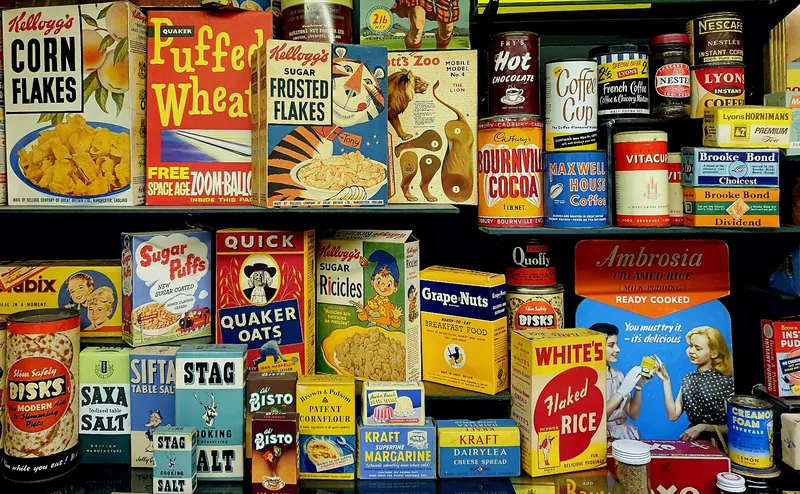
Photo: Museum of Brands · CC BY-SA 4.0 · Wikimedia Commons · resized
Booking, or just turning up
You can book online, but the museum says plainly that plenty of walk-up tickets are available every day, and that has been true in practice. The exception is a popular temporary exhibition, when you may be asked to reserve a free timeslot before buying.
One thing to sort out beforehand: the museum does not take cash. All major cards work except American Express. Gift tickets are valid for two years from purchase.
What the Time Tunnel actually contains
The tunnel is laid out chronologically and traces how consumer life changed from Victorian Britain to the digital age. Because it is arranged by decade rather than by product, you get an accidental social history: the arrival of the railway, the motor car and the aeroplane; cinema, radio and television; the disappearance of domestic servants; the spread of refrigeration and self-service shopping; plastics arriving and taking over.
Magazine covers show how style shifted. Posters show what each period thought it wanted. From the 1950s onwards the toys and games are mostly tie-ins to television programmes, which is its own commentary. An audio installation now runs alongside the displays, taking in everything from steam engines and early BBC broadcasts to disco records, with commentary recorded by Robert Opie himself.
Beyond the tunnel there are temporary exhibitions (Branding Britain was running in September 2026), plus a display of Opie's scrapbooks, a garden, a café and a shop.
The scrapbooks, and what the shop sells
Alongside the tunnel, the museum displays a run of large-format scrapbooks Opie has assembled, each packed with more than a thousand images of everyday objects from Victorian times onwards. They are a different way into the same material: instead of walking past a decade, you look down at a page of it.
Copies are sold in the shop, which is worth a few minutes even if you buy nothing. Unlike most museum shops, it sells things that relate directly to what you have just seen, reproductions of old packaging and reference volumes rather than generic souvenirs, and the proceeds go to the charity that runs the museum.
Who it works for, and who it does not
You will enjoy it if
- You grew up in Britain, or with British products, at any point since about 1950
- You are visiting with a mixed-age group: grandparents and grandchildren stop at different cases for different reasons
- You like design, packaging or advertising as a subject
- It is raining in west London and you need ninety warm minutes
You may not if
- You have no reference points for British brands; a lot of the pleasure is recognition
- You want objects of beauty or value — this is deliberately ordinary material
- You are travelling with under-sevens, who go free but will not last the tunnel
- You are on a tight schedule in central London; Notting Hill is a detour
The garden, the café and the cloakroom
Unusually for a museum of this size, the practical side is well covered. There is a cloakroom, a café, a garden to sit in, seating points through the galleries, a changing station, free wi-fi and a gift shop. The building is described as fully accessible.
The garden is the surprise: a small planted courtyard that most visitors do not expect in a museum about packaging, and a good place to eat a sandwich if the café is busy. Our round-up of museum and gallery cafés covers the grander versions elsewhere in the city.
Dates when it is shut, including carnival weekend
The museum closes on 24, 25 and 26 December. It also closes on the Sunday and Bank Holiday Monday of the August bank holiday weekend, because Notting Hill Carnival takes place on the surrounding streets and the area is impassable. Anyone planning a quiet museum hour in the middle of carnival should think again.
Shorter changes appear on the museum's key information page (a gallery closing at 1pm for an event, or an exhibition opening late), so it is worth a glance before you set out, particularly if you are coming specifically for a temporary show.
Carnival weekend closes this museum, not just the roads. On the Sunday and Monday of the August bank holiday the museum does not open at all. The rest of the carnival week is normal.
Getting to Lancaster Road
Ladbroke Grove station, on the Circle and Hammersmith & City lines, is a five-minute walk. It is not step-free: the museum's nearest step-free station is Paddington, from which local buses run to Ladbroke Grove. From the Ladbroke Grove bus stop marked B, routes 7, 23, 52, 70, 228 and 452 stop a few minutes away.
There is no visitor parking nearby, and the museum recommends public transport; Blue Badge parking is available in the surrounding streets. Coaches can drop off and collect at the front of the building, but local coach parking is limited. Bike racks are behind the museum.
Building a Notting Hill day around it
Lancaster Road sits north of Portobello Road, so the obvious combination is Portobello Road Market on a Saturday morning followed by the museum in the afternoon, though the market crowds mean the walk takes longer than the map suggests. Our Notting Hill guide covers the rest of the area, and vintage and second-hand shopping is the natural follow-on for anyone who has just spent an hour looking at old packaging.
Twenty minutes south, Holland Park and the Kyoto Garden make a quiet contrast. For design at a larger scale, the Design Museum is in Kensington and the V&A, where Opie's collection first went on show in 1975, is twenty-five minutes away by bus.
Two other museums built on a single private obsession pair well with this one: the London Transport Museum in Covent Garden and the Cartoon Museum in Fitzrovia. For a free City alternative on a weekday, try the Bank of England Museum. More small collections appear in our piece on the capital's overlooked museums, and this one is a reliable entry in our rainy-day guide. Families should also see London with kids, and older visitors our guide to London for older visitors, since this museum lands particularly well with both ends of that range.
Frequently asked questions
How much does the Museum of Brands cost?
In September 2026 an adult aged 26 to 59 paid £14, a concession (over-60 or aged 17 to 25) £10, a child aged 7 to 16 £8, and a family of two adults and two children £36. Younger children go free, and a £1 ticket is available to people receiving certain benefits.
Can you visit more than once on one ticket?
Yes. Tickets bought from 1 January 2026 allow unlimited return visits for twelve months, including to temporary exhibitions. Keep the paper ticket or the QR code, because you need it to get back in.
Do you need to book in advance?
Usually not. The museum keeps plenty of walk-up tickets available every day. For a popular temporary exhibition you may be asked to book a free timeslot first. Note that the museum takes cards only and does not accept American Express.
How long does the Time Tunnel take?
Most visitors spend between an hour and ninety minutes in the museum as a whole. The tunnel itself can be walked in half an hour, but very few people do, because almost everyone stops at the decade they remember.
Is the Museum of Brands open during Notting Hill Carnival?
No. It closes on the Sunday and the bank holiday Monday of the August carnival weekend, when the surrounding streets are given over to the parade. It also closes on 24, 25 and 26 December.
Sources
- Museum of Brands - Ticket Information 2026 (checked September 2026)
- Museum of Brands - Key Information and How to Get Here (checked September 2026)
- Museum of Brands - The Time Tunnel (checked September 2026)
- Museum of Brands - Plan Your Visit (checked September 2026)