
The Grant Museum of Zoology is a single crowded room at University College London holding more than 100,000 animal specimens: skeletons, skulls, dissections in jars and a backlit wall of microscope slides. Entry is free and needs no booking, but it opens only from 1pm to 5pm, Tuesday to Saturday.
It has been in continuous use by UCL students since 1828 and is named after Robert Edmond Grant, the university's first professor of comparative anatomy and zoology. It opened to the public in 1996 and still functions as a working university resource, which is why the labels assume you are interested rather than needing to be entertained.
The room is the point. Glass cases run floor to ceiling on all four walls and down the middle, packed far tighter than any modern museum would allow. Our guide to free museums in London lists it among the small ones worth a detour; this page explains how to actually get in, what to look for, and how to handle the fact that almost everything here was once alive.
The Grant Museum at a glance
- Address
- Rockefeller Building, 21 University Street, London WC1E 6DE
- Open
- Tuesday to Saturday, 1pm to 5pm. Closed Sunday and Monday
- Price
- Free. No booking needed for individuals
- Groups
- Booking essential for 10 or more; maximum group size 20
- Time needed
- 45 minutes to an hour; there is no time limit
- Nearest station
- Euston Square, 160 metres. Warren Street 320 metres, Euston and Goodge Street both 480 metres
The four-hour window, and how to use it
The single most important fact about this museum is that it only opens in the afternoon. One o'clock to five, Tuesday to Saturday. It is shut all day Sunday and Monday, and shut every morning of the week, because the mornings belong to researchers who book ahead.
That makes it an afternoon museum by design, and it is worth building the day around. A morning at the British Museum ten minutes away, lunch, then the Grant at one o'clock, works. Arriving at 11am with your afternoon already booked does not.
There is no ticket and no queue system unless the room fills. If it does, staff run a one-in, one-out arrangement and you wait outside; UCL says the wait is unlikely to exceed five or ten minutes outside school holidays. In practice the busiest hour is between 2pm and 3pm on a Saturday.
Pair it with the Petrie, which keeps identical hours. UCL's other public museum is a seven-minute walk away on Malet Place and also opens Tuesday to Saturday, 1pm to 5pm. Two free museums, one afternoon, one campus. Our guide to the Petrie Museum of Egyptian and Sudanese Archaeology has the detail.
What is in the room
The collection covers every animal group on earth, which in a space this size means density rather than breadth of display. A few things are worth finding deliberately.
The jar of moles. A large glass jar packed with whole preserved moles. Nobody at the museum claims it was assembled for any profound reason; it is a teaching set of specimens stored economically, and it has become the museum's mascot. The shop sells merchandise based on it.
The quagga skeleton. A subspecies of zebra from South Africa, hunted to extinction by 1883. Seven skeletons are known to exist worldwide and this is one of them, which makes it, by the museum's own description, the rarest skeleton in the world.
The thylacines. Marsupial carnivores from Tasmania, deliberately exterminated, with the last known animal dying in 1936. The museum holds preserved dissections, skeletons and skulls, an unusually complete set.
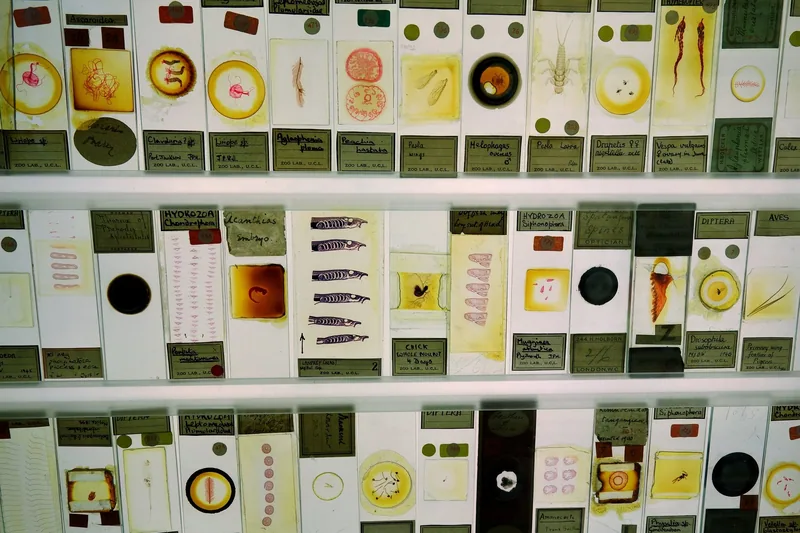
The Micrarium. A small alcove lined with 2,300 backlit microscope slides, most of them tiny animals that would be invisible in an ordinary case. It is the one part of the museum that looks designed rather than accumulated, and it is the picture everyone takes.
The python and the dodo. A five-metre Central African rock python skeleton, articulated around a branch rather than laid out flat, from an animal that lived at London Zoo. And a tray of dodo bones — not a mounted skeleton, but a real assemblage of the actual material.
The Blaschka glass models. Marine invertebrates and land snails made in glass by Leopold Blaschka and his son Rudolph in the 1880s, for a time when there was no way to preserve a jellyfish. They are beautiful and slightly unnerving.
Also here: giant deer antlers among the largest known, sawfish rostra used in modern conservation research, and Seychelles frogs studied for what they reveal about climate impacts on vulnerable species.
Animal remains, plainly
Almost everything in this room is a dead animal, and a good deal of it was dissected before being preserved. Jars hold organs, embryos and whole bodies. Skeletons are wired together with the joints visible. Nothing is disguised.
Most visitors find this straightforward: a natural history collection is a collection of remains, and this one is simply more honest about it than a diorama would be. Some do not, and there is no shame in deciding in the doorway that it is not for you. If you are bringing children, walk in first and look before you call them over.
The collection was assembled across two centuries of university teaching, under standards of collecting that were not those of today. UCL is open about that history in its research and cataloguing work. Photography is allowed for personal use, without flash, tripods, selfie sticks or live streaming.
The audio tour and what the museum does not have
A free 30-minute audio tour covers ten stops and is the best way to see the room if nobody is on hand to talk to you. It gives the specimens context that the labels, written for zoology students, largely assume.
There is no café. Bottled water and baby bottles are allowed inside; everything else is not, and there is nowhere to eat on site. There is no cloakroom either, so leave large bags and suitcases behind. Bikes cannot come in either, though UCL has bike storage around the campus. Toilets, including a gender-neutral accessible toilet and a baby care cubicle, are reached by key access: ask at the welcome desk.
The shop is better than it needs to be, running from postcards and books to affordable 3D-printed specimens that let children start their own collection. Every purchase supports the museum.
Groups, schools and the guiding rule
Groups of ten or more must book a slot by emailing the museum, and the maximum group size is twenty: the room genuinely cannot hold more. Self-guided group visits are free, though donations are welcome.
One rule catches tour operators out: external guiding is not permitted inside the museum. If you want a guided visit, it has to be arranged through UCL's venue hire route as a private tour. Walking-tour companies cannot bring a group in and talk to them in the gallery.
Evenings, and the other UCL events
The Grant runs after-hours events through the year: life-drawing evenings among the skeletons, and themed nights built around parts of the collection. They are ticketed separately from the free daytime opening and tend to sell out, so check UCL's events calendar rather than assuming you can turn up. Our guide to museum lates in London covers the bigger institutions' versions of the same idea.
Everything about this museum is free except the evening events. Entry, the audio tour, group visits and the family activities all cost nothing. If you are assembling a no-cost day in Bloomsbury, the Grant, the Petrie and the British Museum are three free collections within fifteen minutes of each other.
Getting to University Street
Euston Square is the closest station at 160 metres, served by the Circle, Hammersmith & City and Metropolitan lines. Warren Street on the Northern and Victoria lines is 320 metres; Euston itself and Goodge Street are both about 480 metres; Russell Square is just under a kilometre. Buses 1, 18, 24, 29, 30, 68, 91 and 134 all stop within walking distance. Our Underground guide explains the lines and fares.
The museum sits inside the Rockefeller Building on University Street, a working UCL medical building, so the entrance is less obvious than a museum front door. Vehicle access to the campus is restricted; limited accessible parking can be booked in advance, and there are several drop-off points with dropped kerbs.
Where it fits in a Bloomsbury afternoon
This is a 45-minute museum in an area thick with much larger ones. The obvious companions are the Petrie, seven minutes away, and the British Museum, ten minutes south, both free. Wellcome Collection on Euston Road is five minutes north and covers medicine and the body; it opens Tuesday to Sunday and is a good fallback on a Monday when the Grant is shut.
For the same subject at national scale, the Natural History Museum in South Kensington is the obvious comparison, and it is worth making: the Grant shows you what a collection looks like before it is curated for the public. The Horniman Museum in Forest Hill sits somewhere between the two. For human anatomy rather than animal, the Hunterian Museum at Lincoln's Inn Fields is twenty minutes away and also free.
Teenagers often take to this museum when they have had enough of grand galleries. See our list of London museums that work for teenagers. Younger children usually need a shorter visit and something afterwards; London Zoo in Regent's Park is the live version, twenty-five minutes away. The surrounding area is covered in our Bloomsbury guide, and King's Cross is fifteen minutes on foot for food afterwards.
Frequently asked questions
Is the Grant Museum of Zoology free?
Yes. Entry is free for individuals and no booking is needed. Groups of ten or more must reserve a slot in advance, and even then self-guided group visits are free. Only the evening events are ticketed.
What are the Grant Museum's opening hours?
Tuesday to Saturday, 1pm to 5pm. It is closed on Sundays and Mondays and does not open in the mornings, because weekday mornings are reserved for booked research visits. There is no maximum visit length once you are inside.
What is the jar of moles?
A large glass jar containing a number of whole preserved moles, kept as a teaching set and now the museum's best-known object. It is a jar rather than a drawer, and it sits in the main room with the other fluid-preserved specimens.
Is the Grant Museum suitable for children?
Many children love it, but everything on display is a dead animal, including dissections and specimens in fluid. There are no under-16 restrictions, and the museum welcomes families, but it is sensible for an adult to look around the room first and decide.
How long does a visit take?
Most people spend 45 minutes to an hour. The free 30-minute audio tour covers ten stops and is a good structure if you want one. There is no time limit, so you can stay until the museum closes at 5pm.
Sources
- UCL - Visit the Grant Museum of Zoology (checked September 2026)
- UCL - Top ten specimens in the Grant Museum (checked September 2026)
- UCL - Grant Museum of Zoology (checked September 2026)