
The Garden Museum occupies the deconsecrated church of St Mary-at-Lambeth, beside Lambeth Palace and directly across the Thames from Parliament. It tells the history of British gardens and gardening, opens seven days a week, and charges £16 for an adult. Its medieval tower is currently closed for maintenance.
The museum exists because two people would not let the building be knocked down. In 1977 Rosemary and John Nicholson came to see the tomb of John Tradescant and found the church boarded up and awaiting demolition. They set up the Tradescant Trust, took a 99-year lease from the Diocese of Southwark and turned the shell into the world's first museum devoted to garden history.
That origin explains the shape of a visit. You are in a medieval and Victorian church that contains a museum, a courtyard garden built around a 17th-century tomb, and one of the better restaurants attached to any London museum. It is a strange, pleasant combination, and it takes about ninety minutes.
The Garden Museum at a glance
- Address
- Lambeth Palace Road, London SE1 7LB
- Open
- Monday to Sunday, 10am to 5pm. Last admission 4.30pm
- Adult ticket
- £16 (September 2026). Senior 65+ £13; student or unemployed £9; child 7–18 £9; under-7s free
- Families
- £20 for one adult and one child; £40 for two adults and two children
- Free entry
- Friends and Patrons, carers, and members of the museum's Community Access Scheme
- Nearest stations
- Vauxhall, Westminster, Waterloo and Lambeth North, each about ten minutes' walk
The tower is shut, so do not plan around it
The museum's medieval tower is the oldest surviving structure in the borough of Lambeth. It was built in 1377, repaired in 1834–35 and otherwise stands as it was. When it is open, 131 steps lead to a view over the Thames towards Westminster. Wenceslaus Hollar is thought to have climbed it to draw his 1647 panorama, The Prospect of London and Westminster taken from Lambeth.
It is closed for maintenance. The museum says only that it hopes to welcome visitors back up the tower "later in 2026", and no reopening date has been published, so assume the climb will be unavailable unless you have confirmed otherwise. If the tower is your reason for coming, email or telephone before you buy a ticket.
There is a small consolation. A screen in the baptistry area at the foot of the tower shows a point-of-view film of the ascent, so you can at least see what you are missing. For alternatives that are definitely open, see our guide to the best free viewpoints in London.
You cannot climb St Mary's tower at the moment. The 131 steps and the river view are out of action for maintenance and the museum has not named a reopening date. Everything else is open as usual: galleries, gardens, café and tombs.
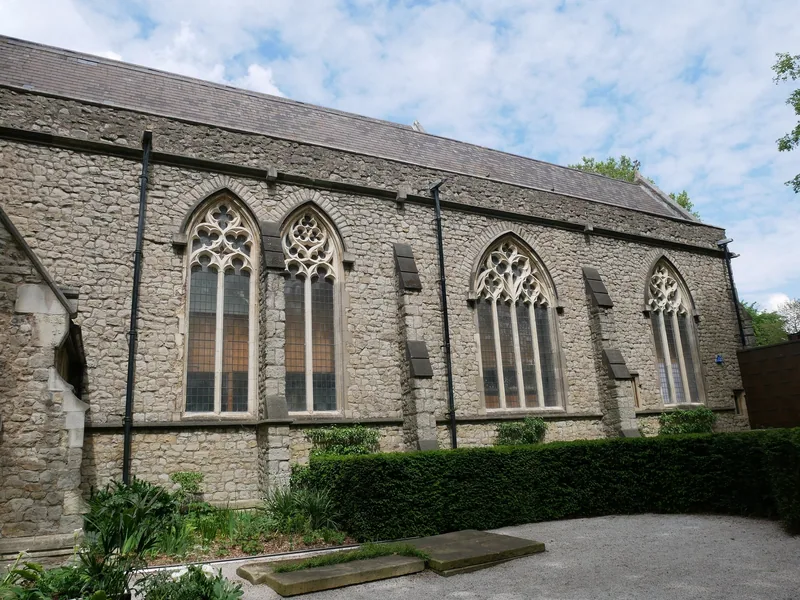
Photo: Ethan Doyle White · CC BY-SA 4.0 · Wikimedia Commons · resized
What £16 covers, and the cheaper ways in
One ticket covers the permanent collection, the temporary exhibition and the gardens. In September 2026 an adult paid £16, a senior over 65 £13, and students, unemployed visitors and children aged 7 to 18 £9 each. Children of 6 and under go free. A National Art Pass brings the adult rate down to £8.
Family tickets are £20 for one adult with one child, and £40 for two adults with two children, the second of which saves £10 on four separate tickets. Carers go free with the person they are supporting, as do the museum's Friends and Patrons and members of its Community Access Scheme, which is aimed at local residents and community groups.
The museum notes that prices may vary with the exhibition programme, so treat £16 as the standard rather than a fixed figure and check the day you book.
The opening-hours trap
The museum opens every day from 10am to 5pm, which makes it one of the few small London museums that does not shut on Mondays. But it hires itself out for events, and it publishes a long list of days when it closes early or entirely.
In the autumn of 2026 alone the published list included early closures at 4pm on 15, 19, 26 and 30 September and 7 November; 1.30pm closures on 25 September, 21 October and 12 December; a 12pm closure on 28 November; a late 2pm opening on 2 November; and a full-day closure on Wednesday 7 October.
None of that is unreasonable for a charity that has to earn its keep, but it does mean the published hours are a starting point rather than a promise. The museum runs an opening time checker on its visit page; use it. Last admission is always half an hour before whatever the closing time turns out to be.
Inside: the Ark Gallery, the tombs and the glass floor
The nave is the main space, with the permanent collection on a first floor built inside the church as a free-standing timber structure, a prefabricated Swiss system designed by Dow Jones Architects that stands up by itself without foundations or fixings into the old walls. It means the building could be filled without being damaged, and it is worth looking up at the joinery as much as the exhibits.
The Ark Gallery, named after Tradescant's famous cabinet of curiosities, holds two late-medieval wall monuments: the chantry tomb of Hugh Peyntwyn, who died in 1504, and a monument of the same type to John Mompesson, who died in 1524. St Mary-at-Lambeth is the only church in the country with two of this kind, both associated with the royal workshops.
Watch for the glass panel set into the floor, which looks down onto steps below. It is safe to walk on, but it surprises people. The church's aisles and nave were almost entirely rebuilt by Philip Charles Hardwick in 1851–2, and four of the eight corbels in the nave ceiling survive from earlier work.
The churchyard was later closed to new burials, with an estimated 26,000 people interred on the site, which is why the ground level around the building has risen over the centuries.
The gardens, the Tradescant tomb and Captain Bligh
Two gardens come with the ticket. The courtyard garden is built around the Tradescant family tomb and planted to reflect the life of John Tradescant, who died in 1638 and was the first great English plant hunter, the man who introduced a long list of species to English gardens and whose collection of curiosities became the seed of the Ashmolean. The decorated tomb itself was put up by Hester, the widow of his son, as a family memorial.
Also buried in the churchyard is Admiral William Bligh, of the Bounty, who lived nearby on Lambeth Road and lies in the family tomb here. His grave is the second thing most visitors photograph.
A separate community garden on Lambeth Green is open to all, and the museum's archive preserves the working records of leading British garden designers, consulted by appointment rather than displayed.
The café has its own opening hours. The Garden Café keeps a separate timetable from the museum, so if lunch is part of the plan, check its page as well as the museum's. It looks out onto the courtyard garden and does not require a museum ticket.
Access, bags and practicalities
The museum is accessible to wheelchair users, with level access through the Garden Café. A lift reaches the permanent collection on the first floor, but the museum asks anyone who needs it to telephone 020 7401 8865 or email ahead to confirm it is working — an unusually candid request, and worth taking seriously. Toilets are on the ground floor and are wheelchair accessible, with baby changing in the accessible toilet.
There are a few rough edges to know about: uneven flooring and a small step near the baptistry, low lighting around the tower screen, and a tower door that can bang in high winds. The audio in the upstairs collection gallery runs continuously and has no subtitles.
There is no cloakroom. Small bags and coats may be left at the front desk at the discretion of staff, at your own risk, and large bags and suitcases are not accepted at all. Our guide to accessible London covers the wider picture.
Getting to Lambeth Palace Road
The museum sits on the river bank beside Lambeth Palace, at the southern end of Lambeth Bridge. It is roughly a ten-minute walk from Vauxhall, Westminster, Waterloo and Lambeth North, all of which have step-free access, though it is worth checking Transport for London before you travel. Our Underground guide explains the lines serving each.
Walking from Westminster across Lambeth Bridge is the best approach: you arrive with the Palace of Westminster behind you and the museum's tower in front. There is accessible parking information on the museum's website, but no general visitor parking.
What to combine it with
The nearest museum is the Florence Nightingale Museum, five minutes north in the grounds of St Thomas' Hospital, which makes a tidy pairing: two small, well-made museums on the same stretch of riverbank, both overlooked by the vast majority of visitors staring at the Palace of Westminster from the other side. Fifteen minutes east, the Imperial War Museum is free.
For gardens rather than garden history, the Chelsea Physic Garden is the obvious next step and Kew Gardens the full day out. Our guides to the Chelsea Flower Show in May and the Hampton Court Garden Festival in July cover the show season, and RHS Wisley is an easy day trip.
The area around the museum is covered in our South Bank guide, and for more green space at height see roof gardens and free terraces. It is also a reliable wet-weather option, listed in our rainy-day guide, and one of the small museums covered in our wider small museums round-up.
Frequently asked questions
Can you still climb the Garden Museum's tower?
Not at present. The medieval tower is closed for maintenance. The museum says it hopes to reopen it later in 2026, but no date has been published, so plan on the assumption that the climb will not be available. When it is open, the climb is 131 steps and leads to a view over the Thames towards Westminster.
How much does the Garden Museum cost?
In September 2026 an adult ticket was £16, a senior over 65 paid £13, and students, unemployed visitors and children aged 7 to 18 paid £9. Under-7s go free, a family of two adults and two children is £40, and a National Art Pass brings the adult price to £8.
Which days is the Garden Museum open?
Every day from 10am to 5pm, with last admission at 4.30pm. However, it closes early or entirely on a number of days for private events (including a full-day closure on 7 October 2026), so check the amended opening hours on its website before travelling.
Who is buried at the Garden Museum?
The churchyard of St Mary-at-Lambeth holds the tomb of the plant hunter John Tradescant, which forms the centrepiece of the courtyard garden, and the family tomb of Admiral William Bligh of the Bounty. An estimated 26,000 burials took place on the site before it closed to new interments.
Do you need a ticket for the café?
No. The Garden Café can be used without buying museum admission, and it keeps its own opening hours, which differ from the museum's. It sits beside the courtyard garden and serves a seasonal modern European menu.
Sources
- Garden Museum - Visit, admission costs and amended opening hours (checked September 2026)
- Garden Museum - Our Museum and the Medieval Tower (checked September 2026)
- Garden Museum - Our History (checked September 2026)
- Garden Museum - Access (checked September 2026)