
The Florence Nightingale Museum sits in the grounds of St Thomas' Hospital, directly across the river from the Houses of Parliament. It holds the lamp she carried in the Crimea, her medicine chest, a first edition of Notes on Nursing and her stuffed pet owl. It opens six days a week, costs £12 for an adult, and that ticket is valid for a year.
The location is not decorative. Nightingale founded her nurses' training school at St Thomas' in 1860, and the hospital has been associated with her name ever since. The museum is a single ground-floor gallery in the hospital grounds, entered from Lambeth Palace Road, and a typical visit takes between 45 and 75 minutes.
If you have read elsewhere that this museum opens only a few days a week, that is out of date. Six days a week is the current pattern, 10am to 5pm, with one late evening a month.
The Florence Nightingale Museum at a glance
- Where
- 2 Lambeth Palace Road, in the grounds of St Thomas' Hospital, London SE1 7EP
- Open
- 10am to 5pm, Tuesday through to Sunday, with last entry at 4.30pm. Closed Mondays
- Late opening
- Until 8pm on the last Thursday of every month
- Adult ticket
- £12, valid for unlimited visits for a year (September 2026)
- Other prices
- Concession £10, student £7, child 5–16 £6, family £30 for two adults and up to four children
- Access
- Entirely on one level and fully wheelchair accessible
Every ticket is an annual ticket
This is the detail that makes the museum better value than it looks. Any ticket bought directly from the museum (online or at the door) is an annual ticket, valid for as many visits as you like in the twelve months from your first one.
There is a condition: you have to sign the back of the ticket to validate it, and you may be asked for identification on a return visit. Tickets cannot be shared or handed on. If you bought through a third party, the terms are theirs rather than the museum's.
Prices in September 2026 were £12 for an adult; £10 concession, covering over-65s, Blue Light Card holders and disabled visitors; £7 for students with valid ID; £6 for children aged 5 to 16; and free for the youngest children. A family ticket at £30 covers two adults and up to four children, which is the most generous family ratio of any museum in this part of London. National Art Pass holders get 50% off adult and student tickets. Groups of ten or more must pre-book a slot.
The museum states that, as a small charity dependent on admissions, it cannot offer a general discount for nurses. That surprises people, so it is worth knowing before you arrive.
A £12 ticket here buys twelve months, not ninety minutes. Sign the back and you can come back whenever you like for a year. For anyone living in or regularly visiting London, that makes it one of the cheapest museum habits going.
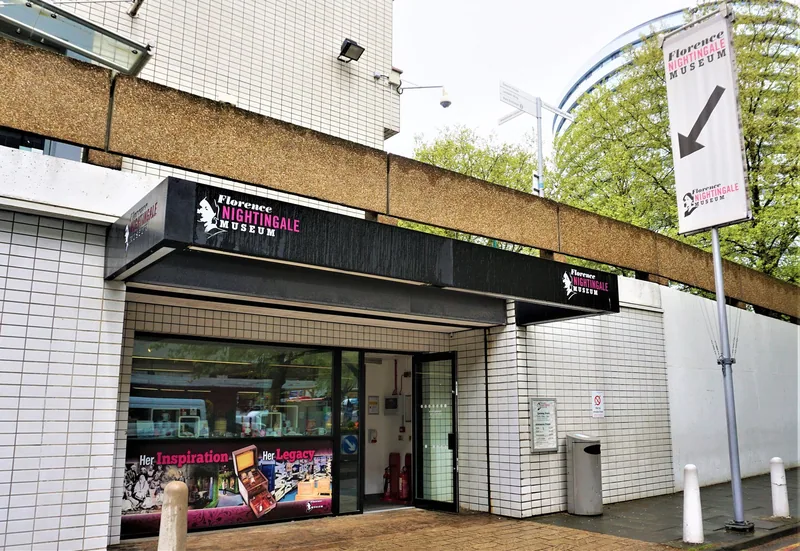
Photo: Joyofmuseums · CC BY-SA 4.0 · Wikimedia Commons · resized
What is in the gallery
The collection is small and specific, which is its strength. The objects that draw people are the lamp Nightingale carried during the Crimean War and her medicine chest from the same campaign. The lamp is worth looking at closely, because it is not the graceful classical oil lamp of the Victorian prints and the popular image.
Alongside them sits Notes on Nursing, the book that made her ideas portable and turned nursing from a job into a trained profession, and Athena, her pet owl, who was carried around in her pocket and was preserved after her death.
The gallery goes beyond the Crimea into what she did afterwards: statistics, sanitation and hospital design, the long campaign conducted largely from a sickbed. The wider story of Victorian medicine is told a few minutes away at the Old Operating Theatre Museum and, in more clinical detail, at the Hunterian Museum.
Sound, and when the museum is quiet
The gallery has a soundscape running through it: bird calls, the chatter of a dinner party, scurrying rats, a grandfather clock. Some video content starts by itself, though the museum keeps the volume low. There is also an audio trail, and every piece of its content is transcribed: you can borrow the transcriptions from the entrance if you would rather read than listen.
The museum is candid about its busiest period: Tuesday to Friday from 10:00 to 14:00 in term time, when primary school groups visit. If you want a quiet visit, come in the afternoon, at a weekend or on the last Thursday of the month, when the museum stays open until 8pm. Emailing ahead will get you a current recommendation based on what is booked.
The last Thursday of the month runs to 8pm. That makes this one of very few museums in central London you can see properly after work, and the quietest time in the gallery by a wide margin. There is a fuller list of London museums that open in the evening elsewhere on the site.
Bags, and why Waterloo matters
There is a small cloakroom with hangers and free lockers for small bags. It is unattended, and everything is left at your own risk. Because of hospital security restrictions, large bags and suitcases cannot be stored at all.
That rules out the obvious plan of visiting on your way to or from a train. Waterloo, ten to fifteen minutes away, has somewhere to leave a case; the options and what they cost are set out in our guide to storing luggage around London.
Access: the flattest museum in this article
Everything is on one level and the museum is fully wheelchair accessible. It sits at car park level in the hospital grounds, reached down a slightly sloping pavement from Lambeth Palace Road, and, importantly, you do not have to go through any hospital building to get to it.
There are male, female and accessible toilets, with baby-changing tables in both the male and female facilities and free period products available. There is no Changing Places toilet in the museum; the nearest is at the main entrance of St Thomas' Hospital, reached step-free either by an external slope or by the hospital lifts, and opened with a radar key that can be borrowed from the hospital security desk.
The museum does not have wheelchairs to lend. The nearest drop-off point is across the car park entrance from the museum, connected by two small zebra crossings. Our guide to accessible London covers the wider picture.
Getting there, and the cycle lane to watch for
Waterloo and Waterloo East are ten to fifteen minutes on foot; Westminster and Waterloo Underground stations about the same. Victoria and Charing Cross are twenty to thirty minutes' walk. Which services run into each of them is explained in our guide to the capital's terminus stations.
Buses 12, 53, 148, 159, 211, 453 and C10 stop on Westminster Bridge Road; routes 77, 507 and N44 stop on Lambeth Palace Road. The museum warns about one local hazard worth repeating: cycle lanes run between the pavement and the bus stops in this area, so look both ways when stepping off a bus.
Taxis can use a designated drop-off point for the hospital before the car park barriers. Driving otherwise means the Congestion Charge, and the hospital's limited parking should be left to patients. There is no coach or minibus parking, and the turning circle outside the museum is tight, so ask to be dropped on Westminster Bridge Road instead.
Lunch, picnics and the Mary Seacole statue
The museum recommends Lower Marsh, a few minutes away, for food: independent cafés and restaurants and a street market that runs from Monday to Friday. Our guide to cheap eats in London has more options in the area.
For a picnic, the hospital gardens are the interesting choice. They contain the statue of Mary Seacole, the Jamaican-British nurse who funded her own way to the Crimea after being turned down by the official channels, and they look straight across the water at Parliament. Archbishop's Park and Jubilee Gardens are the other two options, both with large playgrounds, which helps if you are here with children, as our guide to London with kids explains.
What to combine it with
The Garden Museum is five minutes south along Lambeth Palace Road, which makes the pair the most rewarding half day on this stretch of riverbank. Between them they take about three hours and cost less than one big-ticket attraction.
Ten minutes north are the London Eye and the busiest part of the South Bank, and tours of the Houses of Parliament start across Westminster Bridge. Fifteen minutes east, the Imperial War Museum is free and covers the wars that followed the one Nightingale is remembered for. For the history of medicine at a broader scale, Wellcome Collection is a twenty-minute Tube ride north.
Older children often engage with this museum more than they expect, because the story is about someone who refused to do what she was told; see our list of museums that work for teenagers.
Is it worth an hour?
Yes if
- You want one contained, well-made museum rather than a half-day in a vast one
- You are interested in medicine, statistics or how a Victorian woman ran a public campaign from her bed
- You will be back in London within a year and can use the annual ticket
- Step-free matters: this is the flattest small museum on the South Bank
Probably not if
- You are on a one-day sprint through Westminster and already short of time
- You arrive on a Monday, when it is closed
- You are dragging luggage, which cannot be stored here
- You want scale; this is one gallery, and the ticket is for depth rather than size
Frequently asked questions
Which days is the Florence Nightingale Museum open?
Every day except Monday, from 10am until 5pm, with last entry at 4.30pm. It closes on Mondays. On the last Thursday of every month it stays open until 8pm. Older guidebooks describing a two- or three-day opening pattern are out of date.
How much does it cost, and is the ticket really valid for a year?
An adult ticket was £12 in September 2026, with concessions at £10, students £7 and children aged 5 to 16 £6. Every ticket bought directly from the museum is an annual ticket giving unlimited visits for twelve months, provided you sign the back to validate it.
Is Florence Nightingale's lamp really there?
Yes. The lamp she carried in the Crimea is in the collection, along with her medicine chest from the campaign, a copy of Notes on Nursing and her pet owl Athena. It looks rather different from the elegant lamp shown in Victorian prints, which is part of the interest.
How much time should I set aside?
The museum puts a typical visit at 45 to 75 minutes. It is a single gallery on one level, so it suits an hour between other plans rather than a whole morning.
Is the museum inside the hospital?
It is in the grounds of St Thomas' Hospital, at car park level, with its own entrance on Lambeth Palace Road. You do not need to enter any hospital building to reach it. Large bags and suitcases cannot be stored because of hospital security rules.
Sources
- Florence Nightingale Museum - Visiting Us, opening hours and tickets (checked September 2026)
- Florence Nightingale Museum - Getting Here (checked September 2026)
- Florence Nightingale Museum - Accessibility (checked September 2026)
- Florence Nightingale Museum - Visit (checked September 2026)