
The easiest way for a visitor to cycle in London is to hire a Santander Cycle, TfL's public bike scheme: a single ride costs £1.65 for up to 30 minutes, and a Day Pass costs from £3.50 for unlimited 60-minute rides over 24 hours. You pay with the app or a bank card at a docking station, but you need to be confident in busy traffic, and you should plan your route along London's Cycleways and parks.
London has changed a lot for cyclists. TfL has expanded its network of Cycleways, some with two-way cycle lanes. The public hire scheme has more than 12,000 bikes, and about one in six of them is now electric. For a visitor, a bike can be a quick and cheap way to link sights that are a little too far apart to walk, or a pleasant way to spend a morning in one of the big parks.
It is still a big, busy city, though. Traffic drives on the left, buses and lorries share many roads, and the rules for cyclists are enforced. This guide explains how the hire bikes work, what they cost, where to ride and how to stay safe.
Santander Cycles prices (September 2026)
- Single ride, pedal bike
- £1.65 for up to 30 minutes, then £1.65 per extra 30 minutes
- Single ride, e-bike
- £3 for up to 30 minutes, then £3 per extra 30 minutes
- Day Pass
- From £3.50: unlimited 60-minute rides for 24 hours (e-bikes £1 extra per ride)
- Monthly / annual pass
- From £20 / from £120
- Maximum hire
- 24 hours; late or damaged bikes can cost up to £300
- Age
- 18+ to hire; riders on your hire must be 14 or over
- Bikes and docks
- More than 12,000 bikes at about 800 docking stations in inner and central London
How the Santander Cycles scheme works
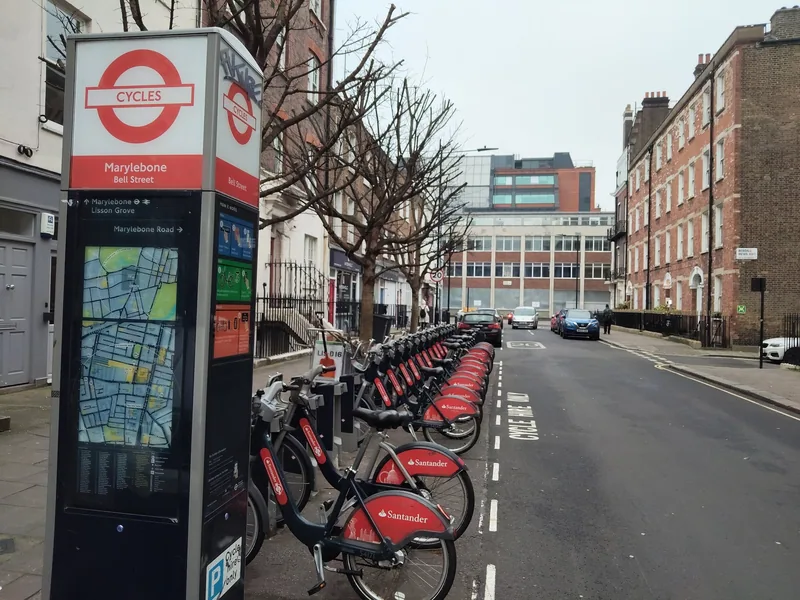
Santander Cycles is run by Transport for London (TfL). The bikes are the heavy red ones you see parked in rows of docking points across central and inner London. You take a bike from one docking station, ride it, and return it to any other docking station with a free space. There is no need to bring it back to where you started.
There are three ways to hire:
- The Santander Cycles app. Choose a docking station, select "Hire now" and you receive a release code on your phone. The app also shows where e-bikes are (marked with a lightning symbol) and how many free docking points each station has.
- The docking station terminal. Choose "Hire a cycle" on the touch screen, pay by debit or credit card (contactless phones and watches work) and take the printed release code. You can hire up to four bikes at once, but not e-bikes.
- A membership key. A £3 key for regular users, bought by phone and registered online. For most visitors, the app or terminal is easier.
To hire, you must be 18 or over. TfL's terms allow you to buy access for up to three other people, as long as they are at least 14. That rules out younger children, who need to ride their own bikes with an adult or stay on foot.
Releasing and returning a bike
- Check the tyres, brakes and bell of the bike you choose.
- Type your release code into the keypad on the docking point and pull the bike out when the green light shows.
- Adjust the saddle. The lights come on automatically when you start pedalling.
- At the end, push the bike firmly into an empty docking point and wait for the green light. Without it, the bike is not docked and you keep paying.
If a docking station is full, choose "No docking point free" at the terminal. TfL says you then get an extra 15 minutes to reach another station. If there is no green light when you dock, call TfL's cycle hire line on 0343 222 6666.
What a Santander Cycle costs
Prices are low as long as you keep an eye on the clock.
| Option | Pedal bike | E-bike |
|---|---|---|
| Single ride | £1.65 for 30 minutes, then £1.65 per extra 30 minutes | £3 for 30 minutes, then £3 per extra 30 minutes |
| Day Pass (24 hours) | From £3.50, unlimited rides of up to 60 minutes; £1.65 per extra 60 minutes | £1 extra per ride; £3 per extra 60 minutes |
| Monthly Pass | From £20 | £1 per ride |
| Annual Pass | From £120 | £1 per ride |
The key rule is that each ride has a time limit: 30 minutes on a single ride, 60 minutes on a pass. On a pass, docking the bike before the hour is up and taking a bike again starts a new ride, so plan your stops around docking stations. You can keep a bike for up to 24 hours in total, but if it is not back within 24 hours, or is damaged, TfL can charge up to £300. Current prices are on TfL's Santander Cycles price page.
The Day Pass pays off from the third ride. A single ride is £1.65 and a Day Pass starts at £3.50, so two rides are cheaper as singles and three are cheaper on the pass. If you plan to hop on and off between sights all day, buy the pass in the morning; if you want one ride across a park, pay as you go.
A cheap way to cross the centre
For a couple, two Day Passes cost from £7.00 in total. Compare that with two adults reaching the daily pay as you go cap for the Tube in Zones 1-2, which is £8.90 each. On a fine day, a mix of walking and hire bikes can cover a full day of sightseeing in the centre for the two of you for less than one person's Tube cap. Our guide to saving money in London has more ideas.
Electric Santander Cycles
About one in six Santander Cycles is an e-bike. They look similar, but the motor gives pedal assistance up to 25 km/h (about 15 mph): you still have to pedal, and the motor helps. They make hills, longer rides and headwinds much easier.
E-bikes cannot be hired at the docking station terminal. You need the Santander Cycles app or a membership key. In the app, e-bikes are shown with a lightning symbol. They cost £3 per 30 minutes on a single ride, or £1 extra per ride on a pass.
Other companies also rent dockless e-bikes through their own apps in many parts of London, with their own prices and parking rules. Check the operator's app for where you are allowed to leave the bike.
Where to ride: Cycleways and quieter routes
The single best tip for a visitor is to plan the route before you set off. TfL's network of Cycleways links many parts of London with signed routes, some with separated two-way cycle lanes. TfL is still renaming the older "Cycle Superhighways" and "Quietways" as Cycleways, so you may see both names on maps and signs.
Useful tools:
- TfL's cycle map shows cycle routes and Santander Cycles docking stations.
- The TfL Go app can plan cycle routes along the Cycleways.
- The Santander Cycles app shows docking stations and free spaces.
TfL publishes maps of individual routes, including Cycleway 4 from London Bridge to Greenwich and Cycleway 8 from Battersea to Lambeth Bridge. A ride east along Cycleway 4 is one way to reach Greenwich by bike, but check where docking stations are near the end before you go.
Parks for a gentler ride
If you are nervous about traffic, start in a park. Hyde Park and Regent's Park are both close to plenty of docking stations and make a relaxed first ride. Cycling in the parks is usually only allowed on certain paths, so follow the signs at each gate and give way to people walking. Further out, Richmond Park is popular with local cyclists, but it is a long way from the central docking stations. Our overview of London's parks and gardens helps you pick one.
For inspiration, TfL's Cycle Sundays pages suggest leisurely routes for a weekend ride, along with links to cycle training and events.
Avoid the South Bank path at busy times. The riverside walk between the London Eye and Tower Bridge is packed with pedestrians, and TfL's advice is not to cycle on the pavement. Enjoy that stretch on foot, as described in our walking guide, and use the bike for longer links.
The rules of the road for cyclists
The Highway Code applies to everyone on the road in England, including cyclists. TfL points out that many of its rules are legal requirements, and breaking them can mean a fine. The main points for visitors:
- Ride on the left, with the traffic. Do not cycle the wrong way along a one-way street unless it is clearly marked for cycles.
- Stop at red lights. Riding through a red light can bring a £50 fine.
- Do not ride on the pavement. Pavements are for people walking.
- Give way to pedestrians on zebra crossings and to people crossing at junctions, including those still crossing after the lights have changed.
- Use lights after dark: white at the front, red at the rear. You can be fined £50 without them. Santander Cycles have automatic lights.
- No phone or headphones while riding.
Helmets are not required by law in the UK, and hire bikes do not come with one. TfL recommends considering a helmet. If you are used to riding on the right, the first junctions are the hardest; our guide to road rules for foreign drivers explains roundabouts and left-hand traffic in more detail.
Staying safe in London traffic
TfL's safety advice is practical and worth following closely:
- Stay well back from lorries and buses. Their drivers may not be able to see you, especially when they turn left. Never go up the inside of a large vehicle at a junction.
- Keep a door's width from parked cars, and ride in a straight line past them rather than weaving in and out.
- Ride away from the gutter. On narrow roads, riding nearer the middle of the lane can stop drivers overtaking dangerously.
- Make eye contact with drivers and signal clearly before turning.
- Wear bright clothing by day and something reflective at night.
The Highway Code's "hierarchy of road users" puts the greatest responsibility on those who can do the most harm. Drivers must look out for cyclists, but cyclists also have a particular responsibility towards pedestrians. In practice, that means slowing down near people crossing and never assuming a driver has seen you.
Rain changes things too. Wet roads are slippery, painted lines more so, and visibility drops. Check the weather in London before a longer ride.
Taking a bike on the Tube, trains and boats
Hire bikes are meant to be ridden from dock to dock, so these rules matter mainly if you bring or rent your own bike. TfL's rules depend on whether it folds.
- Folded bikes (including folded e-bikes) can go on almost all TfL services at any time, although a bus driver can refuse if it is busy.
- Non-folding bikes are allowed on parts of the Tube, the Overground and the DLR outside weekday rush hours (before 07:30, between 09:30 and 16:00, and after 19:00) and at any time at weekends. On the Tube, this applies only to certain lines and sections, mostly those above ground.
- Non-folding e-bikes are not allowed on most TfL services, including the Tube, Overground, Elizabeth line and DLR.
- Buses and trams do not take non-folded bikes.
- River boats: the Uber Boat river bus carries bikes free of charge, with ten spaces on larger boats.
- The Cable Car takes non-folded bikes at any time, but no e-bikes. See our guide to the IFS Cloud Cable Car (London Cable Car).
The full list of lines and times is on TfL's page about cycles on public transport. Our guide to the Underground explains the lines themselves.
E-scooters: what visitors should know
Privately owned e-scooters cannot legally be ridden on public roads or pavements in London. TfL says the only legal way to ride one in public is to rent from an approved operator in the official rental trial, which currently runs with two operators in a limited number of boroughs, including Westminster, Camden, the City of London, Southwark and Lambeth. Riders must register in the operator's app, which includes checking age and a driving licence.
E-scooters are banned from all TfL services and stations, even when folded, and TfL says you risk a fine of up to £1,000. If you bring one from home, you will not be able to use it in London.
Suggested rides for a first visit
These short rides suit a Day Pass and a free morning:
- Hyde Park and Kensington Gardens: a loop inside the parks, past the Serpentine lake; use the app to find docking stations near the park gates.
- Regent's Park: an easy loop, with the option to lock up and walk up Primrose Hill for the view.
- Across the river: use a signed Cycleway or quieter back streets to cross one of the Thames bridges, and walk the busy riverside paths. Our guide to the bridges of London helps you choose one.
- Queen Elizabeth Olympic Park: wide paths around the former Olympic venues in east London; see our guide to the Olympic Park today.
Whatever you choose, dock your bike before the 30- or 60-minute limit, and use the app to check there will be space at the other end.
Frequently asked questions
How much does it cost to hire a Santander Cycle?
A single ride on a pedal bike costs £1.65 for up to 30 minutes, then £1.65 for each extra 30 minutes. A Day Pass costs from £3.50 and gives unlimited rides of up to 60 minutes over 24 hours. E-bikes cost £3 per 30 minutes on a single ride, or £1 extra per ride with a pass.
Can tourists use Santander Cycles?
Yes. You do not need to live in London or have a UK bank account. You can hire a pedal bike at a docking station terminal with a debit or credit card, including contactless, or use the Santander Cycles app. You must be 18 or over to hire, and other riders on your hire must be at least 14.
Do you have to wear a helmet to cycle in London?
No, helmets are not required by law in the UK, and Santander Cycles do not come with one. TfL recommends that you consider wearing one. You must follow the Highway Code, including stopping at red lights, using lights after dark and not riding on the pavement.
Can I take a bike on the London Underground?
Folded bikes can go on almost all TfL services at any time. Non-folding bikes are only allowed on certain lines and sections of the Tube, mostly above ground, and not during the weekday rush hours. Non-folding e-bikes are not allowed on the Tube at all.
Is cycling in London safe for visitors?
It can be, if you are an experienced rider and plan your route. Use Cycleways and parks where possible, stay well back from buses and lorries, keep away from parked car doors and avoid the rush hours. If you have never cycled in heavy traffic, start with a ride inside one of the big parks.
Sources
- Transport for London - Santander Cycles (checked September 2026)
- Transport for London - Santander Cycles: What you pay (checked September 2026)
- Transport for London - Rent a bike (checked September 2026)
- Transport for London - Santander Cycles terms and conditions (checked September 2026)
- Transport for London - Cycling safety (checked September 2026)
- Transport for London - Cycles on public transport (checked September 2026)
- Transport for London - Cycleways (checked September 2026)
- Transport for London - E-scooters (checked September 2026)