
Battersea sits on the south bank of the Thames opposite Chelsea, and Nine Elms is the stretch of former industrial riverside just east of it. The reason to come is the power station: a 1930s brick cathedral of a building with four white chimneys, closed for four decades and reopened in 2022 as shops, restaurants, offices and a glass lift that takes you up inside one of the chimneys.
Around it, on land that used to be gasworks, wharves and a wholesale market, stands a large quarter of new apartment towers, with the United States Embassy in the middle of it. There is also a Victorian park with a lake, a peace pagoda and a children's zoo, and there has been since 1858.
What you get is a short, strange walk between two very different kinds of London. Allow half a day. It works well with Chelsea across the bridge, or as an approach to Pimlico on the north bank.
Battersea and Nine Elms at a glance
- Best for
- Industrial architecture, a chimney lift, a large riverside park, November fireworks
- Address
- Battersea Power Station, Circus Road West, Nine Elms, SW11 8DD
- Tube
- Battersea Power Station and Nine Elms, Northern line, both in Zone 1, both step-free
- Rail
- Battersea Park and Queenstown Road, a few minutes from Victoria and Waterloo
- River
- Battersea Power Station Pier, served by Uber Boat by Thames Clippers
- Park
- Battersea Park, free, open daily
- Fireworks 2026
- Saturday 7 and Sunday 8 November, advance tickets only
Getting there: Tube, train and boat
Until 2021 this was one of the worst-connected parts of inner London. Then the Northern line was extended from Kennington, and two stations opened: Nine Elms and Battersea Power Station. Both are in Zone 1, both are step-free from street to train, and Battersea Power Station is about four minutes from Waterloo and eight from Bank on the Charing Cross or Bank branch respectively. Check the branch on the platform indicator, as covered in our guide to the Underground.
Battersea Park and Queenstown Road are National Rail stations on the north-eastern edge of the park, a few minutes out of Victoria and Waterloo respectively. They are useful if you are staying near either terminus, and pay as you go works on both.
The most enjoyable approach is by water. Uber Boat by Thames Clippers stops at Battersea Power Station Pier, and at weekends the RB2 service runs non-stop between Embankment and the power station in about 10 minutes. River Bus fares are charged by zone and are not included in the daily cap, so a Central-zone single is £9.90 off-peak and £11.90 at peak times (fares in force until 31 October 2026, after which new prices are published). Our pages on the river bus and river bus against sightseeing cruise explain which is better value.
River Bus fares sit outside the Tube daily cap. Two adults taking the RB2 from Embankment and back on a weekend pay about £40 on top of whatever their Tube travel costs. Take the boat one way and the Northern line back, and you get the view without paying twice for it.
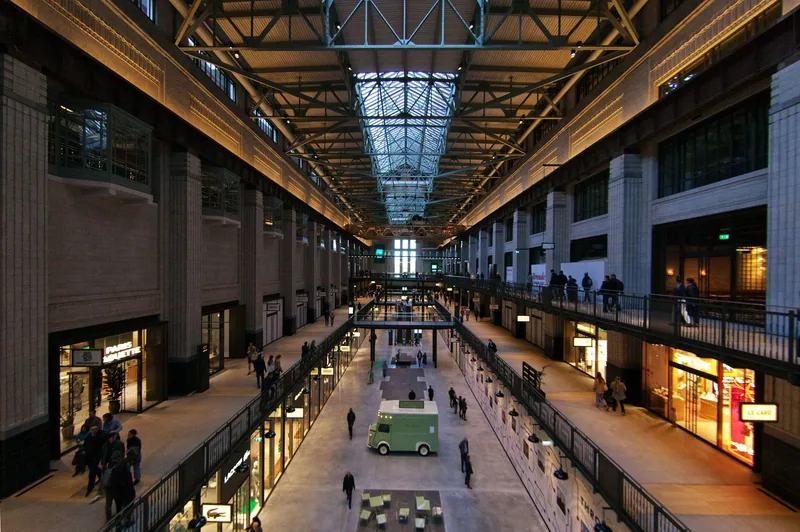
Photo: Ashley Pomeroy · CC BY-SA 4.0 · Wikimedia Commons · resized
The power station itself
Battersea Power Station was built in two halves. The western half went up in the 1930s, the eastern half after the Second World War, which is why the brickwork on one side is slightly different from the other. It burned coal, supplied a fifth of London's electricity at its peak, and stopped generating in 1983. It is Grade II* listed, it appeared on a Pink Floyd album cover in 1977, and it stood roofless and derelict for most of the time between.
Inside, the two Turbine Halls now hold shops. Turbine Hall A keeps its art deco finish, all fluted plaster and gilding; Turbine Hall B is the plainer 1950s one. The Control Room A, with its original dials and marble panels, is now a bar, and Control Room B is used for events. Walking through, it is the scale that registers first: the halls are the length of a football pitch and several storeys high.
Entry to the building and the shops is free. You pay only for Lift 109, the glass lift that rises inside the north-west chimney to a viewing platform 109 metres above the ground. It is a timed, ticketed attraction, and the price and slots are on the power station's official site. It is a short experience compared with the bigger towers, and our comparison of London's viewing platforms sets it against the Shard, the Eye and the free options.
Our detailed article on the power station covers the restoration and what survives of the original machinery.
Nine Elms: what is actually there
East of the power station, Nine Elms is the biggest single redevelopment in central London: several thousand flats in towers, a linear park being built between them, and the United States Embassy, a cube of glass behind a moat, which moved here from Grosvenor Square in 2018. There is also a sky pool between two residential towers, which is private and which you cannot swim in or visit.
This is not, by any measure, a charming part of London. The streets are wide, windy and short of the ordinary shops that make a neighbourhood work, and much of it is still a building site. What it does offer is a clear, uncrowded riverside walk with a view across to Pimlico, and a sense of what a city looks like when it is built all at once.
New Covent Garden Market, London's wholesale fruit, vegetable and flower market, is here and has been since 1974. It is a working market that runs through the night, and the flower market opens to the public in the early hours; it is not a visitor attraction, and going there means arriving before dawn.
If you want shops and eating under one roof rather than a half-finished street grid, our guide to the Westfield centres covers the larger options at Stratford and White City.
Battersea Park
Battersea Park, ten minutes west along the river, is the counterweight to all the glass. It opened in 1858 on reclaimed marshland, and it has a boating lake, a bandstand, a sub-tropical garden, tennis courts, a running track and long avenues of plane trees.
Two things stand out. The London Peace Pagoda, on the riverside, was built in 1985 by Buddhist monks and nuns of the Nipponzan Myohoji order and has four gilded scenes from the Buddha's life. And Battersea Park Children's Zoo, in the middle of the park, is a small paid-entry zoo aimed squarely at under-8s, with monkeys, meerkats, otters and a farmyard. It is a fraction of the size of London Zoo and a fraction of the price.
The park is free and open daily. Our fuller article on Battersea Park has the layout, and our lists of city farms and playgrounds and things to do with children put the zoo in context.
Battersea Dogs and Cats Home, founded in 1860, is just east of the park on Battersea Park Road. It is a working animal shelter rather than an attraction, and it is not set up for casual visitors.
Bonfire Night: the Battersea Park fireworks
The Battersea Park display is one of London's largest organised firework events, run by Wandsworth Council. In 2026 it runs across two evenings, Saturday 7 and Sunday 8 November, not on 5 November.
On the Saturday, gates open at 6pm and the fireworks start at about 8.30pm. On the Sunday, gates open at 4.30pm, the display starts at about 7pm, and there is no entry after 6.30pm. Tickets must be bought in advance and cannot be bought at the gate. Adult prices rise through the release bands, from £10.60 up to £18.10 as listed for 2026, and under-5s are free but still need a ticket.
Our guide to Bonfire Night in London compares it with the Alexandra Palace display on the same weekend and explains why neither falls on the traditional date this year.
You cannot buy a Battersea fireworks ticket on the night. Wandsworth Council states plainly that tickets are not sold at the gate, and the Sunday display closes admission at 6.30pm. Buy through the official booking page well in advance, and allow extra time: Battersea Park station and the Northern line stations are heavily crowded for an hour after the display.
Eating and drinking
Inside the power station there are around two dozen restaurants and cafés, from chains to sit-down places, plus a food hall. Prices are central-London prices. The arches under the railway on Battersea Park Road hold a run of independent restaurants and bars that are usually cheaper and quieter.
There are several terraces with a view over the river and the chimneys; our round-up of rooftop bars covers the ones worth the price. On a fine day, the simplest option is to buy lunch at the power station and eat it in Battersea Park.
Crossing the river, and what is next door
Three bridges connect this stretch to the north bank. Chelsea Bridge leads from the park to the Chelsea Embankment; Albert Bridge, the pale suspension bridge lit with thousands of bulbs at night, is the prettiest crossing in London and still carries a sign asking troops to break step; Vauxhall Bridge leads to Pimlico. Our guide to the bridges of London covers all of them as a walking route.
South of the railway, Battersea runs into Clapham and then Brixton, both about 15 minutes away by bus. For where to base yourself, our comparison of the best areas to stay in London explains why Nine Elms hotels are cheap and what you give up by staying there: the location is Zone 1 and well connected, but there is little to walk to in the evening.
Frequently asked questions
Is it free to go inside Battersea Power Station?
Yes. The building and its shopping halls are open to the public at no charge, and you can walk through both Turbine Halls. Only Lift 109, the chimney lift, is ticketed, with timed slots bookable on the official website.
How do I get to Battersea Power Station by Tube?
Take the Northern line to Battersea Power Station, the southern terminus of the Charing Cross branch. It is in Zone 1, step-free from street to train, and about four minutes from Waterloo. Nine Elms, one stop back, is the station for the eastern end of the development.
Can you go up one of the chimneys?
Yes, in the north-west chimney, using Lift 109. It is a glass lift that rises to a viewing platform 109 metres up, and it is sold as a timed ticket. The visit is short compared with the Shard or the London Eye, so check the price before deciding.
When are the Battersea Park fireworks in 2026?
On Saturday 7 and Sunday 8 November 2026. Saturday gates open at 6pm with fireworks at about 8.30pm; Sunday gates open at 4.30pm with the display at about 7pm and no entry after 6.30pm. Tickets are sold in advance only.
Is Battersea Park worth visiting on its own?
If you are already south of the river, yes. It has a boating lake, a peace pagoda, a children's zoo and a long riverside path, and it is free. It is not worth a special journey across London when Hyde Park and Regent's Park are more central.
Sources
- Battersea Power Station - Visitor information and Lift 109 (checked September 2026)
- Wandsworth Council - Battersea Park Fireworks 2026 (checked September 2026)
- Uber Boat by Thames Clippers - Fares and ticket information (checked September 2026)
- Transport for London - The Tube and the Northern line extension (checked September 2026)
- Wandsworth Council - Battersea Park (checked September 2026)