
Battersea Park is a 200-acre Victorian park on the south bank of the Thames, opposite Chelsea. It is free, open from 8am until dusk, and holds a boating lake, a small children's zoo, a Japanese peace pagoda on the riverside and a gallery in an old pumping station. It is the easiest big park in London to reach now that the Northern line runs to Battersea.
Londoners think of it as the park you go to when you want the space of Richmond without the journey, and the facilities of Hyde Park without the crowds. Wandsworth Council built it between 1854 and 1870 on reclaimed marshland, and its bones are still Victorian: a carriage drive round the edge, a serpentine lake, a riverside promenade and a lot of very good trees.
For a visitor it is worth an afternoon rather than a morning. Nothing in it takes more than an hour on its own, but the combination of the zoo, the lake, the pagoda and a walk along the river makes a genuinely pleasant half-day with children, and costs almost nothing unless you go into the zoo.
Battersea Park at a glance
- Entry
- Free. The children's zoo and boat hire are paid
- Opening
- 8am until dusk; park gates open 6.30am to 10.30pm for access to facilities
- Size
- 200 acres, built between 1854 and 1870
- Address
- Battersea Park, London SW11 4NJ
- Pedestrian gates
- Albert Bridge Road, Prince of Wales Drive and Queenstown Road
- Managed by
- Enable, on behalf of Wandsworth Council
Getting there, and why the walk got shorter
Until the Northern line extension opened, Battersea Park was awkward: a National Rail station most visitors had never used, or a long walk over a bridge. That has changed. Battersea Power Station station on the Northern line puts you about ten minutes east of the park's Queenstown Road gates, through the redevelopment around the power station itself.
- Battersea Power Station (Northern line) is the simplest arrival from central London, and lets you combine the park with the power station in one trip.
- Battersea Park and Queenstown Road (Battersea) are National Rail stations, both a few minutes from the eastern gates, with frequent trains from Victoria and Waterloo.
- Sloane Square on the District and Circle lines is on the other side of the river. Walk down to the Thames and cross Chelsea Bridge or Albert Bridge, which takes about 15 minutes and gives you the best approach of all: you arrive on the riverside promenade with the pagoda in front of you.
- By bus, several routes run along Queenstown Road and Prince of Wales Drive.
Our guide to the London Underground explains the zones and fares if you are new to the system. The Albert Bridge crossing is covered in our walking guide to London's bridges, and it is one of the prettiest bridges in the city after dark.
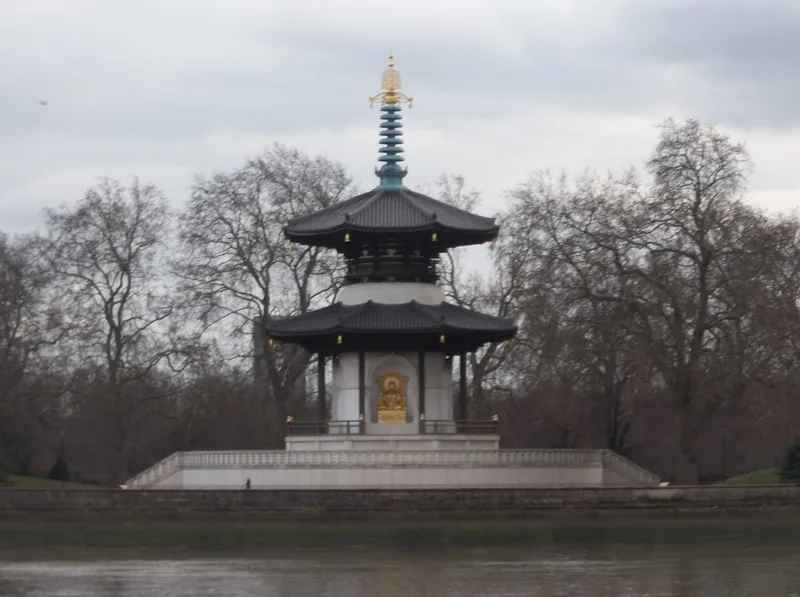
The Peace Pagoda and the riverside promenade
The London Peace Pagoda stands on the river wall on the north side of the park, a white Buddhist stupa with gilded statues of the Buddha at four stages of his life facing out in four directions. It was built by monks and nuns of the Nipponzan Myohoji order and dedicated in 1985, one of a series of peace pagodas put up around the world after the Second World War as monuments against nuclear weapons.
It is free, always open while the park is, and there is no ticket or interpretation centre. A monk still lives nearby and tends it. The best time to look at it is late afternoon, when the low sun catches the gold and the river behind it, and it is rarely crowded.
The promenade running along the river from the pagoda is the part of Battersea Park that most surprises people. It is a proper Thames-side walk with benches, looking across at the red and white ironwork of Albert Bridge and the houses of Chelsea beyond. Walk the whole length and you have done about a mile without noticing.
Cross Albert Bridge on foot, not Chelsea Bridge. Both connect Chelsea to the park, but Albert Bridge lands you directly at the pagoda end of the promenade and is the more interesting crossing. Chelsea Bridge carries heavier traffic and drops you at the noisy corner by Queenstown Circus.
The boating lake
The lake sits in the middle of the park, with wooded islands, herons and a long curving shape that makes it more rewarding to row on than most London park lakes. Pedalos and rowing boats are hired from the boathouse on Carriage Drive East, near the Pear Tree café.
The season runs from March, with weekend, bank holiday and school holiday opening from 10am to 4.30pm, and daily opening from 10am to 5.30pm between 1 June and 30 September. The last ticket is sold at closing time and boats come back in half an hour later. There is no booking: you queue at the hut and pay on the spot.
The rules are worth knowing before the children get excited. Under-16s must have an adult in the boat, under-12s must wear the life jacket handed out free, alcohol is not allowed on board, and pets cannot go on the water. Current prices are on the operator's own site. Our guide to boat hire and pedalos in London compares this lake with Greenwich, Victoria Park and the royal parks.
Battersea Park Children's Zoo: what it costs and who it suits
This is a small, family-run zoo, and expectations matter. It is not a substitute for ZSL London Zoo: there are no big cats, no giraffes and nothing you would call a headline animal. What it has is meerkats, monkeys, otters, lemurs, lizards and farm animals, at a scale a three-year-old can actually take in, with two adventure playgrounds and picnic tables so that adults can sit down.
| Battersea Park Children's Zoo (September 2026) | Price |
|---|---|
| Adult (16-59) | £17.50 |
| Child (2-15) | £13.95 |
| Under 2 | Free |
| Senior (60+), student or military concession | £16.50 |
| Family (2 adults and 2 children, or 1 adult and 3 children) | £53.95 |
| Registered disabled adult (one carer free) | £16.50 |
It opens daily from 10am to 5.30pm, booking is not required, and a ticket is valid for one visit within 30 days of purchase. Children under 16 must be accompanied. Check the current prices on the zoo's own ticket page before you go.
Our verdict: worth it for under-7s, especially in combination with the playgrounds, and poor value for anyone over about 10. If you are travelling with a mixed-age group, send the small children in and let the older ones take the boats out. For cheaper animal-watching, our guide to city farms and playgrounds covers the free options across London.
The gardens, the Cascades and the Pump House Gallery
Three quieter corners repay a detour. The Sub-Tropical Garden and the Old English Garden are formal planted enclosures away from the main paths, and the second is at its best in high summer. The Cascades, Battersea Park's Victorian waterfall, is being restored with support from the National Lottery Heritage Fund and will be powered by solar energy when the water runs again, so check whether it is flowing before you build a walk around it.
The Pump House Gallery stands beside the lake in the park's former water-pumping station, a tall brick building with a chimney. It shows contemporary art across several floors, entry is free, and it takes about 20 minutes. It is a good stop in rain, and the view from the upper floor across the lake is the best one in the park.
Sculpture in the park
Battersea Park has an unusually good collection of open-air sculpture, a legacy of the open-air sculpture exhibitions held here from the late 1940s. Henry Moore's Three Standing Figures stands on the grass near the lake, and Barbara Hepworth's Single Form is nearby. Both are outdoors, free and unfenced, which is a rare thing for work of that standing.
The other piece people look for is the Brown Dog statue, a memorial connected to the anti-vivisection campaigns of the early 1900s, tucked away in the Woodland Walk rather than displayed on a main path. Ask a park keeper if you cannot find it; it moves less often than visitors expect but it is easy to walk past.
Running, tennis and the Millennium Arena
The carriage drive runs right round the park, flat and closed to through traffic, which makes it one of the best running loops in inner London. Like most large London parks, it hosts a free timed 5km run on Saturday mornings that anyone can join after registering online.
The Millennium Arena is a floodlit athletics track and sports centre on the eastern side, and there are tennis courts, all-weather pitches and a bowling green. All are bookable through the park's operator rather than the council. If you are staying nearby for a week, the track and the courts are open to the public and cheap.
Bonfire Night: 7 and 8 November 2026
Battersea Park holds one of London's two big firework displays, and in 2026 it falls on Saturday 7 and Sunday 8 November, not on 5 November. This catches visitors out every year.
- Saturday 7 November: gates at 6pm, fireworks at about 8.30pm.
- Sunday 8 November: gates at 4.30pm, fireworks at about 7pm, and no entry after 6.30pm. The Sunday is the family evening, with an earlier display.
- Tickets must be bought in advance. They cannot be bought at the gate. Adult prices rise through a series of releases, and in 2026 ranged from about £10.60 to £18.10 depending on when you booked.
- Under-5s go free but still need a ticket.
Book as early as you can, because the cheapest release always sells first. Our guide to Bonfire Night in London compares this display with the one at Alexandra Palace, which falls on the same two dates.
Neither big London fireworks display is on 5 November in 2026. Battersea Park and Alexandra Palace both run on 7 and 8 November. If you have booked a trip around the fifth expecting fireworks, change the dates or look for a smaller borough event instead.
Cafés, toilets and how long to allow
There are cafés by the lake and near the zoo, and picnic tables inside the zoo for ticket-holders. Public toilets are near the main facilities; the park is flat throughout, which makes it one of the easier large London parks for wheelchairs and pushchairs, and there is parking inside the park with charges.
Allow two hours for a walk that takes in the pagoda, the promenade, the lake and the gallery. Add an hour and a half if you are going into the zoo. If you want to make a full day of the area, walk east to the power station and its shops and restaurants, covered in our guide to Battersea and Nine Elms, or cross the bridge for the King's Road.
For a park with a similar feel further south, see Clapham Common and Brockwell Park; for something smaller and more formal, Holland Park and the Kyoto Garden. General family advice is in London with kids.
Frequently asked questions
Is Battersea Park free?
Yes. The park, the Peace Pagoda, the riverside promenade, the gardens and the Pump House Gallery all cost nothing. You pay only for the children's zoo, boat hire, sports facilities and parking. The park opens at 8am and closes at dusk.
How do I get to Battersea Park by Tube?
Battersea Power Station on the Northern line is about ten minutes' walk from the eastern gates. Sloane Square on the District and Circle lines is about 15 minutes away on the other side of the river, crossing by Albert Bridge or Chelsea Bridge. Battersea Park and Queenstown Road are the nearest National Rail stations.
Is Battersea Park Children's Zoo worth the money?
For children under about seven, yes: it is small, easy to walk round in an hour, and the playgrounds are included. For older children it is poor value at £17.50 for an adult and £13.95 for a child, and London Zoo or the free city farms are better choices. Booking is not required.
When are the Battersea Park fireworks in 2026?
Saturday 7 and Sunday 8 November 2026, not 5 November. Gates open at 6pm on the Saturday with fireworks at about 8.30pm, and at 4.30pm on the Sunday with fireworks at about 7pm and no entry after 6.30pm. Tickets must be bought in advance and are not sold at the gate.
Can you hire a boat in Battersea Park?
Yes, pedalos and rowing boats from the boathouse on Carriage Drive East, for 30 minutes or an hour, with no booking. The season runs from March to the end of September, daily from 1 June. Under-12s must wear a life jacket and under-16s must have an adult in the boat.
Sources
- Wandsworth Council - Battersea Park (checked September 2026)
- Battersea Park Children's Zoo - Day visit prices (checked September 2026)
- Battersea Boats - Opening times and boat hire (checked September 2026)
- Battersea Boats - Frequently asked questions (checked September 2026)
- Battersea Park Fireworks - Visitor information 2026 (checked September 2026)
- Friends of Battersea Park - gardens, trees and sculpture (checked September 2026)