
Parking in London is possible, but in the centre it is scarce, expensive and strictly enforced. Street parking rules are set by each borough and can change from one street to the next, so for a visitor the safest choices are a booked car park or a station car park in outer London, with the Tube for the rest of the journey. A parking fine in central London costs up to £160.
Many streets in inner London are "controlled": at set times you may only park in marked bays, and you must either hold a residents' permit or pay. Yellow and red lines along the kerb show where you cannot park at all. Civil Enforcement Officers (traffic wardens) patrol on foot, and cameras watch bus lanes and some other restrictions. If your car is in the wrong place, it can be given a penalty, clamped or towed away.
None of this is hard once you know how to read the signs. This guide explains who sets the rules, what the lines and bays mean, how to pay, where to find car parks and park-and-ride style options, and what to do if you get a ticket or find your car gone.
London parking: the numbers that matter
- Parking penalty, Band A (all of central London and several outer boroughs)
- £160 for serious contraventions, £110 for lesser ones
- Parking penalty, Band B (the rest of London)
- £140 or £90
- Early payment
- 50% off if paid within 14 days (21 days for camera penalties sent by post)
- Wheel clamp release
- £100
- Release from a council car pound
- £280, plus £55 a day storage after 24 hours
- Car towed away?
- Call TRACE on 0300 077 0100 (24 hours)
Who makes the rules: boroughs and TfL
London is divided into 32 boroughs plus the City of London, and most roads are managed by these local councils. Each council sets its own parking hours, prices, payment methods and permit schemes. That is why the rules in Westminster are different from those in Camden or Kensington and Chelsea, even on neighbouring streets.
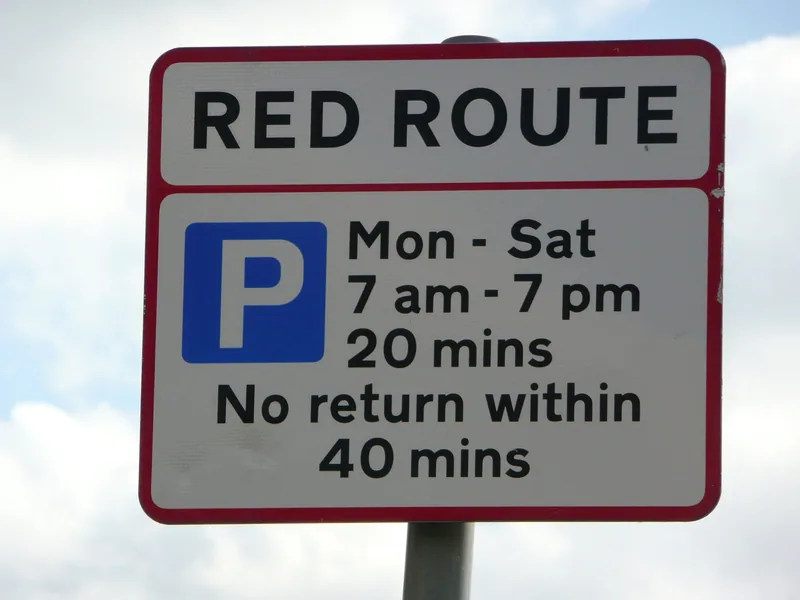
The main through roads are different. Transport for London (TfL) manages a network of "red routes", marked with red lines along the kerb. TfL says these roads make up only 5% of London's road length but carry more than 30% of its traffic. On red routes the priority is keeping traffic moving, so stopping rules are tighter than on council roads. A penalty on a TfL red route costs £160, reduced to £80 if paid within 14 days.
For you, this means one simple habit: read the signs every time you park, even if you parked legally on a similar-looking street the day before.
Reading the kerb: lines, bays and signs
The markings on the road and the small signs on posts beside it tell you everything. The main ones:
| Marking | What it means |
|---|---|
| Double yellow lines | No parking at any time. No sign is needed. |
| Single yellow line | No parking during the times shown on a nearby yellow sign, or during the zone's controlled hours shown at the entry to the zone |
| Double red lines | No stopping at any time, not even to drop off passengers or unload |
| Single red line | No stopping during the hours shown on the sign |
| White-marked bay with a sign | Parking allowed, but read the sign: it may be for residents' permits, pay-to-park, disabled badge holders, loading or other users |
| Yellow bag over a meter, or a yellow "no parking" notice on a bay | The bay is suspended; do not park there |
On yellow lines you may stop briefly to let passengers get in or out, and on some yellow lines you may load or unload goods. On red lines you may not, according to London Councils, the body that represents the capital's local authorities. When in doubt, don't stop.
Two more rules catch many visitors out. First, parking on the pavement (the footway) is banned on almost all London streets at all times, even with just one or two wheels up, unless signs and marked bays say otherwise. There is no exception for disabled badge holders. Second, do not park across a dropped kerb, which is where the pavement is lowered for a driveway or a pedestrian crossing.
No warning sign is needed before your car is towed. London Councils points out that there is no legal requirement for signs warning that clamping or removal may take place. A car left in a suspended bay, a disabled bay or on double red lines can be towed without any notice on the street, and getting it back costs at least £280.
Paying for a street parking bay
In controlled areas you need to find a pay-to-park bay (sometimes called pay and display, or a shared-use bay if permit holders can use it too) and pay for your time straight away. There is no free time allowed to go and find change or download an app. The hours of control and the maximum stay are shown on the signs; London Councils says the maximum is typically two to four hours, and in Westminster it is usually four hours. Once your time is up you must move, even if you could pay for more.
Residents' bays are for permit holders only during controlled hours. Visitors to a resident may be able to use a temporary visitor permit in some boroughs, but not all: Westminster, for example, does not run an on-street visitor permit scheme.
Payment methods vary by council: some still have machines on the street, while others take payment only by phone or app. Westminster, which covers much of the West End, is a good example of how it works in 2026:
- You pay through one of three apps, RingGo, PayByPhone or JustPark, or by phone. Each app may add its own service charge of up to 30p per transaction.
- The price depends on the zone and on your car's carbon dioxide emissions, which the system looks up from the number plate. Diesel cars from before 2015 pay a surcharge of up to 50%.
- Westminster has removed all on-street payment machines. Scratch-card "Parking Cards", each worth one hour, are sold at Westminster libraries as an alternative.
- Outside controlled hours, Westminster says you may park safely and considerately on single yellow lines.
Other boroughs use different apps and prices, so look for the operator's name and location code on the sign next to the bay. See the Westminster visitor parking page for current tariffs if you are staying in areas such as Mayfair and St James's or Marylebone.
Using a parking app with a foreign car or card
Parking apps ask you to register your number plate and a payment card, then enter the location code from the street sign. Set up the app before you arrive, on Wi-Fi, rather than standing at the kerb with a warden nearby. We could not confirm how every app handles foreign number plates, so if you are driving a car registered outside the UK, test the registration before your trip. With a hire car, enter the plate exactly as shown on the car.
Never pay for parking with a QR code stuck on a sign. Westminster City Council has warned that fraudsters stick fake "scan to pay" QR codes on parking signs, especially in Mayfair, St James's, Marylebone and Fitzrovia. The council does not use QR codes for payment. Download the official app from your app store instead.
Car parks in central London
London Councils suggests that car parks are often a better choice than street parking, because many streets are reserved for residents and car parks usually let you stay longer. In central London, most off-street car parks are run by private companies. Westminster, for example, operates no off-street car parks itself and names Q-Park, NCP and Titan among the operators. We are not recommending any one of them: compare prices, opening hours and height limits before you book.
Prices in central car parks are high, and a full day can cost more than a day of public transport for a whole family. Booking online in advance is often cheaper than turning up. Before you book, check two things:
- Is the car park inside the Congestion Charge zone? If so, driving to it during charging hours costs £18 on top of the parking fee. Our guide to the Congestion Charge and ULEZ explains how to check.
- Does it close overnight? Some city-centre car parks lock their doors in the evening, which matters if you are out at the theatre.
If you are staying in a hotel, ask whether it has parking and what it costs per night before you book. Many central hotels have no parking at all. If a car is essential for your trip, it may be worth choosing a hotel further out; our guide to the best areas to stay in London will help you weigh up location against convenience.
Station car parks: London's version of park-and-ride
Many British cities run park-and-ride schemes with dedicated buses from large car parks on the edge of town. London does not work that way. The practical equivalent is to park at a station in outer London and take the Tube, the Elizabeth line or the Overground into the centre.
TfL has car parks next to a number of its stations. According to TfL, they offer all-day parking, free parking for Blue Badge holders, and CCTV at most sites. They are managed by Saba UK, which lists the locations on its website, and you pay through PayByPhone (app, or 0330 060 4252). Many National Rail stations in outer London and beyond have car parks too.
This approach has three advantages. You avoid driving in central London, you avoid the Congestion Charge, and parking is usually much cheaper than in the centre. Choose a station in a zone that suits your plans: fares from outer zones cost more, but a day of travel is capped. Our guide to London's travel zones explains how zones affect the fare.
Remember the ULEZ still applies across all of Greater London, including at outer stations. If your car fails the emissions standard, you pay £12.50 for any day you drive it inside London.
Park at the edge, ride the last miles. A day of pay as you go travel in Zones 1-6 is capped at £16.30 per adult, and children aged 5-10 travel free with a paying adult. Add a day of station parking, and a family arriving by car will usually spend far less than on central car parks and the Congestion Charge.
Parking tickets, clamping and towing
A council parking ticket is called a Penalty Charge Notice (PCN). It is usually put on the windscreen or handed to the driver, but a camera-issued PCN can arrive by post weeks later, sent to the registered keeper. With a hire car, that is the hire company, which can pass it on to you if your hire agreement makes you liable for penalties, and may add an admin fee.
The amount depends on where you were and how serious the offence was:
| Area | Higher level (e.g. yellow lines, obstruction) | Lower level (e.g. overstaying in a paid bay) |
|---|---|---|
| Band A: all of central London (including Westminster, Camden, the City, Kensington and Chelsea, Islington and Tower Hamlets), plus several outer boroughs and town centres | £160 | £110 |
| Band B: the rest of London | £140 | £90 |
Parking or stopping in a bus lane during its hours of operation costs £160 anywhere in London, and cameras enforce it. If you pay within 14 days (21 days for a camera penalty sent by post), the charge is halved. If you think the ticket is wrong, write to the council shown on the PCN before paying, because paying closes the case. If the council rejects your challenge, you can appeal free of charge to an independent adjudicator at London Tribunals. Full details are on the London Councils parking penalties page.
If your car is wheel-clamped, follow the instructions on the notice attached to it; release costs £100. If your car has disappeared, it may have been towed rather than stolen. Call TRACE on 0300 077 0100, a 24-hour service that tells you where the car is held and how to get it back. Release from a council pound costs £280, plus £55 for each day after the first 24 hours. If TRACE has no record and you believe the car was stolen, report it to the police; our page on emergency numbers and what to do explains how.
Blue Badge and disabled parking
The UK's Blue Badge scheme gives disabled drivers and passengers parking concessions, but in central London it does not fully apply. In the City of Westminster, the City of London, the Royal Borough of Kensington and Chelsea and part of Camden, local rules replace the national ones, and there are fewer places where a badge lets you park. Check each borough's rules before you set off.
Blue Badge holders can park free at TfL's station car parks and can register for a 100% discount on the Congestion Charge. Whether a disabled parking card issued in another country is accepted in London was not something we could confirm from an official source, so ask the borough or TfL before you rely on it. Our guide to accessible London covers wider travel support, and step-free public transport may be easier than driving to the centre.
A checklist before you walk away from the car
- Read every sign by the bay, including small plates underneath with times and exceptions.
- Check the kerb for yellow or red lines and for "no loading" marks.
- Make sure the whole car is inside the white bay markings and nowhere on the pavement.
- Pay at once, for the right location code and the right number plate, and keep the confirmation.
- Note the maximum stay and set a phone alarm.
- Look for a yellow suspension notice or a bagged meter.
- If anything is unclear, move on and find a car park.
For the wider rules of the road, see our guide to driving in the UK as a foreign driver. If you have not yet decided whether to take a car at all, our guide to car hire in London sets out the pros and cons, and taxis and minicabs can be a simpler way to handle luggage.
Frequently asked questions
Is it easy to park in central London?
No. Street spaces are limited, many bays are for residents only, and most areas are controlled during the day, often with a maximum stay of a few hours. A booked car park, or a station car park further out with the Tube into town, is much less stressful for a visitor.
Can I park on a single yellow line in London?
Only outside the hours shown on the nearby sign or at the entry to the controlled zone. During those hours you may stop briefly to drop off or pick up passengers. Double yellow lines mean no parking at any time.
How much is a parking fine in London?
In central London and other Band A areas, a council parking penalty costs £160 for serious contraventions and £110 for lesser ones. In Band B areas, which cover the rest of London, it is £140 or £90. Paying within 14 days halves the amount, and a TfL red route penalty is £160, or £80 if paid within 14 days.
What should I do if my car has been towed in London?
Call TRACE on 0300 077 0100, which runs 24 hours a day. It tells you which pound has the car and how to get it back. Release costs £280, plus a £55 daily storage fee if you collect it after more than 24 hours.
Is there park-and-ride in London?
Not in the usual sense of dedicated buses from edge-of-town car parks. Instead, you can park at a TfL or National Rail station car park in outer London and take the train or Tube into the centre. TfL's station car parks are paid through PayByPhone.
Sources
- London Councils - How to park your car in London (checked September 2026)
- London Councils - Parking and traffic charges in London (checked September 2026)
- London Councils - Parking penalties (checked September 2026)
- Westminster City Council - Visitor parking information (checked September 2026)
- Transport for London - Station car parks (checked September 2026)
- Transport for London - Rules of TfL's red routes (checked September 2026)
- Transport for London - Blue Badges and driving (checked September 2026)