
Bruce Castle is free, Grade I listed, and open only in the afternoons: Wednesday to Sunday, 1pm to 5pm. It is Haringey's museum and archive, it stands in twenty acres of public park whose gates are never locked, and despite the name it is not a castle. It is a manor house of about 1600 with a round brick tower beside it that was built in 1514 and that nobody has ever been able to explain.
For a visitor this is a very specific kind of afternoon out: a genuinely old building with a local museum inside it, forty minutes from the centre, in a part of Tottenham that gets no tourists at all. The building is the reason to come. The collections are about Haringey rather than about London, and they are good at what they do.
Get the timing right and it works. Turn up at eleven in the morning and you will find a locked door and a park.
Bruce Castle Museum and Archive: the practical frame
- Address
- Lordship Lane, Tottenham, London N17 8NU
- Admission
- Free to the museum and the archive
- Museum hours
- Wednesday to Sunday, 1pm to 5pm
- Archive search room
- Wednesday to Friday, 10am to 12.30pm and 1.30pm to 4pm, plus the second Saturday of each month; booking essential
- Always closed
- 25 and 26 December, 1 January, Good Friday and the summer bank holidays
- Park
- Twenty acres, open all year, gates not locked
- Listing
- House Grade I, list entry 1358861; the round tower Grade I in its own right, entry 1294388; both first listed 22 July 1949
- Nearest station
- Bruce Grove, on the London Overground Weaver line; the museum gives a seven-minute walk up Bruce Grove
- Telephone
- 020 8489 4250
Four afternoons a week, and how to time the visit
The museum opens five days a week but only for four hours a day, which is the single most important fact on this page. There is no morning session for general visitors. Groups and schools can book outside those hours by arrangement, but an individual cannot.
The museum's own advice, published on its access page, is that after 3pm is the quieter time on days when it is open for general visits. That gives you a two-hour window that is both open and calm, which is enough for the building and the galleries without rushing.
The archive search room runs on a different timetable entirely: Wednesday to Friday morning and afternoon sessions, and the second Saturday of the month. Booking is essential for the archive, and it is the only part of the operation where that is true.
Do not plan Bruce Castle for a Tottenham Hotspur match day. The stadium is less than a mile away, and the controlled parking zone around the museum is enforced only on club event days. Free on-street parking in Church Lane and Church Road is available on non-match days, which is the museum's own way of saying it disappears on the others.
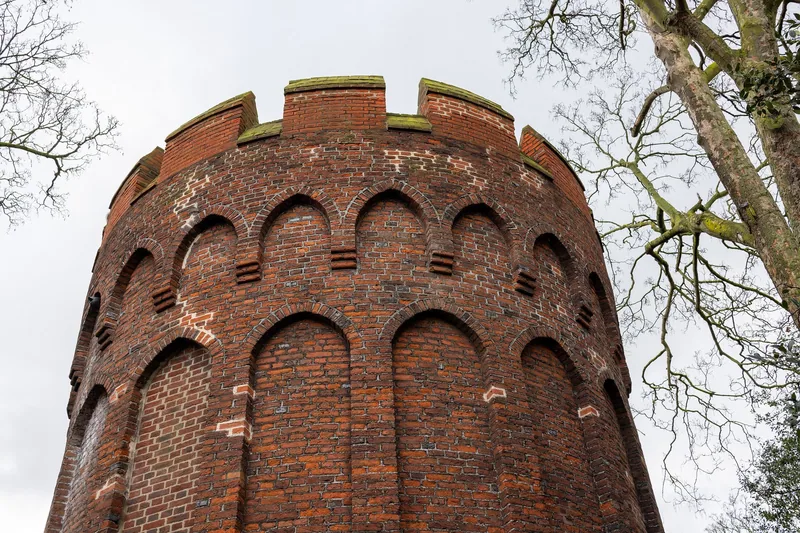
Photo: The wub · CC BY-SA 4.0 · Wikimedia Commons · resized
Why it is called a castle when it is not one
Haringey is straightforward about this. Its own heading on the subject asks when a castle is not a castle, and the answer is that Bruce Castle is a sixteenth-century manor house that acquired a romantic name in the 1680s.
The name was given by Henry Hare, the second Lord Coleraine, who was interested in the antiquity of Tottenham and traced the manor's ownership back to the medieval de Brus family. Robert the Bruce, who became King of Scotland in 1306, lost the de Brus estates in England, Tottenham among them. Coleraine liked the association and named his house after it. You can see original manorial court rolls carrying the de Brus name on display inside.
Haringey calls it one of the two largest and most important Tudor houses remaining in the greater London area. If you want actual castles within reach of London, our guides to Hever Castle and Warwick Castle cover the real thing; and for another London place name that promises a castle and delivers something else entirely, see Elephant and Castle.
What the list entry sees from the front lawn
Stand on the grass in front of the entrance and the building is more legible than it first looks. The list entry describes a red brick house of about 1600 on a shallow H-plan, with additions of 1684 and of the early and late eighteenth century.
- The frontispiece. The projecting square block in the middle of the entrance front is the addition of 1684. Above the roofline it rises as a stuccoed clock tower stage, crowned with a glazed octagon, an open drum and a cupola, with wooden balconies at the second floor, the octagon and the drum. That is Coleraine's work, and the list entry notes that it challenged seventeenth-century taste.
- The side wings end in half-octagons, with renewed plaster quoins and bands, and all the roofs are hidden behind a parapet.
- The east wing is late eighteenth-century, in plum-coloured brick, three storeys and eight windows, with an Ionic doorcase and pediment in the fourth bay from the right.
- The north facade is early eighteenth-century, five bays and two storeys in pinkish brick, with a very heavy wooden entablature and pediment cornice carrying an achievement of arms in the tympanum, and an arcaded ground floor of very finely gauged red brick arches.
- The north-west wing is late Victorian and, as the list entry drily puts it, of educational appearance. That is the school talking.
The Tudor Tower: 1514, and no agreed purpose
The round brick tower to the south-west of the house is listed at Grade I separately and is the oldest visible thing on the site. It was built in 1514 using locally made bricks, and it was added to the estate by Sir William Compton, Groom of the Stool and a favourite of Henry VIII, who held the manor and improved the house for a royal visit. A letter of 1516 records Henry VIII meeting his sister Margaret Tudor, Queen of Scots, at Master Compton's house near Tottenham.
What the tower was for is still an open question, and it has been an open question for a long time. When Coleraine was researching Tottenham's history in 1701 he could find no mention of it and wondered whether it had been built as a monument house, a mews, a pigeon house or a prison. The museum's current view is that it was most likely a hawks' mews, and possibly also part of a structure supplying water to the house.
Architecturally it is worth a slow look. The list entry records a battlemented parapet, renewed in modern times, over a corbel table of pointed brick arches; below that, four-centred arcading running all the way round; and a second corbel table of single carved bricks crossing the arcade panels a little over halfway up. There is one quatrefoil window, probably later, and a nineteenth-century window with Y-tracery. The tower had major investment in 2021 and 2022 through a grant from Historic England and Haringey Council: the roof was restored using traditional craftsmanship and the brick face has been conserved with lime mortar. The stated plan is to bring it back into use as a small gallery, a wedding room and a space for school and tour groups. Check on arrival whether it is open; the house is the reliable part.
Rowland Hill, and the school that saved the building
The house's best-known resident is Sir Rowland Hill, the creator of the Penny Post, which changed postal systems worldwide. The Hill family ran the radical Bruce Castle School here from 1827, and Haringey makes the point that being a school is what saved the house from Victorian redevelopment.
The school also left a physical trace that is not a preserved classroom. A community archaeological dig, informed by ground-penetrating radar survey in 2006, turned up everyday objects belonging to the Victorian children who attended the school, and the best of those are displayed in the downstairs galleries. For the postal reform story itself, and for Hill's stamps, our guide to the Postal Museum and Mail Rail is the place to go; Bruce Castle owns the house and the school, not the national collection.
The other names attached to the house are worth knowing because the museum tells their stories rather than just listing them: the third Earl of Dorset, a gambler; the Hare dynasty, which held it for nearly two hundred years; Henrietta Hare, illegitimate and French-born, whose marriage to the MP James Townsend kept the house in the family into the nineteenth century, and the Townsend family's African heritage; and Joshua Pedley, a philanthropist who bought the estate in 1891 and pressed the Tottenham Local Board to buy it for the public.
Access, and the 24 stairs
There is same-level access at the front entrance and a ramped entrance from the car park, both with intercoms. All the ground and first-floor galleries, the search room, the lecture hall, the education room and the toilets are described as accessible for wheelchairs, buggies and walking aids. The first floor is reached by 24 stairs or a stair lift, with staff on hand.
There are two accessible unisex toilets on the ground floor and another on the first, seating throughout, two baby-changing points, and somewhere to leave buggies and scooters. Large-print information, raised plans, a tactile model of the building, a magnifying glass and a torch can be asked for at the reception desk, and touch tours of the galleries are possible if you contact the museum in advance. There is an induction loop at reception and in the lecture hall. Assistance dogs are welcome.
Getting there, and the free car park nobody mentions
| Route | Detail |
|---|---|
| London Overground, Weaver line | Bruce Grove station, then the seven-minute walk up Bruce Grove that the museum's own directions give |
| Underground plus bus | Victoria line to Seven Sisters or Piccadilly line to Wood Green, then the 123 or 243 bus |
| Buses to the door | 243, 123 and 318 stop in Lordship Lane, Bruce Grove or The Roundway; the announcement says to alight for Bruce Castle Park and Museum |
| The quiet approach | W3 bus to the Tottenham cemetery stop in White Hart Lane, then a ten-minute walk along Church Path through the cemetery and the grounds of All Hallows church |
| Car | Free car park for museum and archive visitors only, behind the building via Church Lane off All Hallows Road; usable from 9am until the gates are locked at 5pm; use N17 7AA for satnav. One accessible bay, beside the ramp. Not suitable for coaches |
The station is Zone 3, so contactless and Oyster caps apply in the ordinary way. Bruce Grove is one of the stations that changed its line name in 2024, which our guide to the Overground's six new line names explains, with the route itself covered in the Weaver line guide. Bruce Castle also sits on the City to Tottenham Cycleway, and you can lock a bicycle at the front of the building.
The park, food, and an hour and a half
Bruce Castle Park is twenty acres, free, open all year, and its gates are not locked, which makes it one of the more useful green spaces in this part of north London. There are picnic areas, and a café in the south-east corner that is open to general visitors as well as to park users. Other small cafés are along Lordship Lane. The museum itself serves tea and coffee only at its talks, events, tours and room hire.
Allow an hour for the galleries and half an hour for the outside of the building and the tower. That is a comfortable ninety minutes, and it fits neatly inside the 1pm to 5pm window with room to sit in the park.
To make a day of it, Alexandra Palace and Alexandra Park are a short bus ride west and give you the view over London that Tottenham itself does not. Among London's other free outer-suburban museums in historic houses, the closest relatives are Valence House and the museums of outer London, Forty Hall in Enfield and Charlton House in Greenwich, all three of them Grade I and all three free. Our round-up of free things to do in London sets them in context.
Frequently asked questions
Is Bruce Castle Museum free?
Yes. Admission to both the museum and the archive is free, the surrounding twenty-acre park is free, and the car park behind the building is free for museum and archive visitors. The only charges are for room hire and some events.
What time does Bruce Castle open?
The museum opens Wednesday to Sunday from 1pm to 5pm, with no morning opening for general visitors. It is always closed on 25 and 26 December, 1 January, Good Friday and the summer bank holidays. The archive search room has separate hours and must be booked.
Is Bruce Castle a real castle?
No. It is a manor house of about 1600 with later additions, and Haringey says so on its own pages. The name was invented in the 1680s by Henry Hare, second Lord Coleraine, who traced the manor back to the medieval de Brus family and liked the connection with Robert the Bruce.
How old is the tower at Bruce Castle?
It was built in 1514 for Sir William Compton, a courtier of Henry VIII, in locally made brick, and it is listed at Grade I separately from the house. Its original purpose has never been established; the museum's present view is that it was probably a hawks' mews, and perhaps also part of a water supply to the house.
Which station is nearest to Bruce Castle?
Bruce Grove, on the London Overground Weaver line, from where the museum gives a seven-minute walk up Bruce Grove. Alternatively take the Victoria line to Seven Sisters or the Piccadilly line to Wood Green and then the 123 or 243 bus, both of which stop right by the museum.
Sources
- Historic England - Bruce Castle, list entry 1358861 (Grade I) (checked September 2026)
- Historic England - Tower to south west of Bruce Castle, list entry 1294388 (Grade I) (checked September 2026)
- Bruce Castle Museum and Archive (Haringey Council) - Opening hours (checked September 2026)
- Bruce Castle Museum and Archive - Getting here and parking (checked September 2026)
- Bruce Castle Museum and Archive - Access to our facilities and resources (checked September 2026)
- Bruce Castle Museum and Archive - The Tudor Tower (checked September 2026)
- Bruce Castle Museum and Archive - When is a castle not a castle? (checked September 2026)