
Charlton House is free, and you can walk in off the street and up the Jacobean staircase without booking anything. It opens weekdays 9.30am to 3.30pm and Saturdays 9.30am to 3pm, and it is closed on Sundays. The gardens are free too, open 10am to 4pm on the same days. There is a working public library inside, a tea room in the middle of the building, and a mulberry tree in the grounds that the trust describes as one of James I's.
It was built between 1607 and 1612 for Sir Adam Newton, tutor to Prince Henry of Wales, the eldest son of James I. It is Grade I listed and is run today by the Royal Greenwich Heritage Trust, a charity, on behalf of the borough. The trust calls it one of the finest surviving Jacobean manor houses in England, which is a fair claim and a more careful one than the superlatives that get attached to it elsewhere.
Practically, this is the easiest great Jacobean interior in London to get into, because there is no ticket and no timed slot. The catch is the hours: it shuts in the middle of the afternoon and does not open on Sundays at all, which rules out the day most visitors have free.
Charlton House: cost, hours and access
- Address
- Charlton House, Charlton Road, London SE7 8RE
- Admission
- Free, including the self-guided tour and the audio tour
- House
- Weekdays 9.30am to 3.30pm; Saturdays 9.30am to 3pm; closed Sundays
- Gardens
- Weekdays and Saturdays 10am to 4pm; closed Sundays
- Guided tour
- Fridays at 12 noon, one hour, £12 per person plus booking fee, meeting in the Great Hall
- Library
- Charlton House Library, open Monday, Tuesday and Thursday to Saturday
- Listing
- Grade I, list entry 1218593, first listed 19 October 1951; the stable buildings and the west gateway are each Grade I in their own right
- Nearest station
- Charlton, about 13 minutes on foot and uphill
- Also closed
- Usually at Christmas and Easter, and occasionally at other times
- Telephone
- 020 8856 3951
The hours are the thing that goes wrong
Read the factbox again before you plan anything around this house. Sunday closing is unusual for a free attraction and it catches people who assume a heritage property follows heritage-property habits. Saturday closes half an hour earlier than the weekdays. And the trust says plainly that the house and gardens are usually closed at Christmas and Easter and occasionally at other times, pointing visitors to its social media for short-notice changes.
Recent experience shows why that warning is there. In August 2026 the upstairs historic rooms closed for essential roof investigation: self-guided tours of the house were unavailable from 17 to 28 August, the Friday tours on 21 and 28 August did not run, and the trust aimed to reopen fully on 29 August. The gardens, the tea room, the Tree Trail and the library all stayed open throughout. If the upstairs rooms are the reason you are coming, telephone.
The free tour is not a person, and that is fine. Self-guided and audio tours run free throughout the opening hours, every weekday and Saturday. The paid Friday tour at noon buys you a guide for an hour and access to parts of the building the self-guided route does not reach.
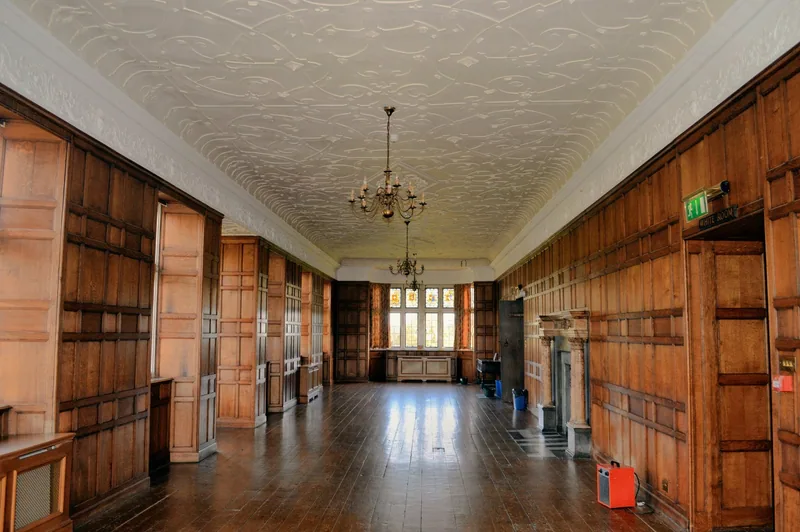
Photo: AndyScott · CC BY-SA 4.0 · Wikimedia Commons · resized
What the list entry describes, from the west lawn
The best place to stand is on the terrace on the west side, which is the show front. The statutory description sets out what you are looking at: a large Jacobean mansion on an H-shaped plan, three storeys, red brick with stone dressings and stone bands at the floor levels, and mullioned windows throughout.
The west front carries a pierced stone parapet. In the centre is a brick and stone projection containing a richly ornamented porch with two bay windows above it, linked by two-window sections to the projecting wings. The east front matches the outline but is plainer. North and south are three storeys and seven windows each, with square central towers rising five storeys to a corbelled stone cornice and an ogee slated roof; the south tower carries the clock. The terrace wall in front of the west front, and its returns, is pierced stone as well. On the roof, the octagonal brick chimney stacks stand in groups of three and five with moulded caps and bases.
Inside, the list entry records contemporary staircases, panelled rooms, ornamental ceilings and chimneypieces, which is what you have come to see and which is the reason for the Grade I.
One date to be careful about. The list entry says the house was built in 1612 for Sir Adam Newton, with additions in 1659 for Sir William Ducie. The trust says 1607 to 1612. Both figures appear here because both are official and they do not agree; 1607 to 1612 is the construction period, 1612 the completion.
Newton's money went next door as well
Across the road stands St Luke's Church, and the connection is direct: Sir Adam Newton's estate paid for the complete rebuilding of the church in 1630. Later owners of the house, the Maryon-Wilson family, have named private pews inside it. The church opens alongside the house during the Open House Festival in September and has offered tours of the building and the tower.
The house has had a long institutional afterlife. The list entry, written in 1951, notes that it was then a community centre, and the building has also served as a medical centre in wartime. Since 2025 the trust has been running Charlton House 100, a series of exhibitions across the house marking a century of public ownership, open weekdays 9.30am to 3.30pm and Saturdays 9.30am to 3pm. That is the same window as the house, so you do not need to plan separately for it.
The gardens, the mulberry and the summer house
The grounds are free, maintained by a head gardener and volunteers, and used daily by local people rather than visitors. The trust picks out three highlights: the house's original walled gardens, one of James I's mulberry trees, and a summer house attributed to Inigo Jones.
All three are worth knowing about. James I promoted mulberry planting from 1608 in an attempt to establish English silk production, which is where the Charlton tree's traditional date comes from; the scheme failed and the trees mostly outlived it. The summer house is the more remarkable object, because an attribution to Inigo Jones puts it in the same conversation as the Queen's House in Greenwich, which Jones began for Anne of Denmark in 1616 and which is a few minutes away by bus.
There is also a Tree Trail through the grounds, which stays available even when parts of the house are shut.
Eating here, and what the tea room actually is
Frilly's at the Mulberry Tea Room sits at the centre of the building, in the Great Hall, which is also where the Friday tours meet. It was established in 2021, it is run by two sisters, and it does a vintage afternoon tea as well as ordinary cafe food. Its hygiene rating is 5, the top score, from an inspection on 2 February 2026; you can look that up on the Food Standards Agency register, and we do not link to venues' own sites.
Because the tea room is inside the house, its hours are effectively the house's hours, and the practical consequence is that there is nowhere to eat on site on a Sunday. For anything more substantial, our guide to where to eat in Greenwich covers the town centre two miles west.
Getting there, and the hill
| Route | Detail |
|---|---|
| Charlton station | Southeastern services from London Bridge, Cannon Street and Charing Cross. TfL's walking route gives about 13 minutes and just over a kilometre, and it is uphill most of the way |
| North Greenwich or Greenwich, then bus | Buses along Charlton Road and Charlton Church Lane; the stop is by the house |
| By car | Charlton Road, SE7 8RE. There is parking on site, and the surrounding streets are residential |
| Combining with Greenwich | Two miles west. A bus is much better than the walk along the main road |
The trust states that Charlton House is a wheelchair-accessible venue. The grounds are on a slope, and the approach from the station is the steepest part of the journey, so if that matters, take a bus up to Charlton Road rather than walking from the station.
An hour and a half, and what to put around it
Allow an hour for the rooms and the exhibitions and half an hour for the gardens and the summer house. That is enough unless you are taking the Friday tour, in which case add the hour and arrive a little before noon.
The obvious pairing is Greenwich itself, and the obvious mistake is to try to do both properly in one day. Charlton House closes at 3.30pm, so do it first thing in the morning and move west afterwards. Our guide to Greenwich sets out the town, the Old Royal Naval College has the Painted Hall, Greenwich Park is the green space above it, and Ranger's House and the Wernher Collection is the other great house on the park's edge.
Eastwards is less visited and more interesting than it sounds: the Thames Barrier is on the river below Charlton, and Woolwich is the next town along. Eltham Palace, three miles south, is the other great royal house of south-east London and the natural half-day partner if you want two big interiors in a row.
Among London's other free Grade I houses, Charlton belongs with Bruce Castle in Tottenham and Forty Hall in Enfield, both of which are also free and also run by a borough. Hall Place and Danson House in Bexley are the nearest equivalents in the same direction, though neither lets you simply walk into the historic rooms the way Charlton does. For the wider list, see free things to do in London, and for the September weekend when the church next door opens too, the Open House Festival.
Frequently asked questions
Is Charlton House free to visit?
Yes. Entry to the house, the exhibitions and the gardens is free, and so are the self-guided and audio tours. The only paid options are the Friday guided tour at £12 per person, private group tours, and afternoon tea in the tea room. The trust says ticket sales for tours go towards keeping the house and gardens open free of charge.
What are Charlton House opening times?
The house opens weekdays from 9.30am to 3.30pm and Saturdays from 9.30am to 3pm, and it is closed on Sundays. The gardens open weekdays and Saturdays from 10am to 4pm. It is usually closed at Christmas and Easter, and occasionally at other times, so check before a long journey.
Can you go inside Charlton House without booking?
Yes. There is no ticket, no timed entry and no advance booking for a general visit, which makes it one of the easiest Jacobean interiors in London to see. Only the Friday guided tour and private tours need to be booked in advance.
Is there a library in Charlton House?
Yes. Charlton House Library is a working public library inside the building, open Monday, Tuesday and Thursday to Saturday according to the trust's own visiting page. It stayed open during the roof works in August 2026 that closed the upstairs historic rooms.
How do you get to Charlton House from central London?
Take a Southeastern train from London Bridge, Cannon Street or Charing Cross to Charlton station, then walk about 13 minutes uphill to Charlton Road. Alternatively come from Greenwich or North Greenwich by bus, which avoids the climb and takes you to a stop by the house.
Sources
- Historic England - Charlton House, list entry 1218593 (Grade I) (checked September 2026)
- Royal Greenwich Heritage Trust - Visit Charlton House and Gardens, opening times (checked September 2026)
- Royal Greenwich Heritage Trust - Gardens, grounds and tours (checked September 2026)
- Royal Greenwich Heritage Trust - Historic Fridays: Charlton House tours (checked September 2026)
- Royal Greenwich Heritage Trust - Room closures at Charlton House, August 2026 (checked September 2026)
- Royal Greenwich Heritage Trust - Open House 2026 and St Luke's Church (checked September 2026)
- Food Standards Agency register - Frilly's at The Mulberry Tea Room, Charlton House, Charlton Road SE7 8RE, rating 5 (checked September 2026)