
Forty Hall is free, it is Grade I listed, it was built between 1629 and 1636 for a Lord Mayor of London, and the house itself opens only Thursday to Sunday, 11am to 5pm. The gardens and parkland are open every day from 8.30am. In the field north of the house lie the buried remains of a Tudor royal palace where Elizabeth I spent part of her childhood.
It sits at the northern edge of London, in Enfield, about forty minutes out from Liverpool Street. Nothing is ticketed: the house, the museum displays, the walled garden, the parkland and the car park are all free, and Enfield Council, which owns and runs the estate, simply invites donations.
Two things catch people out. The house shuts on Mondays, Tuesdays and Wednesdays, so half the week is no use at all. And the hours published as of September 2026 are explicitly summer hours, running from 2 April to 31 October; winter hours are not published on the same page, so if you are going in November or later, telephone first.
Forty Hall: what it costs and when it opens
- Address
- Forty Hall, Forty Hill, Enfield EN2 9HA
- Admission
- Free to the house, museum and grounds; donations invited
- House and gift shop
- Thursday to Sunday, 11am to 5pm (summer hours, 2 April to 31 October 2026)
- Gardens and parkland
- Daily, 8.30am to 6.30pm
- Car park
- Free, open daily from 8.30am, locked at dusk
- Last entry to the house
- 15 minutes before closing, though the estate recommends arriving at least 30 minutes before
- Listing
- House Grade I, list entry 1294469, listed 19 March 1951; the estate is a Grade II registered park and garden, entry 1001357
- Nearest station
- Enfield Town, then a walk of about 20 to 30 minutes, or the 191 bus
- Telephone
- 020 8363 8196
The house Sir Nicholas Rainton built, and what the listing notices
Forty Hall was built for Sir Nicholas Rainton, a haberdasher who became Lord Mayor of London. The statutory list entry dates it 1629 to 1636. The estate's own visitor pages say 1632 in one place and 1629 to 1636 in another, so we have followed the list entry and flagged the disagreement rather than choosing silently.
From the outside it is a square, almost cubic block of three storeys and six windows, in light red brick, with a high-pitched hipped and swept roof of green slate carrying four groups of tall octagonal brick chimney shafts. The quoins, window architraves and horizontal bands are stuccoed now, though the list entry notes there is probably stone underneath. Some of the sash windows date from around 1800 and others are replacements. The two Doric porches are eighteenth-century additions, and so is the Corinthian order and pediment framing the first-floor centre window on the south front. The main entrance porch is Ionic, with a later glass enclosure over it.
That mixture is the point. This is not a house frozen in 1636. Successive owners, the last family being the Parker-Bowleses, reworked it, and the list entry records seventeenth-century plasterwork and one panelled room surviving alongside a great deal of eighteenth-century decoration, including an arched Ionic hall screen, hall plasterwork of trophies of arms, and a screen with early classical motifs in the dining room.
Inside: rooms, not a collection
Set your expectations correctly. Forty Hall is not a stately home with a picture collection, and it is not a local-history museum of the Bruce Castle kind either. It is a set of period rooms with a permanent exhibition in them, which begins in the Great Hall with the story of the house and its owners, and uses visual and audio interpretation, hands-on activities, some period furniture, paintings and artefacts.
An hour covers the interior comfortably. The estate's own answer to how long a visit takes is that the house is quick and the grounds are not: it suggests two to three hours or a whole day for the walled garden, pleasure grounds and woodland.
Guided tours of the house cost £5 a head and need a group of ten. They run inside public opening hours and last about 45 minutes to an hour; outside opening hours the price is £8 per person. That is much cheaper than the equivalent at most London houses, and it is the only way to get the rooms explained to you.
Elsyng Palace: the royal house under the grass
The most remarkable thing on the estate is invisible. North of Forty Hall, under the field, lie the buried foundations of Elsyng Palace, a scheduled monument covering just over 22 hectares, first scheduled on 6 April 1967.
The outline of the story, as the estate tells it, runs like this. The earliest reference to Elsyng dates from 1374. The manor passed to Thomas Lovell, then to his brother-in-law Thomas Manners, later Earl of Rutland, and in 1539 it was exchanged with Henry VIII for other lands. Henry's real interest was the deer hunting on Enfield Chase, but his Privy Council met at the newly renovated palace in 1541. It was a childhood residence for the future Edward VI and Elizabeth I, and it is believed that the two of them were told of their father's death while at Elsyng in 1547.
By 1597 the palace was decaying. A warrant to demolish it and reuse the materials at Theobalds was issued in 1608 but not fully carried out, and the buildings were still standing when Rainton's nephew acquired the site in 1656. Demolition followed around then.
No contemporary picture of the palace survives. The Enfield Archaeological Society has excavated the site every year and concluded that it was on the scale of Hampton Court Palace, with outer and inner courts, and similar in appearance to St James's Palace. The Society's annual reports going back to 2014 are published on the estate's Elsyng Palace page. There is no visitor centre, no reconstruction and nothing marked on the ground, so read the page before you walk out there or you will be looking at a field.
The estate, and how much of it there is
The figures need care. Historic England's register entry for Forty Hall covers 31.7 hectares, which is about 78 acres. Enfield Council describes the wider estate as 273 acres and as a rare surviving intact eighteenth-century landscape. Both are accurate about different boundaries: the registered historic designed landscape is the smaller core.
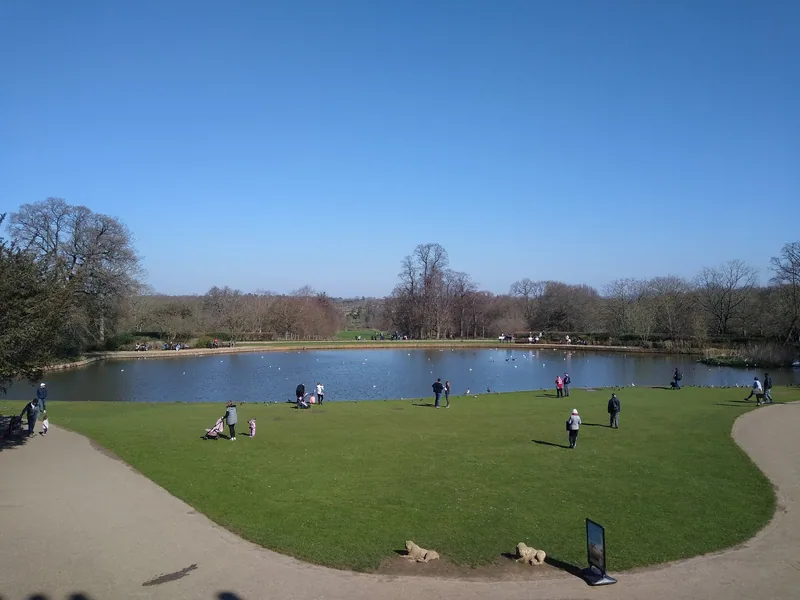
Inside it you get an ornamental lake in front of the hall, medieval fishing ponds and streams, a walled garden, pleasure grounds, lime avenues and meadows. There are marked trails from 1.1km to 6.3km, and a downloadable estate map that includes them. The London Loop passes through on section 17, which makes Forty Hall an easy anchor for a longer walk; our guide to London's long-distance walking routes explains how the Loop is signed and split.
The listed buildings do not stop at the house. The screen wall, gateway and north pavilions west of the hall are separately Grade I (entry 1079565), and the stable ranges, the barns to Forty Hall Farm and the entrance gateway on Forty Hill are each Grade II. Walk the courtyard before you go into the house.
Getting there, and the Piccadilly line problem
Forty Hall is often described as being at the top of the Piccadilly line. In practice that route is poor. Enfield's own directions have you take the Piccadilly line to Oakwood, then the 307 or 121 bus to Enfield Town, then the 191 to Forty Hill: two buses after the Tube.
The sensible route is the train.
| Route | Then | Notes |
|---|---|---|
| Liverpool Street to Enfield Town, London Overground Weaver line, about 30 minutes | A walk of around 20 to 30 minutes, or the 191 bus to Forty Hill | The estate gives 20 minutes; TfL's walking route gives more like 30, so allow the longer figure if you are not quick |
| Turkey Street or Gordon Hill station | About a 20-minute walk | Both are the estate's own figures |
| 191 or W10 bus from Enfield Town | Alight at the Myddleton Avenue roundabout, then 10 minutes up Forty Hill | Both stations and the buses are inside the London fare zones, so contactless works throughout |
| Car | Entrance on Forty Hill, from Bullsmoor Lane or Caterhatch Lane off the A10; M25 junction 25 is two miles away | Free car park with disabled bays, locked at dusk |
Because everything is inside the zones, a bus leg costs a single fare rather than a rail fare. Our guides to London buses and Oyster and contactless caps cover how that arithmetic works on a day with several short bus rides in it. Enfield Town is the obvious place to start and finish.
Dogs, picnics, bikes and the byelaws
Enfield enforces the estate byelaws, and they are stricter than most London parks:
- Dogs are welcome in the gardens and parkland but must be on a lead in the walled garden, and are not allowed inside the museum except guide dogs.
- Picnics are fine. Barbecues, gazebos and marquees are prohibited by byelaw, and so are drones anywhere over the estate.
- Bicycles are allowed, with racks in the car park and by the café courtyard. Free hire of bikes and scooters is offered from April to September, subject to availability and advance booking; wheelchairs can also be borrowed free with advance notice.
- Fishing is not open to the public. The Pond Grove lakes are leased to an angling society and require both a licence and membership; the ornamental lake in front of the hall and the two field ponds are closed to fishing entirely.
There is full wheelchair access throughout the house, with an accessible toilet and baby changing inside the museum and further toilets in the park.
Eating, the farm, and how to build the day
There is a café in the courtyard, recently refurbished, open Tuesday to Friday 9am to 4pm and Saturday and Sunday 9.30am to 5pm, closed Mondays. That is a wider window than the house itself, which is worth knowing if you are walking the estate on a Tuesday.
Forty Hall Farm is an organic farm on the estate run by Capel Manor College, and it opens Saturday and Sunday, 11am to 3pm, with last entry at 2.30pm. Its farm shop opens Tuesday to Sunday, 11am to 4pm. With children, the weekend is therefore the only sensible day: farm, house and café all open together.
For a full day out here, pair Forty Hall with Trent Park and Enfield Chase, which is the surviving fragment of the hunting ground Henry VIII actually wanted, or with the New River Path, which runs through Enfield and gives you a flat walk back towards the centre. The Lee Valley Regional Park is the other big green space within reach.
Among London's free historic houses, Forty Hall belongs with Bruce Castle in Tottenham and Charlton House in Greenwich, which are both free, both Grade I and both further into the suburbs than most visitors get. Our list of free things to do in London has the wider picture, and Eltham Palace is the ticketed royal house at the other end of the city that Elsyng most nearly resembles in date.
Frequently asked questions
Is Forty Hall free to enter?
Yes. Entry to the house, the exhibition, the walled garden and the parkland is free, and the car park is free too. Enfield Council, which owns and runs the estate, invites donations towards conservation but charges nothing at the door. Guided tours and events are the only things that cost money.
What days is Forty Hall open?
The house and gift shop open Thursday to Sunday, 11am to 5pm. The gardens and parkland open every day from 8.30am to 6.30pm. Those are the summer hours published for 2 April to 31 October 2026; telephone 020 8363 8196 to check winter hours before travelling in November or later.
Can you see Elsyng Palace at Forty Hall?
Not in any visible sense. The palace was demolished around 1656 and survives as buried foundations in the field north of the house, protected as a scheduled monument. The Enfield Archaeological Society excavates it annually and publishes reports on the estate's website; there is nothing standing and nothing signposted on the ground.
How do I get to Forty Hall from central London?
Take the London Overground Weaver line from Liverpool Street to Enfield Town, about 30 minutes, then either walk for 20 to 30 minutes or catch the 191 bus towards Forty Hill. Turkey Street and Gordon Hill stations are each about a 20-minute walk. The Piccadilly line route via Oakwood needs two further buses and is not worth it.
How long should I allow at Forty Hall?
An hour for the house and its displays, and two to three hours if you want to walk the walled garden, pleasure grounds and woodland. Marked trails run from 1.1km to 6.3km. With children at a weekend, add an hour for the organic farm, which closes at 3pm with last entry at 2.30pm.
Sources
- Historic England - Forty Hall, list entry 1294469 (Grade I) (checked September 2026)
- Historic England - Forty Hall, register of parks and gardens, list entry 1001357 (Grade II) (checked September 2026)
- Historic England - Elsyng Palace scheduled monument, list entry 1002040 (checked September 2026)
- Forty Hall Estate (Enfield Council) - Plan your visit and opening hours (checked September 2026)
- Forty Hall Estate - Getting here and admission (checked September 2026)
- Forty Hall Estate - Elsyng Palace (checked September 2026)
- Forty Hall Estate - Frequently asked questions, tours and byelaws (checked September 2026)