
Senate House is the white Portland stone tower on Malet Street, built for the University of London between 1932 and 1938 to Charles Holden's design, and paid for largely by the Rockefeller Foundation. It housed the Ministry of Information during the Second World War, which is why it turns up in Orwell and Evelyn Waugh. It is not a museum, there is no visitor entrance, and the only way in is a reading ticket at Senate House Library.
What you can do without a ticket is look, and this is a street worth looking at. Within four hundred metres of the tower there is a Grade I church that was built for a lost religious sect, two Grade II* university buildings of the 1930s and the 1970s, a Grade II school of tropical medicine with bronze insects on it, a cabmen's shelter, and three listed telephone kiosks. Most people walk past all of it on the way to the British Museum.
This page is about the buildings. Our guide to Bloomsbury covers the district as a place to spend a day, Bedford Square and the Bloomsbury squares owns the Georgian garden squares, and Art Deco London explains how to get the library day ticket. What follows is the architecture, from the ground.
Senate House at a glance
- Address
- Malet Street, London WC1E 7HU
- Architect
- Charles Holden, 1932 to 1938
- Listing
- Grade II*, list entry 1113107, first listed 28 March 1969, as Senate House and Institute of Education and attached railings
- Tower
- 18 storeys, 64 metres or 215 feet
- Materials
- Load-bearing brick faced with Portland stone and Cornish granite; principal interiors lined in travertine
- Public access
- None as a building. A reader's day pass can be bought over the counter in Senate House Library, Monday to Saturday when it is staffed
- Cost to look
- Free
- Nearest stations
- Goodge Street, about nine minutes on foot; Russell Square and Tottenham Court Road similar
Where the money came from, and the shape it bought
The University of London was expanding fast after the First World War and needed a centre of operations. The decisive figure was William Beveridge, the social reformer, who became vice-chancellor and in 1927 persuaded the Rockefeller Foundation to give £400,000, which paid for the move to the Bloomsbury site.
Holden's brief was demanding and slightly contradictory: something dignified enough to express a global centre of learning, permanent but of its time, functional but beautiful, imposing but neighbourly. What he produced was a central tower flanked by courtyard ranges, and the form he took for the tower was a pyramid, with the 18 storeys contracting in stages as they rise, supported by broad central buttresses on the east and west faces.
The tower's height, 64 metres, was set by its job: it was designed to store more than 500,000 books. On completion in 1937 it was London's tallest secular building, exceeded only by St Paul's Cathedral. Holden called it his life sentence.
Two details on the elevations are worth going close for. The stone above first-floor level is grooved so that it self-cleans and weathers evenly, which is why the building is whiter than its neighbours. And the decorative panels on the first-floor windows are a diagram of the building's own plan.
The building was never finished, and the model of what it should have been is inside. Holden's original scheme was a single spinal building running the length of Torrington Square, abandoned as construction began. The north-east wing was never built. Holden's own model of the full design is displayed on the first-floor balcony of Senate House, which is one of the few things a library day-ticket holder can see.
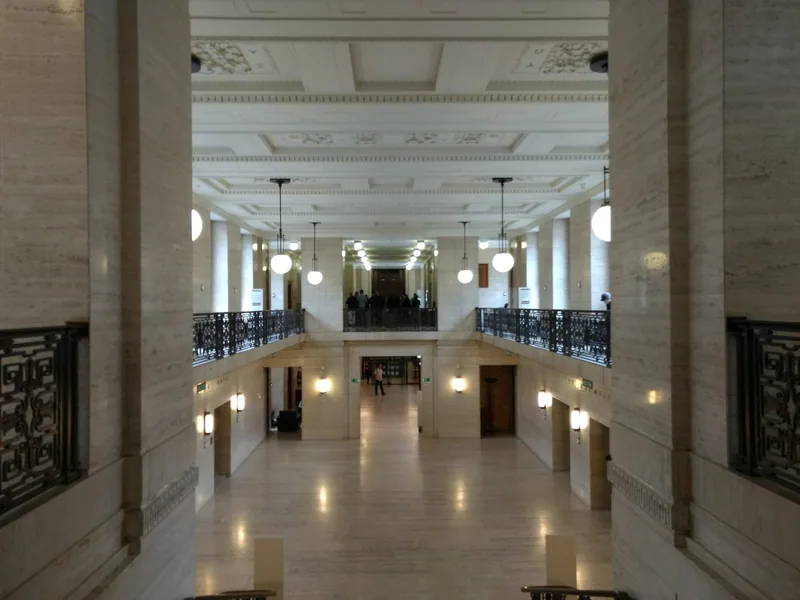
Photo: Philafrenzy · CC BY-SA 4.0 · Wikimedia Commons · resized
The Ministry of Information, and the two novels
The Ministry of Information moved into Senate House in September 1939, and that wartime function has shaped the building's reputation ever since.
It appears in Evelyn Waugh's Put Out More Flags as a gross mass of masonry protecting all the secrets of all the services. It appears, much more famously, in George Orwell's Nineteen Eighty-Four as the enormous pyramidal structure of glittering white concrete that houses the Ministry of Truth, which is the model most readers carry in their heads without knowing what they are picturing.
The last piece of the reputation is a rumour rather than a fact, and Historic England says so. The story goes that Senate House survived the heavy bombing of Bloomsbury because Hitler had earmarked it as the Nazi party's headquarters after an invasion. Historic England's own account points out that Senate House was hit at least five times during the Blitz, and that its survival says more about the way Holden built it than about German planning.
What is behind the door, if you ever get in
The interior is why the listing is Grade II* rather than Grade II, and the statutory description runs to several hundred words on it. The short version, for a reader deciding whether a day ticket is worth the trouble:
- The entrance hall at the base of the tower is described in the list entry as imposing and Egyptianate, with a travertine floor and walls and broad fluted pilasters, a semi-open space giving through access to Senate House on one side and the Institute of Historical Research and School of Slavonic Studies on the other.
- The ceilings of the principal spaces are moulded plaster with flat panel patterns and embellishments based on a London plane tree motif, which is the only ornamental flourish Holden allowed himself and the right tree for Bloomsbury.
- The staircases are floored in travertine with bronzed balustrades treated as stylised Ionic columns.
- The named halls are the MacMillan Hall, with a square panelled ceiling, acoustic panels to Holden's design set into fluted travertine pilasters, a teak floor and original light fittings; and the William Beveridge Hall, with dado panelling set with brass fillets in a Greek key pattern.
- The Senate Room is fully panelled in English walnut, double height, with a trabeated ceiling and original fixed seating in stepped rows like a council chamber. Its ante-rooms have heraldic glass by Ervin Bossanyi dated 1937.
- The libraries on the fourth floor are double height. The two general reading rooms are finished in oak with original English walnut bookcases and fittings. The Goldsmiths' Library to the south has glazed bookcases, a ceiling of cypress wood and more stained glass by Bossanyi. The bookstacks sit above them on a steel frame on a concrete raft.
The list entry's verdict is that the whole is a remarkably unaltered ensemble of 1930s design, with a high proportion of highly decorated ceremonial spaces sitting over functional offices. The railings outside are part of the listing too: cast iron on a stone sleeper wall, with radial gates carrying central bosses containing coats of arms, and pillars topped by rectangular down-lighter lamps.
Getting to any of it means buying a day pass over the library counter, which brings identification requirements, a card-only payment and a seat at a desk rather than a walk round the ceremonial rooms. The procedure is set out in full on the Art Deco page linked above, and is worth reading before you try it. Two warnings belong with it. The price went up in August 2026, and the university's website could not be read from our end in September 2026, so telephone or ask at the desk rather than relying on any figure published anywhere. And a reader's ticket is a licence to work, not to sightsee: if you take one and then wander, you will be asked to sit down.
The walk: eight listed buildings in four hundred metres
Start at the foot of the tower on Malet Street, where the approach gives you the full height and, outside term, almost nobody. Then work outwards.
| Building | Listing | Why stop |
|---|---|---|
| Church of Christ the King, Gordon Square | Grade I, list entry 1113038, listed 10 June 1954 | An Early English Gothic Revival church of about 1851 to 1854 by J R Brandon, in Bath stone ashlar, cruciform and on a cathedral scale. Built as the Catholic Apostolic Church and now the Church of England chaplaincy to the University of London. Its west end was never finished and is still bare brick |
| Three telephone kiosks outside it | Two K2 kiosks, Grade II, both listed 27 February 1987; one K6, Grade II, 10 June 1987 | The K2 is the earlier and much rarer of the two standard red designs. Seeing a K2 and a K6 within a few metres of each other is the quickest way to learn the difference |
| Institute of Education and Clore Institute, Bedford Way | Grade II*, list entry 1246932, listed 4 December 2000 | Denys Lasdun's long concrete slab, the Brutalist answer to Holden's Portland stone, running down the east side of Bedford Way |
| Philips Building, School of Oriental and African Studies | Grade II*, list entry 1401342, listed 20 May 2011 | Lasdun again, listed only in 2011, and evidence that the university kept commissioning the architect of the moment decade after decade |
| London School of Hygiene and Tropical Medicine, Keppel Street | Grade II, list entry 1113106, listed 9 March 1982 | The best short detour here. Built 1926 to 1928 by Morley Horder and Verner Rees, and the list entry catalogues the details: entwined serpents over the door holding a panel of Aesculapius in his chariot, first-floor balconies decorated with gilded tropical insects, a frieze carrying the names of eminent medical scientists, and a foundation stone laid by Neville Chamberlain on 7 July 1926 |
| Cabmen's shelter, Russell Square | Grade II, list entry 1246151, listed 10 March 1988 | A timber-framed green hut of 1897, restored in 1987, seven bays by three, with fretwork panels below the eaves and a louvred fleche on the roof. Still trading, still only for licensed drivers |
| British Museum, King Edward VII Galleries | Grade I, list entry 1322129, listed 24 October 1951 | The northern range on Montague Place, with its attached wall and lions, and the entrance most visitors never find |
That is a forty-minute walk at a steady pace and an hour if you look properly. The British Museum is at one end of it and free, and its Montague Place entrance is usually far quieter than the main one on Great Russell Street.
Holden's other London, which you can get inside
Senate House is the frustrating Holden building, because it is the one you cannot enter. His other great commissions are almost all public.
The Underground stations are the obvious ones, and they are free: our guide to Charles Holden's Underground stations covers the Piccadilly line extensions and 55 Broadway, the headquarters he built for Frank Pick, who was the colleague and critic whose remark that the man in the street sees the shapes and not the arguments still explains why Senate House divides opinion. For the wider category of 1930s London you can walk into, Brutalist London takes the story on from Lasdun's buildings in this table, and the BT Tower is the building that finally took the height record away from towers like this one.
When to come, and where to sit
Come out of term time if you want the streets empty, and on a bright day if you want the Portland stone doing what Holden intended. Early morning gives you the east face lit; late afternoon gives you the west face and the approach from Malet Street at its best.
The garden squares are the places to sit, and they are free: Gordon Square and Woburn Square are both within two minutes of the tower and both usually empty of visitors. If it rains, the Grant Museum of Zoology is the nearest free interior, three minutes north in University College's own buildings. For coffee and lunch, our guide to staying in Bloomsbury covers the streets where the university's own population eats, and free things to do in London has the museums within ten minutes of here, of which there are an unreasonable number.
Frequently asked questions
Can you go inside Senate House in London?
Not as a visitor attraction. There is no visitor entrance, no tour and no viewing floor. The single route in is a reader's day pass bought at the Senate House Library counter, available Monday to Saturday while the desk is staffed, which buys you a seat and the use of the open shelves. Bring photographic identification, something dated that proves your address, and a payment card.
Was Senate House the Ministry of Truth in Nineteen Eighty-Four?
Orwell's Ministry of Truth is a fictional building, but Senate House is generally accepted as its model, and Historic England says so in its own account of the building. The Ministry of Information really did occupy Senate House from September 1939, and the building appears in Evelyn Waugh's Put Out More Flags as well.
Did Hitler plan to use Senate House as his London headquarters?
That is a rumour rather than a fact. Historic England addresses it directly and notes that Senate House was hit at least five times during the Blitz, so its survival among the heavy bomb damage in Bloomsbury reflects the way Holden built it rather than any German instruction to spare it.
How tall is Senate House?
The tower is 18 storeys and 64 metres, or 215 feet. Its height was determined by its function as a bookstore for more than 500,000 volumes. When it was completed in 1937 it was the tallest secular building in London, with only St Paul's Cathedral higher.
What else is worth seeing near Senate House?
Within four hundred metres: the Grade I Church of Christ the King in Gordon Square, three listed telephone kiosks outside it, Denys Lasdun's Grade II* Institute of Education and Philips Building, the London School of Hygiene and Tropical Medicine with its gilded insects and its frieze of scientists' names, a working cabmen's shelter of 1897 in Russell Square, and the British Museum's Grade I King Edward VII Galleries.
Sources
- Historic England - Senate House and Institute of Education and attached railings, list entry 1113107 (Grade II*) (checked September 2026)
- Historic England - Heritage Highlights: Senate House, the Ministry of Information and the Hitler rumour (checked September 2026, via a dated Internet Archive copy of 10 October 2024 because the live site blocks our request)
- Historic England - Church of Christ the King, Gordon Square, list entry 1113038 (Grade I) (checked September 2026)
- Historic England - Institute of Education and Clore Institute of Advanced Legal Studies, list entry 1246932 (Grade II*) (checked September 2026)
- Historic England - Philips Building, School of Oriental and African Studies, list entry 1401342 (Grade II*) (checked September 2026)
- Historic England - London School of Hygiene and Tropical Medicine, list entry 1113106 (Grade II) (checked September 2026)
- Historic England - Cabmen's shelter, Russell Square, list entry 1246151 (Grade II) (checked September 2026)