
Until November 2024 the London Overground was a single orange line on the Tube map, tangled through six unconnected routes. It is now six separately named and coloured lines: Mildmay, Lioness, Windrush, Weaver, Suffragette and Liberty. The names are not decoration. Each one commemorates something specific about the part of London its trains run through, and most visitors see them on every map without any idea what they refer to.
How the Overground works as a railway, and which journeys on it are worth making, is covered in our guide to the DLR and the London Overground. This page is about the names themselves, and about what changed when one line became six.
The short practical version: nothing about your ticket changed, and everything about the map did. Fares, zones and pay as you go work exactly as before. What is different is that a disruption message now tells you which of six routes is affected instead of telling you that "the London Overground" has a problem somewhere across 113 stations.
The six lines and what each name honours
- Mildmay (blue)
- The Mildmay Hospital in Shoreditch and its role in the HIV/AIDS crisis
- Lioness (yellow)
- The England women's football team
- Windrush (red)
- The Windrush generation and their contribution to London
- Weaver (maroon)
- The East End textile trade and the migrant communities that built it
- Suffragette (green)
- The working-class East End movement for votes for women
- Liberty (grey)
- The historic independence of the people of Havering
Why one line became six
The Overground had grown into something the map could not express. It is more than 100 miles of railway serving 113 stations across all nine fare zones, carrying over three million passengers a week, and until 2024 all of it shared one colour. A passenger at Highbury & Islington could not tell from the map which orange train went where, and a service message about "the London Overground" might refer to a problem 20 miles away on a route they would never use.
The naming project was run for Transport for London by DNCO, a place-branding agency, which led a programme of engagement with customers, community groups, historians, industry professionals and staff before generating the names. The final six were chosen to reflect London's communities and their contribution to the city.
The rollout itself was unusually compressed. Over nine days before the launch on 28 November 2024, TfL and its suppliers replaced 6,000 station wayfinding signs and updated Tube maps, digital screens, on-train information and audio announcements. The Mayor launched the new names at Dalston Junction, a Windrush line station, with the Windrush Foundation hosting an exhibition inside the station.
One detail deserves more attention than it got. The colours were tested for inclusiveness before they were chosen, including active consideration of colour blindness, with input from TfL's Independent Disability Advisory Group and its Inclusive Transport Forum. That is why the six sit as they do against the existing Tube line colours. Our guide to step-free and accessible transport covers the rest of TfL's accessibility provision.
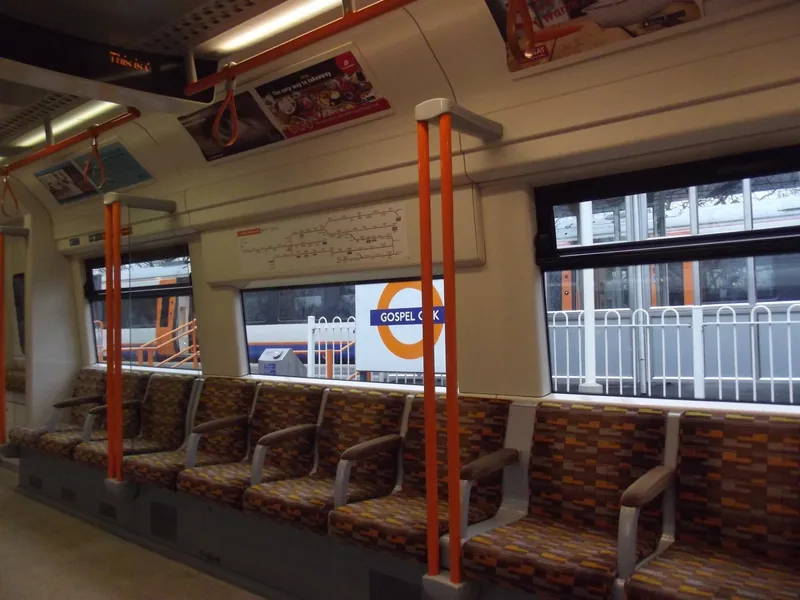
Photo: Smiley.toerist · CC BY-SA 4.0 · Wikimedia Commons · resized
Mildmay: Stratford to Richmond and Clapham Junction, through Highbury & Islington
The Mildmay line is named after the Mildmay Hospital in Shoreditch, a small charitable hospital that has cared for Londoners for many years. In TfL's own words it played a pivotal role in the HIV/AIDS crisis of the 1980s, and that is what made it the valued and respected place it remains for the LGBTQ+ community. The hospital's chief executive represented the line at the launch and described the naming as recognition of a legacy of compassionate, inclusive care.
The line itself runs east-west across north London, from Richmond and Clapham Junction in the west to Stratford in the east. For a visitor it is the most useful of the six: it serves Kew Gardens for the Royal Botanic Gardens, Richmond, Hampstead Heath station at the foot of the Heath itself, Camden Road, and Hackney on the way to Stratford.
Lioness: Euston to Watford Junction
The Lioness line celebrates the England women's football team and the legacy of their achievements. The Football Association's Women's Technical Director, quoted by TfL at the launch, tied the name to the team's achievement on 31 July 2022 and to what she called the historic European Championship success, and said she hoped girls travelling on the line would feel encouraged to take up the sport.
The route runs north-west out of Euston to Watford Junction, stopping at every station on the way. That makes it the slowest way to get to Watford, and it matters mainly because the Warner Bros. Studio Tour coaches leave from outside Watford Junction. Faster mainline trains cover the same journey from Euston in about 20 minutes and accept Oyster and contactless, so use those instead; our guide to the Warner Bros. Studio Tour explains the shuttle.
Windrush: Highbury & Islington to New Cross, Clapham Junction, Crystal Palace and West Croydon
The Windrush line commemorates the contribution of the Windrush generation: the people who came to Britain from the Caribbean from 1948 onwards, many of whom settled along this route through east and south London. The launch was deliberately held at Dalston Junction on this line, with the Windrush Foundation and guests whose families arrived on the HMT Empire Windrush.
Of the six names this is the one carrying the most weight, because the Windrush generation's story in Britain includes both their contribution and the later scandal in which many were wrongly treated as illegal residents. TfL's framing at the launch was about celebration and public interest in the history rather than commemoration alone.
The line is the old East London Line extended at both ends. It runs under the Thames through Rotherhithe and Wapping, and serves Shoreditch High Street and Hoxton for Shoreditch, Dalston Junction for Dalston and Stoke Newington, Canada Water, and the southern branches out to Crystal Palace and West Croydon. It also runs a night service on Friday and Saturday nights as part of the Night Tube.
The Windrush line is the one visitors use without realising it. It is how you get from Shoreditch to Canada Water without going through Zone 1, how you reach Columbia Road from the south, and how you get home from east London late on a Friday or Saturday. If you learn only one of the six names, learn this one. Our guide to Columbia Road flower market explains why you will be over there on a Sunday morning.
Weaver: Liverpool Street to Enfield Town, Cheshunt and Chingford
The Weaver line is named for the textile trade of east London. It runs through Liverpool Street, Spitalfields, Bethnal Green and Hackney, areas known for a cloth trade shaped over centuries by successive migrant communities: Huguenot silk weavers first, then Jewish and later Bangladeshi garment workers in the same streets and often the same buildings. The Worshipful Company of Weavers represented the line at the launch.
It is the least glamorous of the six to ride and one of the most useful. Bethnal Green and Cambridge Heath, two stops out of Liverpool Street, are the stations for Columbia Road on a Sunday morning, and the line carries a great many people into the City every morning from north-east London.
Suffragette: Gospel Oak to Barking Riverside
The Suffragette line honours the working-class movement in the East End that fought for votes for women and, as TfL puts it, paved the way for women's rights. The Fawcett Society, founded by Millicent Fawcett in 1866, represented the line at the launch, and its chief executive framed the name as recognition of activism that is too often left out of the story.
The route is the old Gospel Oak to Barking line, extended east to Barking Riverside, and it runs across the top of London without touching Zone 1 at all. Its main value to a visitor is as a shortcut: it crosses the Northern, Victoria and Central lines and connects Hampstead Heath's northern edge to Walthamstow and the east without going into the centre and out again. Most of its traffic is local.
Liberty: Romford to Upminster
The Liberty line celebrates freedom and the historic independence of the people of Havering, the outer east London borough it runs through. Havering was for centuries a royal liberty, a district that governed itself outside the ordinary county administration, and that is the independence the name refers to. Romford's business improvement district represented the line at the launch.
Nothing else on the Overground is anywhere near as short: a shuttle between Romford and Upminster calling at Emerson Park, three stations and two stops. Very few visitors will ever use it, and it exists on this list mainly because it needed a name like the others. If you are heading to Upminster you are probably on the District line anyway.
What actually changed for passengers
| Question | Answer |
|---|---|
| Did fares change? | No. Tube-style pay as you go fares and caps apply exactly as before |
| Is a line name a zone? | No. Zones are unchanged and unrelated to the names |
| Do I need a different ticket? | No. Contactless or Oyster covers all six |
| Do announcements use the names? | Yes, on trains, at stations and in the TfL Go app |
| Does the Tube map show them? | Yes, as six double lines in their own colours |
| Are delay refunds different? | No. Overground delays of 30 minutes or more qualify, as before |
The practical gain is in disruption information. A message now names the Suffragette line rather than the London Overground, which tells you immediately whether it affects you. The practical cost is that six names take a while to learn, and that a visitor who has memorised "orange equals Overground" now has to read the map more carefully.
Fares work identically to the Tube, including the daily and weekly caps and the pink card readers that give you the right fare on routes avoiding Zone 1. Our guides to Oyster and contactless fares and London's travel zones cover both.
One fleet, six names: what you are actually getting on
The trains did not change with the names, and they are much the same whichever of the six you ride. Expect a short electric unit — four carriages on most of the network — with open gangways from end to end, so you can walk the length of it while it is moving and see from one door to the last. The doors are wide enough for a pushchair without folding it. Seating runs mostly along the sides rather than in bays, which is generous for standing room and unkind on a sixty-five-minute journey.
Three absences matter more to a visitor than anything on the seat covers. There are no toilets on any Overground train, and not at every station either, which is the thing to settle before committing to a full end-to-end run. There is no first class. And there are no luggage racks, so a suitcase travels in the aisle or against your knees — worth knowing on the Lioness line to Watford Junction, which is the one people use with cases. The Overground is also outside the Tube's air-conditioning programme; our guide to which lines have air conditioning sets out what that means in July.
One physical detail is line-specific and not obvious from the map: on some Overground platforms the train floor sits noticeably higher above the platform than a Tube train's does, and at a few stations the gap is a hand's span in both directions. Each line guide gives the figures for its own stations, and staff will fetch a boarding ramp where one is held.
Two of the six are genuinely worth riding for their own sake. The Mildmay line from Richmond to Stratford crosses the whole width of north London above ground, past Kew, Hampstead Heath and Hackney, for a single capped fare. The Windrush line runs under the Thames through the Victorian Thames Tunnel at Rotherhithe, the first tunnel ever built under a navigable river. Neither is a tourist attraction and both are better than most sightseeing buses. The same logic applied to buses is in our guide to bus routes worth riding for the view.
Which of the six you will actually use
For a first visit, the honest ranking is Windrush first, Mildmay second, and the other four only if your hotel or your plans put you on them. Windrush links the east London neighbourhoods most visitors want to see and runs late at weekends. Mildmay is the cross-London route for Kew, Richmond and the Heath.
Weaver is a commuter line you might use once for the Sunday markets. Suffragette is a shortcut across the north. Lioness is the slow way to Watford. Liberty is two stops in outer east London.
If your journey is across the outer boroughs rather than into the centre, the express bus network usually beats all of them; our guide to the Superloop and outer London explains when.
Frequently asked questions
When did the London Overground get six line names?
The new names and colours were officially launched by the Mayor of London on 28 November 2024, at Dalston Junction. The names had been announced earlier that year. In the nine days before the launch, TfL replaced 6,000 station signs and updated maps, screens and announcements across the network.
What does the Windrush line commemorate?
The contribution of the Windrush generation, the people who came to Britain from the Caribbean from 1948 onwards, many of whom settled along the route the line now follows through east and south London. The launch event was held on this line, with the Windrush Foundation hosting an exhibition at Dalston Junction station.
Why is a line called Mildmay?
After the Mildmay Hospital in Shoreditch, a small charitable hospital that played a pivotal role in the HIV/AIDS crisis of the 1980s and is held in particular regard by London's LGBTQ+ community. TfL chose the name to recognise the hospital's long-standing care for vulnerable Londoners.
Did the Overground line names change the fares?
No. Fares, zones, daily and weekly caps and pay as you go all work exactly as they did before, and the same as on the Tube. The names are a navigation change only. Contactless or Oyster covers all six lines, and delay refunds still apply to Overground delays of 30 minutes or more.
Which Overground line should a visitor learn first?
The Windrush line. It connects Shoreditch, Hoxton, Dalston, Whitechapel, Canada Water and Crystal Palace, runs under the Thames through the historic Rotherhithe tunnel, and operates a night service on Friday and Saturday nights. The Mildmay line is the next most useful, linking Richmond and Kew with Hampstead Heath, Hackney and Stratford.
Sources
- Transport for London - Mayor of London officially launches the new London Overground line names and colours (28 November 2024) (checked September 2026)
- Transport for London - London Overground (checked September 2026)
- Transport for London - Daily and weekly capping (checked September 2026)
- Transport for London - Night Tube and the Overground night service (checked September 2026)
- Transport for London - Step-free access (checked September 2026)