
You cannot go up the BT Tower, and nobody has been able to buy a ticket for the top since 1971. A hotel scheme that would put a visitor experience back up there is now in front of Camden Council, but no opening date exists. For the moment this is a building to look at, and it is one of the easiest buildings in London to find on the skyline.
The BT Tower is the thin concrete cylinder that rises behind the shops of Tottenham Court Road, in the part of the West End called Fitzrovia. It was built to bounce microwave radio signals across the rooftops of Britain, which is why it is a smooth tube with collars of equipment near the top rather than a normal office block. The aerials that gave it its shape were taken down more than a decade ago.
For a while it was also the tallest structure in London, and for six years in the 1960s and 1970s the public could ride a lift to a restaurant near the top that turned slowly all evening. That is the part people remember, and it is the part that has gone. Our neighbourhood guide covers the streets around the tower; this page is about the tower itself, what is happening to it, and where to stand.
The BT Tower, September 2026
- Public access
- None. There is no ticket, no tour and no viewing gallery open to visitors.
- Height
- 177 metres (581 ft) to the top of the main structure; 189 metres (620 ft) including the aerial rigging above it.
- Opened
- Completed 1964; opened for operations in 1965 by the Prime Minister, Harold Wilson.
- Protection
- Grade II listed.
- Address
- 60 Cleveland Street, W1T 4JZ, on the Camden side of Fitzrovia.
- Owner
- MCR Hotels, which agreed to buy it from BT Group for £275 million in February 2024.
- Nearest stations
- Goodge Street (Northern line), Warren Street (Northern, Victoria) and Great Portland Street (Circle, District, Hammersmith & City) are each about five minutes' walk.
A radio mast that happens to be a building
Most tall buildings in London exist to hold people. This one was built to hold aerials, and every design decision follows from that. A microwave link needs a clear line of sight to the next dish on the chain, so the tower had to be tall enough to see over the West End. It also had to be stiff, because a dish that sways loses its signal, and it had to be round, because a round tower presents the same profile to the wind from every direction.
BT Group's own account of the building says the microwave aerials were removed more than a decade ago, once the traffic they carried had moved onto cable and fibre. What kept the tower busy after that was television: it has been one of the main places where live broadcast feeds are handed between networks, and BT has been moving that work onto a cloud platform so it can leave the building.
So the tower you see now is, functionally, almost empty. That is the reason it could be sold at all.
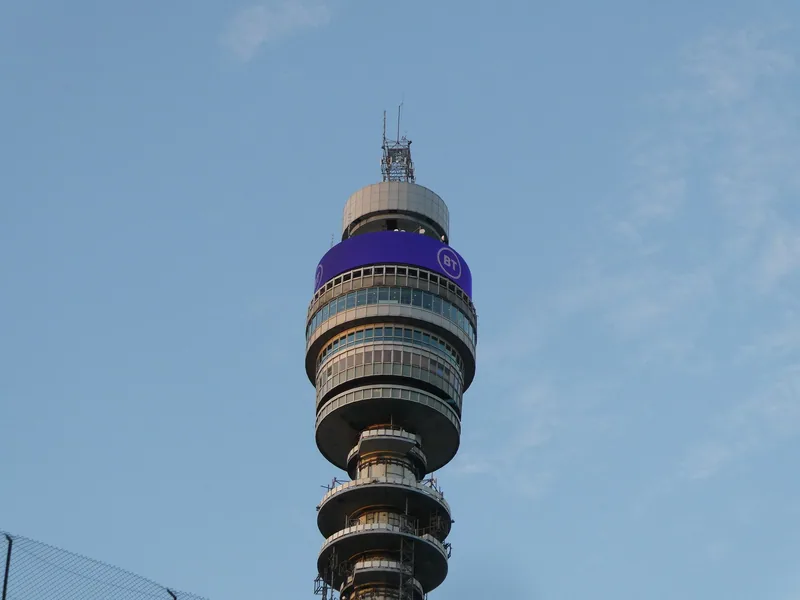
Photo: Sebastiandoe5 · CC BY-SA 4.0 · Wikimedia Commons · resized
Tallest in London for sixteen years
On completion in 1964 the tower passed Millbank Tower to become the tallest structure in London, and it held the title until 1980, when the NatWest Tower in the City went higher. Those two dates are worth holding onto, because they explain why the BT Tower looks more important than its height suggests. It went up when there was nothing else of its kind, in a part of London that is otherwise low, so it still dominates a much larger area than a 177-metre building put up today would.
It is also why it turns up in so many London views. The towers of the City and Canary Wharf cluster together and read as groups. The BT Tower stands alone above the West End, which makes it the most useful landmark on the skyline for working out where you are looking. Our guide to the best free viewpoints in London lists the hills and rooftops where the whole panorama opens up.
The restaurant that revolved, and the year it stopped being public
Near the top there was a circular restaurant floor that rotated. It was leased to a holiday company, and it was the only place in London where an ordinary visitor could sit above the rooftops with a drink and watch the city turn past the window.
BT Group's own history of the building puts the end of public access in 1971. Other accounts date the restaurant's final closure to 1980, when the lease ran out. We have not found an official source for the later date, so this page follows the owner's version: after 1971 the public stopped coming, and the top floor became a corporate and charity events space instead.
Do not build a day around going up the BT Tower. More than fifty years after the last public ticket, there is still nothing to book. If a lift to the top is what you want, Sky Garden is free with a timed ticket, and The View from The Shard is the paid alternative.
The tower that was not on the map
The strangest thing about the BT Tower is not that it closed. It is that for decades the British state declined to admit, on paper, that it was there. It was left off Ordnance Survey maps, even though it was the tallest thing for miles and visible from Hampstead.
This is not a rumour. It is in the official record of Parliament. On 19 February 1993, during a debate on the Right To Know Bill, the MP for Vauxhall, Kate Hoey, offered it as an example of information that remained officially secret for no good reason, and then said she hoped parliamentary privilege covered her while she revealed that the British Telecom tower does exist and that its address is 60 Cleveland Street, London.
The address in the current planning file is the same one she read into Hansard.
The infoband, and reading the tower from the street
The band of screen that wraps around the tower below the old restaurant floor is called the infoband. It runs messages that scroll round the building, which means you can read them from a considerable distance if you have a clear line of sight and a little patience. BT has used it for charity appeals, national moments and announcements.
It is best from the south and west, where the streets around Great Portland Street and Regent Street give long straight views north. From directly underneath you see almost nothing of it: the podium buildings at the base block the lower part of the tower, and the angle is too steep.
The hotel: what has actually been submitted
In February 2024 BT Group announced that it had agreed to sell the tower to MCR Hotels, an American company with around 150 hotels, for £275 million, payable over several years as BT's equipment comes out. MCR said it would develop proposals for a hotel that told the building's story.
That has now become a formal planning application. The Greater London Authority's planning database lists it under Camden reference 2026/3799/P, validated on 2 September 2026, for the site recorded as Telephone Exchange, Cleveland Street, W1T 4JZ. The description asks for the telecommunications buildings to become a hotel, with shops, food and drink, a bar and exhibition and events space at the lower levels, hotel or events use on levels 1 to 4, terraces and a swimming pool at level 6, a new public square outside — and, at the top, what the application calls a visitor, events and entertainment experience.
The database gives 11 October 2026 as the last date for comments on the Camden application, and 28 October 2026 as the target date for a decision. A parallel reference was opened by Islington Council, filed under strategic views, because a change at this height is visible from a long way outside the borough that decides it.
A planning consent is not an opening date. Even if Camden approves the scheme, BT still has to finish stripping its equipment out of a tower that can only be reached by two small lifts, and then the building has to be converted. Nobody has published a year.
Where to stand to see it properly
The tower is visible from a wide arc of north and west London, and from the high ground it reads as a single white pin above the West End. Three approaches give the most for the least effort.
- From the north. The open slopes at the south end of Hampstead Heath put the tower in the middle distance with the City behind it, which is the view that makes the geography of central London click.
- From the park. Walk the eastern edge of Regent's Park and the tower appears and disappears behind the trees; the Outer Circle near Park Square gives a clean line to it.
- From the streets below. Cleveland Street, Maple Street and Howland Street run past the base. This is the only way to understand how narrow the shaft is and how tightly the tower is packed into an ordinary Georgian street grid, next to the Bloomsbury boundary.
If you are photographing it, the rules on tripods and drones are worth checking first: our page on photography and drone rules in London covers both.
London's other lost high views
The BT Tower is not the only place where London has quietly taken a view away. The top-floor bar and restaurant at 30 St Mary Axe, the building everyone calls the Gherkin, stopped serving on 1 January 2026 while the building is reworked, and there is no public route to the top of it now; our page on the Gherkin and the City's skyscrapers has the detail.
Against that, the free viewing floors that opened in the City in the 2020s have given more away than they have taken. If you want to compare what each height actually shows you, London's viewing platforms compared sets the paid and free options side by side, and the ArcelorMittal Orbit in east London is the one that trades height for a slide down the outside.
Two other broadcast landmarks are open in ways the BT Tower is not: Alexandra Palace, where British television started, is a public building with a park around it, and the buildings that never normally open do so for one weekend a year during the Open House Festival.
Frequently asked questions
Can you go up the BT Tower in 2026?
No. There is no public access of any kind, and there has not been since 1971. The top floor has been used for private corporate and charity events, but it is not sold as an attraction and there is no ticket office. Any website offering you a BT Tower tour is not selling one.
How tall is the BT Tower?
The main structure is 177 metres, or 581 feet, and the aerial rigging above it brings the total to 189 metres, or 620 feet. That made it the tallest structure in London from 1964 until 1980, when the NatWest Tower in the City overtook it.
Is the BT Tower going to become a hotel?
That is what the owner has applied for. MCR Hotels bought the tower from BT Group in a deal announced in February 2024, and a planning application for a hotel conversion, including a visitor experience at the top, was validated by Camden Council on 2 September 2026. A decision was due at the end of October 2026. No opening date has been announced and the conversion will take years.
Why was the BT Tower left off maps?
Because it was treated as an official secret, along with a good deal of other harmless information about government and telecommunications sites. Parliament's own record shows an MP raising the tower's absence from Ordnance Survey maps in a 1993 debate on freedom of information, and reading its street address into Hansard to make the point.
What is the best place to see the BT Tower?
For the classic skyline shot, the high ground in north London — the southern slopes of Hampstead Heath, or Primrose Hill above Regent's Park. For the building itself, walk Cleveland Street and Maple Street at the base, where you can see how slim it is. You will not get a good photograph from directly underneath.
Sources
- BT Group - BT Group announces sale of BT Tower to MCR Hotels (21 February 2024) (checked September 2026)
- UK Parliament, Hansard - Right To Know Bill, House of Commons, 19 February 1993 (checked September 2026)
- Greater London Authority - Planning London DataHub (Camden application 2026/3799/P) (checked September 2026)