
The Greenwich Foot Tunnel is free, open every hour of the day and night, and takes most people about ten minutes end to end including the lifts. Both of its lifts are now new and run around the clock, which is a change worth knowing about: for twenty years the tunnel's reputation rested on broken lifts and a long spiral staircase.
It is a walking route under the River Thames, 370 metres long, built by the London County Council and opened in 1902. The south end comes up beside the tea clipper Cutty Sark in the middle of Greenwich; the north end comes up in a small riverside park called Island Gardens, at the tip of the Isle of Dogs. Both entrances are round brick drums with glass domes, and both are listed buildings.
Our overview of the free ways to cross the Thames sets this tunnel beside the Woolwich tunnel, the Woolwich Ferry and the Silvertown cycle shuttle. This page is only about Greenwich: the lifts, the rules, how long it really takes, and whether it is worth the detour.
Greenwich Foot Tunnel at a glance
- Cost
- Free. No ticket, no card to touch, no barrier.
- Open
- 24 hours a day, every day.
- Length
- 370 metres. Visit Greenwich gives a typical crossing time of 10 minutes.
- Lifts
- One at each end, part of a completed refurbishment, operating 24 hours a day. A spiral staircase runs alongside each lift.
- Ends
- South: Cutty Sark Gardens, Greenwich. North: Island Gardens, Isle of Dogs.
- Stations
- Cutty Sark and Island Gardens, both on the DLR, both beside an entrance.
- Bicycles
- Allowed, but you must get off and push. E-scooters must not be ridden either.
- Opened
- 1902. The Woolwich tunnel followed in 1912.
Why a tunnel and not a bridge
Downstream of Tower Bridge the Thames had to stay clear for ocean-going ships, so the river could not be bridged. But people living on the Greenwich side needed to get to work in the shipyards and docks on the north bank, and the ferries they depended on stopped in fog and bad weather.
The London County Council's answer was to go under. The Greenwich tunnel opened in 1902 and the Woolwich one ten years later, and the borough's own history says both were built to give workers south of the river reliable, all-weather access to the yards. It also records a detail that puts the scale in perspective: the tunnels were originally run by a workforce of fifteen people.
If the idea of walking under the Thames appeals, the tunnel that started it all is upstream at Rotherhithe: our page on the Brunel Museum and the Thames Tunnel covers the 1843 original, which is now a railway.
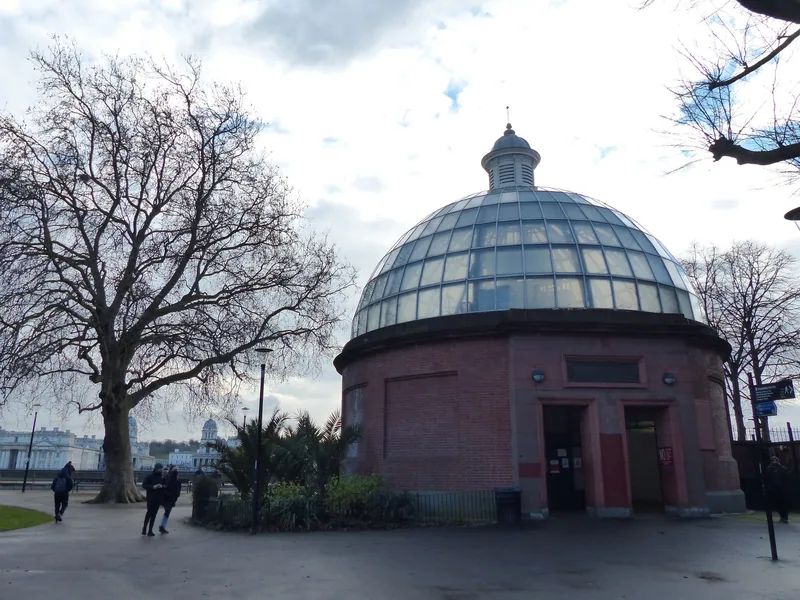
Photo: Megalit · CC BY-SA 4.0 · Wikimedia Commons · resized
Who runs it, and who to ring
The Royal Borough of Greenwich manages the Greenwich tunnel, and it does so on behalf of the London Borough of Tower Hamlets, which owns the north bank. That matters only when something goes wrong, because it means one phone number covers both ends: 020 8854 8888 for an urgent fault.
Inside, there is closed-circuit television through the tunnel, the stairs and the lifts, and help points along the passage that the borough says are monitored 24 hours a day. In an emergency you dial 999 as anywhere else.
The lifts: what has actually changed
This is the part most guidebooks have wrong. The refurbishment of both tunnels is finished, and it delivered new lifts that run 24 hours a day, built with the original lift interiors reused, along with new lighting, new rotunda roofs and external signs at street level showing whether the lift is working before you go down.
The borough publishes a live status page, and it now includes availability figures. On the version dated 6 February 2026, both Greenwich lifts were in service: the south lift showed 97 per cent availability over the previous thirty days and 33,427 trips, the north lift 95 per cent and 38,335 trips. That is a different building from the one that produced the tunnel's old reputation.
Look at the sign outside before you go down the stairs. Each rotunda now carries an external display showing lift availability, so you can see from the pavement whether you are facing a lift or a spiral staircase. If you are carrying a suitcase or pushing a buggy, that thirty-second check is the whole trick.
Nothing is guaranteed. Lifts still come out of service for maintenance, and the same status page in February 2026 noted upcoming work on a guide shoe in the south lift car with no start date fixed. Check it on the morning you travel if getting across step-free is essential, as our guide to accessible London recommends for anything that depends on one lift.
What it is like inside
You descend into a white-tiled tube a little wider than two arms' span, lit end to end, with a slight fall towards the middle where it passes under the deepest part of the channel and a rise back up on the other side. You cannot see the far end when you start, because of that curve.
The acoustics are the memorable part. Footsteps and voices arrive from further away than they should, and children discover this within about four seconds. Near the southern end the lining changes from tiles to a narrower section of metal and concrete, which is where wartime bomb damage was repaired.
Around 4,000 people a day use it, and the two tunnels together carry about 1.5 million people a year, of which roughly 1.2 million are at Greenwich. At 8.30 on a weekday morning it is a commuter route with people walking fast. At 10pm it is nearly empty.
How long it takes, honestly
The published figure of ten minutes is about right door to door if the lifts are running. Allow:
- Two to three minutes at each end for the lift, including waiting for it.
- Five to seven minutes for the walk itself at an ordinary pace.
- Add five minutes at each end if you take the stairs, and more with luggage. It is roughly a hundred steps of tight spiral.
If a lift is out and the stairs are not an option, the DLR covers exactly the same gap from Island Gardens to Cutty Sark in about three minutes, at the normal fare. Our guide to the DLR and the London Overground explains how those fares work, and both stations are step-free.
The rules, and the one that surprises cyclists
You may take a bicycle through, but you must push it for the whole length, and Visit Greenwich puts that as being without exception. The borough's wording covers e-scooters as well: neither should be ridden in the tunnels. The lifts are big enough for a bike or a pushchair, so wheeling one through is entirely normal and nobody minds.
Riding is not worth trying. The tunnel is narrow, sound makes it hard to judge who is coming, and at commuting times it is busy. If you are crossing the river by bike regularly, our page on cycling in London sets out the alternatives, including the shuttle bus through the Silvertown Tunnel.
One more thing to know: the tunnels are cleaned wet. The borough warns that during wet cleaning there is a fair amount of water about, although the tunnel stays open. Sensible shoes, then, rather than a change of plan.
Which direction to walk it
Most visitors go south to north and come back, because the reason to do this is the view from the north bank, not the tunnel. From Island Gardens you look straight across at the composition Canaletto painted: the twin domes of the Old Royal Naval College with the Queen's House framed between them and the Royal Observatory on the hill behind. You cannot see any of that while standing in Greenwich, which is the whole point.
Fifteen minutes on a bench at Island Gardens, then back through the tunnel, is the efficient version. If you have longer, walk north along the Thames Path towards Canary Wharf, or inland to the Mudchute city farm, and come back by DLR; our guide to the Thames Path and London's walking routes covers the route either side.
The Royal Observatory on the hill in that view closes to visitors on 2 November 2026. It is due to stay shut until summer 2027 for rebuilding, so the building will be in the picture from Island Gardens but not open when you cross back. Greenwich Park and the hill itself stay open.
Putting it into a Greenwich day
The tunnel is best used as a twenty-five minute round trip in the middle of a day in Greenwich rather than as an attraction in itself. A sensible order: the market and the riverside first, then the Cutty Sark or the park, then the tunnel when you want fresh air and a view, then lunch. Our list of where to eat in Greenwich covers the last part.
Downstream, the Woolwich Foot Tunnel is a longer, emptier version of the same idea, and its north lift has been out of service since August 2022, so plan around the ferry there instead; our guide to Woolwich has the detail.
Frequently asked questions
Is the Greenwich Foot Tunnel free?
Yes, completely. There is no ticket, no barrier and nothing to touch in. It is a public right of way managed by the Royal Borough of Greenwich on behalf of Tower Hamlets, and it is open 24 hours a day, every day of the year.
Are the lifts in the Greenwich Foot Tunnel working?
Both lifts are new, following a completed refurbishment, and the borough says they operate 24 hours a day. On the status page dated 6 February 2026 both were in service, with availability over the previous thirty days of 97 per cent at the south end and 95 per cent at the north. Check the borough's live status page on the day if step-free access is essential.
How many steps are in the Greenwich Foot Tunnel?
Roughly a hundred at each end, in a tight spiral around the lift shaft. That is manageable for most people but hard with a suitcase, a pushchair or a bike, which is why the external lift-availability signs at street level are worth a glance before you commit.
Can you cycle through the Greenwich Foot Tunnel?
You can take a bicycle through but you must dismount and push it the whole way, with no exceptions. E-scooters must not be ridden either. The lifts take bikes and pushchairs, and pushing a bike through is the normal way people cross here.
Is the Greenwich Foot Tunnel safe at night?
It is lit all night, covered by closed-circuit television along the tunnel, the stairs and the lifts, and fitted with help points the borough says are monitored around the clock. It is also long, echoing and often empty after about 10pm. If you would rather not, the DLR between Island Gardens and Cutty Sark runs late and takes three minutes.
Sources
- Royal Borough of Greenwich - History of the Greenwich and Woolwich foot tunnels (checked September 2026)
- Royal Borough of Greenwich - Check the status of the foot tunnels and lifts (checked September 2026)
- Visit Greenwich - Greenwich Foot Tunnel (checked September 2026)